A lot of teams search for vivint security because they want the comfort of an integrated security system: sensors, alerts, a dashboard, and someone accountable when something goes wrong. That instinct is not wrong. It is just usually applied to the wrong surface.
In CI/CD and software supply-chain security, teams think the problem is finding one more scanner. The real problem is building an operating model where pipeline events, package changes, secrets, permissions, and response actions connect into one workflow.
That changes the conversation. Vivint security is not useful to a DevSecOps team as a consumer product category. It is useful as an architecture metaphor: distributed sensors, a control plane, escalation logic, monitoring, and a response loop. The practical question is how to build that same discipline around GitHub Actions, package managers, pull requests, and release systems.
This guide treats vivint security as a workflow problem for software teams in 2026: how to detect what matters, reduce noisy alerts, assign ownership, and stop supply-chain attacks before they merge.
Table of contents
- Why vivint security is an architecture problem for DevSecOps
- Translate vivint security into a CI/CD threat model
- Start with the asset graph, not the scanner list
- Build detections that match CI/CD behavior
- Use guardrails where review cannot scale
- Control package supply-chain risk before merge
- What breaks when teams implement this badly
- A practical implementation sequence
- Metrics that prove the workflow is working
- Where vu1nz.com fits in the architecture
- Closing checklist for vivint security thinking in CI/CD
Why vivint security is an architecture problem for DevSecOps
The visible device is not the system
The mistake teams make is treating security as the visible device. In a house, that means cameras, door sensors, locks, and panels. In a software organization, it means scanners, dashboards, badges, and pull-request comments.
But the device is only useful when it belongs to a system. A camera that records but never escalates is evidence after the fact. A scanner that comments but never blocks a high-risk merge is documentation of a future incident. A dashboard that nobody owns is a nice-looking backlog.
A useful way to think about it is this: vivint security works as a concept because it joins detection, control, escalation, and response. CI/CD security needs the same architecture. Your sensor may be a GitHub Action. Your door contact may be a workflow file diff. Your broken window may be a new postinstall script in an npm package. Your dispatch workflow is the human and automated path from finding the issue to stopping the release.
Practical rule: if a signal cannot change a decision, it is telemetry, not security control.
CI/CD has the same control-plane problem
Modern delivery systems are control planes. They mint tokens, build artifacts, publish packages, deploy infrastructure, and touch production. Attackers know this. They do not need to exploit a runtime service if they can compromise the path that builds or deploys it.
That is why the security problem is not only vulnerability management. It is authority management. Which workflow can publish? Which token can write releases? Which branch protection rule can be bypassed? Which maintainer can approve a dependency change that executes during install?
Traditional application security tools often enter too late. They inspect code after it is written or containers after they are built. Supply-chain defense has to move closer to the change event. The pull request is where intent, diff, identity, and context still exist together.
Related reading from our network: teams evaluating remote operational tooling face a similar control-plane issue in remote access software architecture, where the tool is less important than ownership, workflow, and audited access paths.
Translate vivint security into a CI/CD threat model
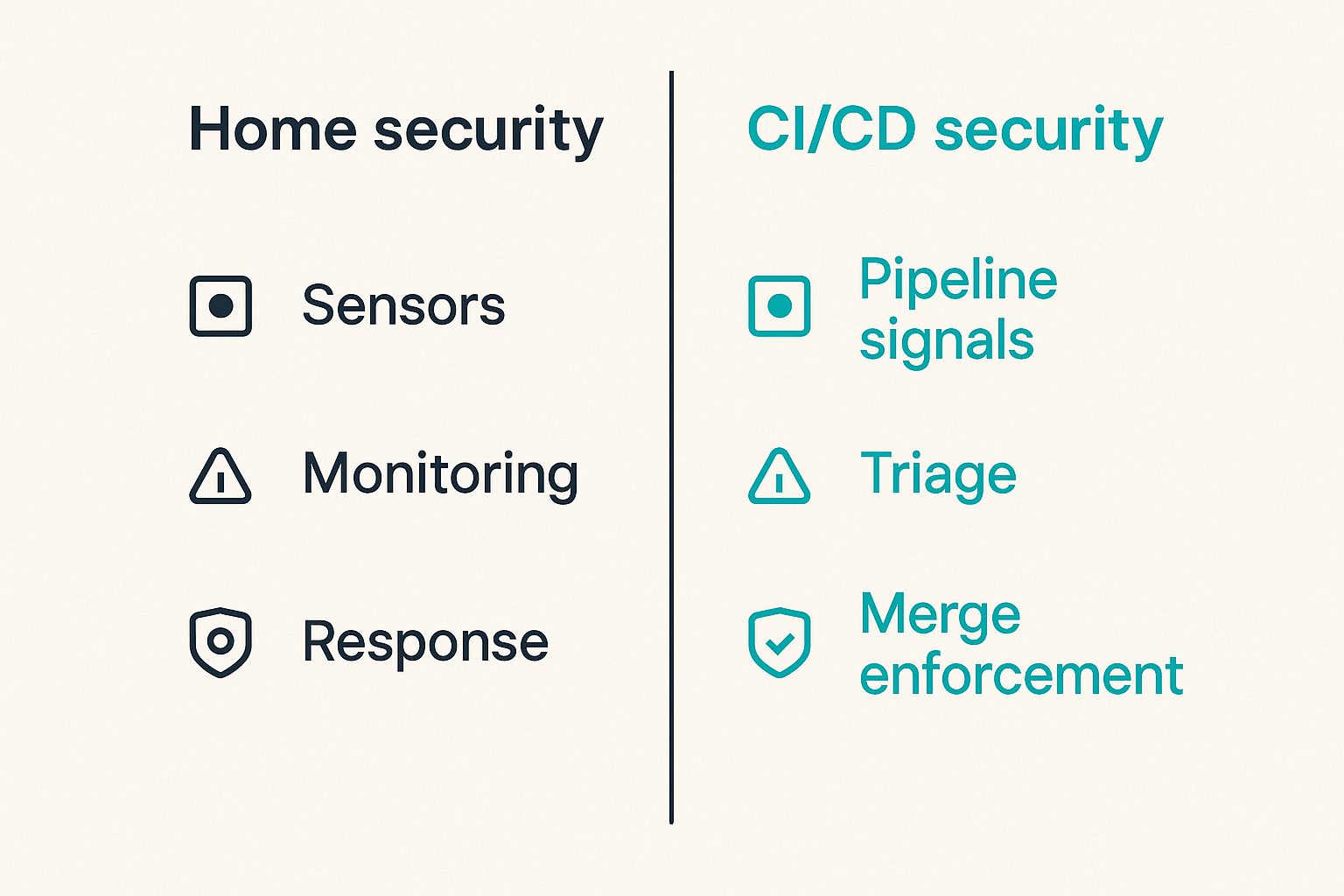
Sensors become pipeline signals
In a CI/CD environment, your sensors are not cameras. They are events and diffs:
- A workflow file changed under
.github/workflows/. - A pull request adds a new dependency to
package.json,requirements.txt,Cargo.toml,Gemfile,go.mod, orcomposer.json. - A workflow requests broader permissions than it used last week.
- A job runs on
pull_request_targetand checks out untrusted code. - A new build step downloads and executes a remote script.
- A package introduces install-time execution.
These are not all incidents. Many are normal engineering changes. The detection job is to separate expected change from dangerous authority expansion.
The practical question is: what signals indicate that the path to production became easier to abuse?
Monitoring becomes triage and escalation
Monitoring in CI/CD security is not watching a screen. It is routing a meaningful decision to the right owner before the risky merge happens.
That means a good alert includes:
- What changed.
- Why the change matters.
- Which asset or release path is affected.
- Whether it is blocking or advisory.
- Who can approve an exception.
- What evidence is needed to close it.
What breaks in practice is that teams send every scanner finding to the same place. A new transitive dependency with a low CVE score, a workflow permission escalation, and a suspicious typosquat package all become generic noise. Engineers learn to ignore the channel because the system refuses to distinguish risk types.
Response becomes merge-time enforcement
The cleanest response point is often before merge. After merge, you are negotiating with release pressure, deployment schedules, and incident ambiguity. Before merge, the suspicious change is still isolated and attributable.
Merge-time enforcement does not mean blocking every issue. It means deciding which issues are serious enough to stop the path to production automatically.
Good blocking candidates include:
- Privileged workflow changes from untrusted contributors.
- Use of
pull_request_targetwith untrusted checkout or script execution. - Broad
GITHUB_TOKENpermissions without a clear need. - Newly introduced packages with suspicious behavior.
- Dependency changes that add install scripts in sensitive repositories.
- Secrets exposed to forked pull requests.
Practical rule: block on authority expansion and execution paths; comment on hygiene issues unless they combine into an exploit path.
Start with the asset graph, not the scanner list
Map repositories to release authority
Most organizations do not have one CI/CD risk level. They have many. A documentation repository, a marketing site, an internal library, and a production deployment repository should not be treated the same way.
Start by mapping repositories to what they can affect:
| Repository type | Typical authority | Security posture that fits |
|---|---|---|
| Documentation | Low production authority | Advisory checks, light blocking |
| Internal library | Downstream code execution | Dependency and release controls |
| Application service | Build and deploy authority | Strong workflow and package checks |
| Infrastructure repo | Cloud and identity authority | Strict policy, approval, audit trail |
| Package publisher | External user impact | Strong provenance and release gating |
This is where many teams get stuck. They buy or enable tools uniformly, then wonder why the same rule creates too much friction in one repository and too little control in another.
Identify privileged workflow paths
A privileged workflow path is any route where a GitHub event can reach secrets, tokens, publishing rights, cloud credentials, or production deploys.
Look for:
- Jobs with
permissions: write-allor broad write scopes. - Workflows using long-lived cloud credentials instead of OIDC.
- Jobs that publish packages or container images.
- Release automation triggered by tags.
- Pull-request workflows that can access repository secrets.
- Self-hosted runners shared across trust boundaries.
The mistake teams make is reviewing workflow syntax but not workflow authority. Syntax tells you whether the YAML is valid. Authority tells you what an attacker gets if they control the job.
Treat dependencies as external code execution
A dependency is not just a line in a manifest. It is code you allow into your build, tests, package scripts, runtime, and sometimes developer machines.
This matters because supply-chain attacks often avoid known-vulnerability workflows. The malicious package may have no CVE. The maintainer account may be legitimate but compromised. The package may behave differently by environment, platform, or install path.
If your asset graph stops at repositories and ignores dependency introduction, it misses a major ingress path.
Build detections that match CI/CD behavior
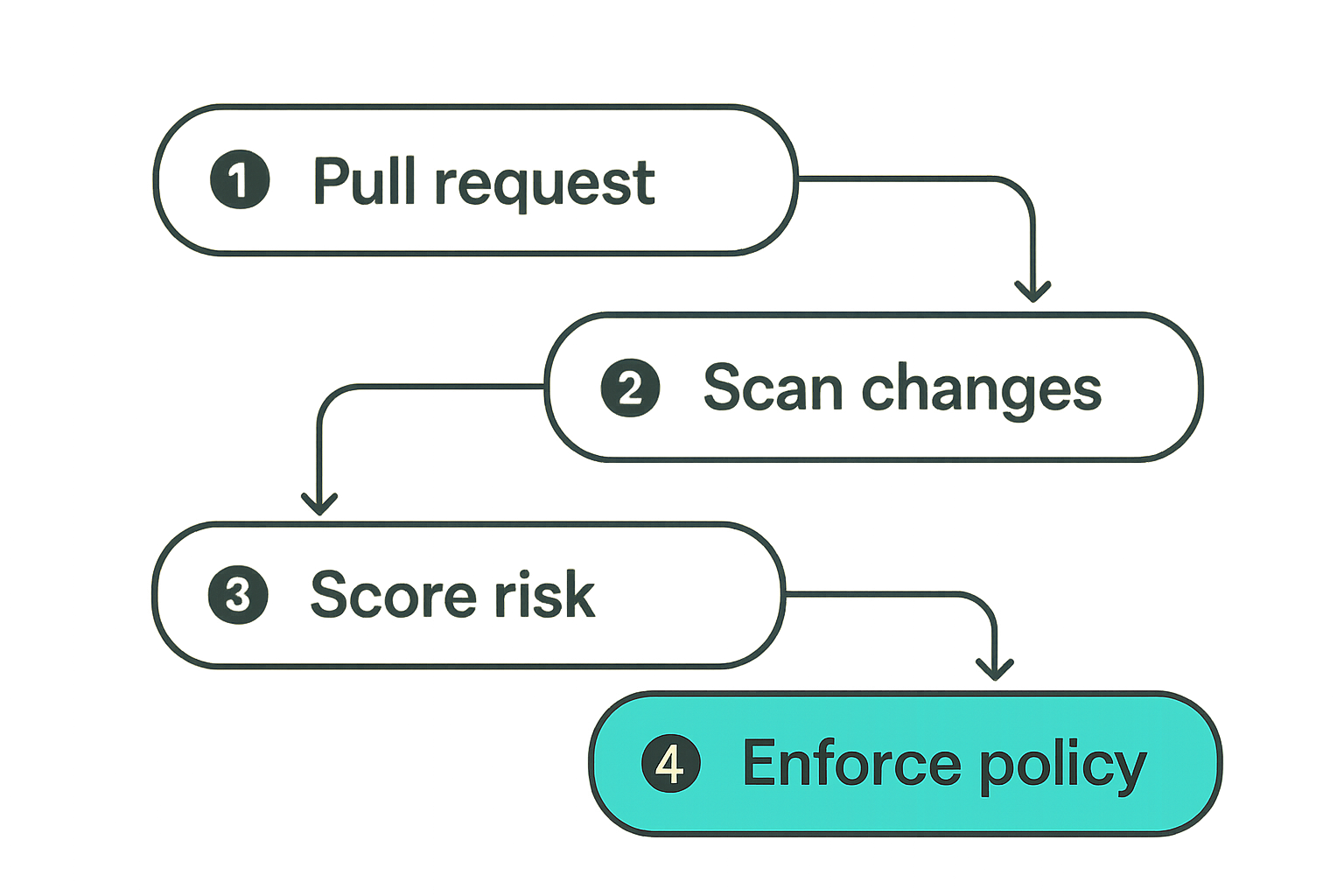
Detect risky workflow changes
Workflow detections should focus on patterns that increase attacker leverage. Examples:
# Risky pattern: privileged token on broad trigger
on:
  pull_request_target:

permissions: write-all

jobs:
  build:
    runs-on: ubuntu-latest
    steps:
      - uses: actions/checkout@v4
        with:
          ref: ${{ github.event.pull_request.head.sha }}
      - run: npm install && npm test
The issue is not that every use of pull_request_target is malicious. The issue is the combination: privileged event context, checkout of untrusted pull-request code, broad token permissions, and script execution.
A useful detection engine should understand combinations. Single-rule linting helps, but exploitability often comes from joins between event type, permissions, checkout target, secret exposure, and command execution.
Detect package introduction and drift
Dependency monitoring needs two modes:
- New package introduction: what code are we trusting for the first time?
- Existing package drift: did a familiar dependency change behavior, maintainer posture, or install behavior?
Known CVE tools are useful, but they do not answer the full question. The more urgent question during review is often: did this pull request introduce a new execution path from an unknown or suspicious package?
That is why package review should inspect manifests and lockfiles together. A manifest shows intent. A lockfile shows the resolved graph. Both can be manipulated or misunderstood if reviewed in isolation.
Detect identity and token abuse paths
CI/CD attacks frequently involve identity boundaries:
- A forked pull request reaching secrets.
- A low-trust contributor influencing a privileged workflow.
- A compromised maintainer publishing a malicious release.
- A GitHub token with unnecessary write permissions.
- A self-hosted runner reused after executing untrusted code.
Related reading from our network: SOC teams working around critical program information hit a similar translation problem, turning assets and ownership into operational detections in CPI security workflows.
In CI/CD, identity detections should be tied to what the identity can do. A bot account that can comment is low impact. A bot account that can publish packages, approve environments, or write to protected branches is part of your production security boundary.
Use guardrails where review cannot scale
Default-deny dangerous workflow patterns
Humans are bad at repeatedly noticing subtle CI/CD risk. They miss one-line permission changes. They normalize remote script execution. They assume a workflow pattern is safe because it worked last week.
Default-deny guardrails are appropriate for high-risk patterns:
- No broad write permissions by default.
- No unpinned third-party actions in sensitive repositories.
- No untrusted checkout inside privileged events.
- No secrets in workflows triggered by forks.
- No install-time package execution without review in release-critical repos.
- No self-hosted runner use for untrusted pull requests.
Practical rule: when a mistake creates production authority for an attacker, make it a policy check, not a documentation request.
Make exceptions explicit and expiring
There will be exceptions. A mature program does not pretend otherwise. The difference is whether exceptions are visible, justified, and temporary.
A good exception includes:
- Repository and workflow name.
- Rule being bypassed.
- Business reason.
- Compensating control.
- Owner.
- Expiration date.
Without expiration, exceptions become undocumented architecture. Six months later, nobody remembers why the dangerous pattern exists, but everyone is afraid to remove it.
Put policy close to the pull request
Policy that lives only in a wiki does not control CI/CD risk. Policy that appears in the pull request can change behavior while the change is still cheap.
For GitHub Actions, this usually means:
- A required status check for sensitive repositories.
- Inline comments that explain the risky diff.
- A clear pass, fail, or needs-review state.
- Links to the specific workflow lines or dependency changes.
- Maintainer-visible remediation steps.
This is also where developer experience matters. A vague block creates resentment. A precise block creates a fix path.
Control package supply-chain risk before merge
Known CVEs are only one failure mode
The mistake teams make is treating dependency security as a CVE subscription. CVEs matter, but many supply-chain attacks are live before there is a CVE, an advisory, or a clean reputation signal.
Attackers can use:
- Typosquatting.
- Dependency confusion.
- Maintainer account compromise.
- Malicious postinstall scripts.
- Obfuscated payloads.
- Environment-aware behavior.
- Protestware or sabotage releases.
We have written before about why known-vulnerability automation is not enough in what Dependabot misses, especially when the malicious package has no CVE at the time it enters production.
New dependency review needs behavior context
A useful package review asks practical questions:
- Is this package newly introduced to the organization?
- Does it execute code during install?
- Does it reach the network unexpectedly?
- Does it access filesystem paths outside normal package behavior?
- Is the maintainer or repository history suspicious?
- Is the package name close to a popular package?
- Does the resolved lockfile differ from the declared intent?
No single answer proves maliciousness. The point is to create enough context for a merge decision.
Lockfiles are evidence, not protection
Lockfiles help reproducibility. They do not eliminate supply-chain risk.
A lockfile can show:
- The exact package version resolved.
- Transitive dependencies introduced.
- Integrity hashes.
- Source registry URLs.
But a lockfile does not guarantee that the package is benign. It also does not help if a malicious package is deliberately introduced and then faithfully locked. Treat lockfiles as evidence for review, not as a control by themselves.
Related reading from our network: private communication systems have the same distinction between visible interface and operational trust boundaries, which is covered well in this guide to end-to-end encrypted messaging workflow.
What breaks when teams implement this badly
Alert volume hides the real intrusion path
Security tools fail when every signal has the same severity and destination. Engineers stop reading. Security teams build dashboards to manage dashboards. Real attack paths blend into hygiene noise.
What fails:
- Commenting on every low-risk dependency update.
- Blocking builds for issues unrelated to exploitability.
- Sending workflow risks and runtime CVEs to the same queue.
- Reporting counts instead of decisions.
What works:
- Severity based on authority and execution.
- Separate workflows for advisory, needs-review, and blocking findings.
- Repository-specific policy.
- Alerts that explain the merge risk.
Ownership falls between platform and application teams
CI/CD security often falls into an ownership gap. Platform owns the runner fleet and reusable workflows. App teams own repositories. Security owns policy. Nobody owns the whole path.
That gap is where incidents live.
A practical ownership model:
| Area | Primary owner | Security role | Platform role |
|---|---|---|---|
| Repository policy | App team | Define required controls | Provide templates |
| Workflow hardening | App or platform | Review risky patterns | Maintain reusable actions |
| Runner isolation | Platform | Set trust requirements | Operate runner pools |
| Package review | App team | Provide detection and escalation | Support caching and registries |
| Exceptions | Risk owner | Approve and track | Enforce expiration |
The key is that ownership follows the decision. The team that can fix the workflow should receive the finding. The team that accepts risk should approve the exception.
The attacker uses the allowed path
The most uncomfortable CI/CD attacks do not look like break-ins. They look like normal automation.
An attacker may:
- Submit a pull request that changes build logic.
- Compromise a dependency that your tests install automatically.
- Abuse a token scope that your workflow explicitly granted.
- Publish through a trusted maintainer account.
- Trigger a deployment path designed for speed.
This is why detection must focus on allowed paths becoming dangerous. Perimeter thinking is not enough when the production boundary runs through YAML, package registries, and automation tokens.
A practical implementation sequence
Phase 1 inventory and baseline
Start with inventory. Not because inventory is glamorous, but because you cannot protect a delivery system you cannot describe.
- List all repositories that can build, publish, deploy, or manage infrastructure.
- Identify workflows with secrets, write tokens, publishing rights, or cloud access.
- Classify repositories by production authority.
- Capture current dependency manifests and lockfiles.
- Identify self-hosted runners and their trust boundaries.
- Record branch protection and required status checks.
- Find reusable workflows and shared actions.
The output should be an asset graph, not a spreadsheet nobody uses. Each node should answer: what can this repository or workflow change in production?
Phase 2 pull-request enforcement
Once you know the authority map, move controls to the pull request.
A practical enforcement sequence:
- Add CI/CD workflow scanning to pull requests.
- Add package introduction scanning for supported ecosystems.
- Start in advisory mode for lower-risk repositories.
- Block only high-confidence dangerous patterns first.
- Add repository-specific policies for privileged repos.
- Require approval for exceptions.
- Review false positives weekly and tune rules.
A minimal GitHub Actions integration usually looks like this shape:
name: supply-chain-security

on:
  pull_request:
    branches: [main]

permissions:
  contents: read
  pull-requests: write

jobs:
  scan:
    runs-on: ubuntu-latest
    steps:
      - uses: actions/checkout@v4
      - name: Run CI/CD and package security checks
        uses: your-security-action@v1
The important part is not the exact syntax. The important part is where it runs: at the change boundary, before the risky update becomes part of the trusted branch.
Phase 3 response and validation
Controls decay. Attack techniques change. Teams add new automation. A pipeline that was safe last quarter can become unsafe after one reusable workflow update.
Validation should include:
- Periodic review of privileged workflows.
- Test pull requests that simulate risky changes.
- Dependency introduction drills.
- Runner isolation checks.
- Exception expiration review.
- Incident tabletop exercises around package compromise.
If you want a concrete example of putting these checks directly into GitHub, our prior walkthrough on shipping safer with vu1nz GitHub Actions shows the pull-request boundary approach in practice.
Metrics that prove the workflow is working
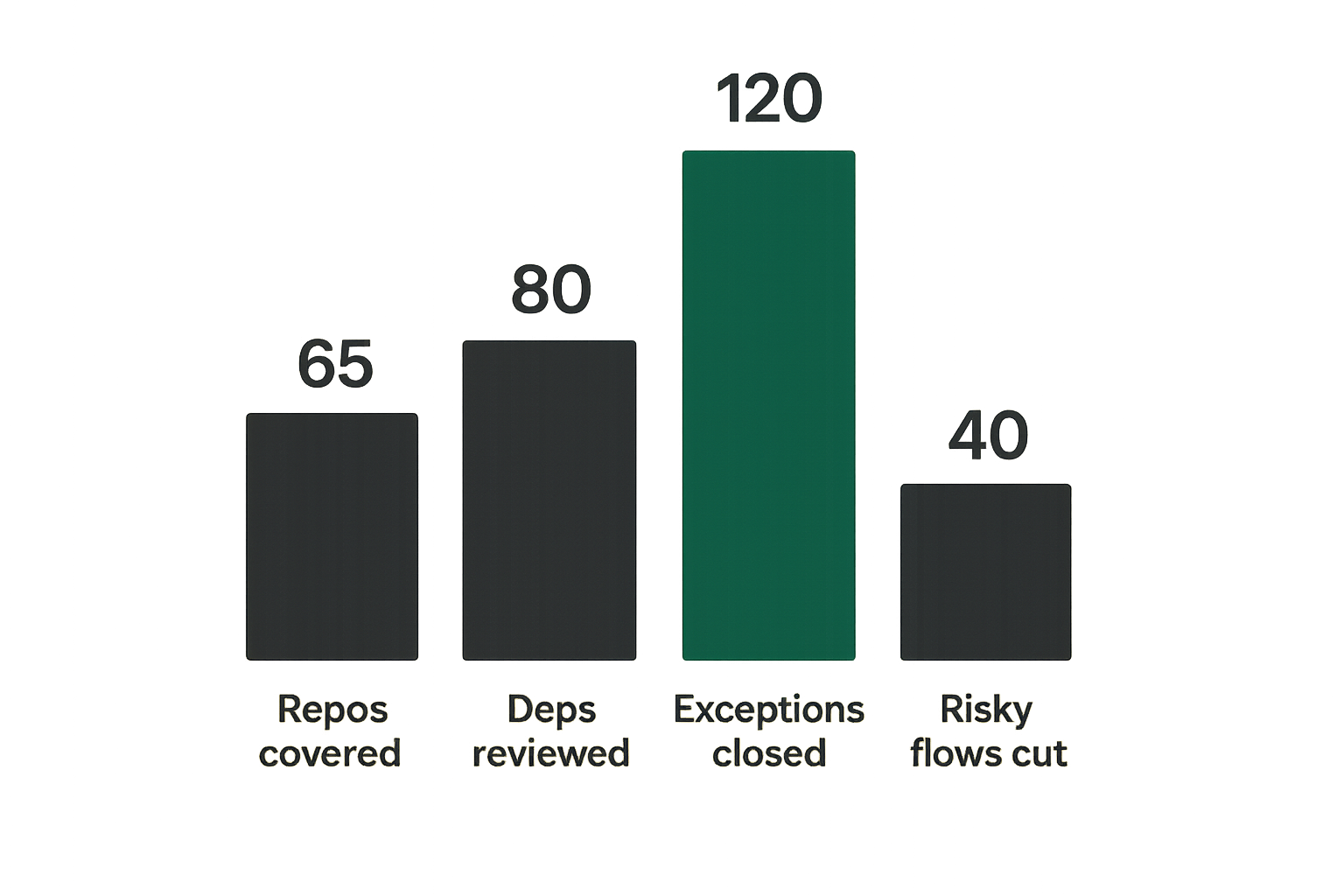
Measure exposure, not scanner activity
Scanner activity is easy to count and easy to misunderstand. A program that produces 10,000 findings is not necessarily more mature than one that produces 200 meaningful decisions.
Better metrics include:
- Number of repositories with privileged workflows identified.
- Percentage of release-critical repositories with required CI/CD security checks.
- Number of new dependencies reviewed before merge.
- Number of broad-token workflows reduced.
- Number of exceptions open past expiration.
- Number of self-hosted runner trust-boundary violations.
The point is to measure exposure reduction. Did you reduce the number of ways an attacker can move from pull request to production authority?
Track investigation time and merge friction
A control that nobody can understand will be bypassed. A control that blocks too much will be disabled. Track both security and delivery impact.
Useful operational metrics:
| Metric | Why it matters | Bad signal |
|---|---|---|
| Time to triage blocked PR | Shows whether findings are actionable | Blocks sit for days with no owner |
| False-positive rate by rule | Shows tuning quality | Teams request blanket bypasses |
| Exception age | Shows unmanaged risk | Exceptions never expire |
| Remediation time | Shows fixability | Same pattern repeats weekly |
| High-risk merge prevention | Shows control value | Dangerous changes merge anyway |
The practical question is not whether developers like every check. The practical question is whether the check stops real attack paths with acceptable friction.
Report exceptions like production risk
Exceptions are not paperwork. They are accepted production risk.
Report them with the same seriousness as infrastructure exposure:
- Which repository is affected?
- Which control is bypassed?
- What authority does the repository have?
- Who approved the exception?
- When does it expire?
- What compensating control exists?
When leadership sees exceptions as risk inventory, the conversation changes. It is no longer security versus engineering. It is an explicit decision about how much trust to place in a delivery path.
Where vu1nz.com fits in the architecture
One action at the pull-request boundary
vu1nz.com is built for the part of this architecture where a lot of teams are under-covered: pull-request-time CI/CD and package supply-chain review.
The goal is not to replace every security tool. You still need secret scanning, branch protection, artifact signing, runtime monitoring, and incident response. The useful role is narrower and more operational: inspect the workflow and dependency changes before they become trusted code.
That is the same lesson from the vivint security model. The sensor matters because it is connected to the decision point.
CI/CD checks plus package malware review
A strong pull-request boundary should cover both sides of the supply-chain problem:
- CI/CD workflow risk: permissions, triggers, secrets, checkout behavior, runner trust, and dangerous automation patterns.
- Package risk: newly introduced packages across npm, pip, cargo, gem, Go modules, and Composer, including suspicious behavior that CVE-only tools may miss.
This combination matters because attackers do not respect tool categories. A malicious package can be delivered through a safe-looking dependency update. A workflow misconfiguration can turn an ordinary pull request into a token theft path.
A useful role in a larger security program
Use vu1nz.com where it has leverage:
- Required checks on release-critical repositories.
- Advisory mode on lower-risk repositories.
- Package review for new dependencies.
- CI/CD workflow review for YAML changes.
- Evidence for security review during pull requests.
- Triage context for DevSecOps and platform teams.
Do not use any single tool as a substitute for architecture. The architecture is the asset graph, policy model, enforcement point, ownership path, and validation loop. A tool is useful when it strengthens those parts instead of creating another disconnected queue.
Closing checklist for vivint security thinking in CI/CD
What works
If you borrow one thing from vivint security thinking, borrow the system model. Sensors alone are not enough. Alerts alone are not enough. A dashboard alone is not enough.
What works in CI/CD security:
- Map repositories by production authority.
- Detect workflow changes that expand attacker leverage.
- Review new dependencies before merge.
- Block high-confidence execution and permission risks.
- Keep exceptions explicit and expiring.
- Route findings to the team that can fix them.
- Measure reduced exposure, not alert volume.
- Validate controls with realistic pull-request tests.
What fails
What fails is buying another disconnected scanner and calling the program done.
Common failure patterns:
- Treating all repositories as equal.
- Treating all findings as equal.
- Relying only on known CVEs.
- Ignoring CI/CD tokens and workflow authority.
- Reviewing package manifests without lockfile context.
- Allowing permanent exceptions.
- Sending every alert to a central queue with no owner.
- Measuring security by comment count.
The practical question for 2026 is not whether you have security tooling. It is whether your delivery system can detect, decide, and respond before a risky change becomes trusted. That is the useful DevSecOps lesson inside vivint security: build the operating workflow, not just the visible device.
Try vu1nz.com
vu1nz.com is for security engineers and DevSecOps teams who need to defend CI/CD pipelines and software supply chains from modern attacks. Try vu1nz.com
Catch the next supply-chain attack on the PR that adds it.
14-day free trial · no card required