Most teams do not lose control of a software pipeline because one scanner was missing. They lose control because nobody can explain which change opened which attack path, who owns that path, and what should happen before the pull request merges.
That is the practical problem behind vector security in 2026. The term sounds broad, but for DevSecOps teams it becomes very concrete: every workflow edit, new dependency, token permission, package maintainer change, build script, and release step can create a route into production.
Teams think the problem is finding more vulnerabilities. The real problem is managing attack vectors as a workflow across code review, CI, package intake, secrets, identity, and incident response.
That changes the conversation. Vector security is not a definition exercise. It is an architecture decision for how your organization turns weak signals into blocking decisions without turning CI into a ticket factory.
Table of contents
- Vector security starts with attack paths, not tool categories
- Build the vector map around changes
- The CI/CD vectors teams underestimate
- What works in production
- What fails when vector security is bolted on
- Implementation workflow for vector security
- Signals and data model
- Response playbooks for supply-chain vectors
- Metrics that make vector security operational
- Where vu1nz.com fits
Vector security starts with attack paths, not tool categories
What vector security means in a software factory
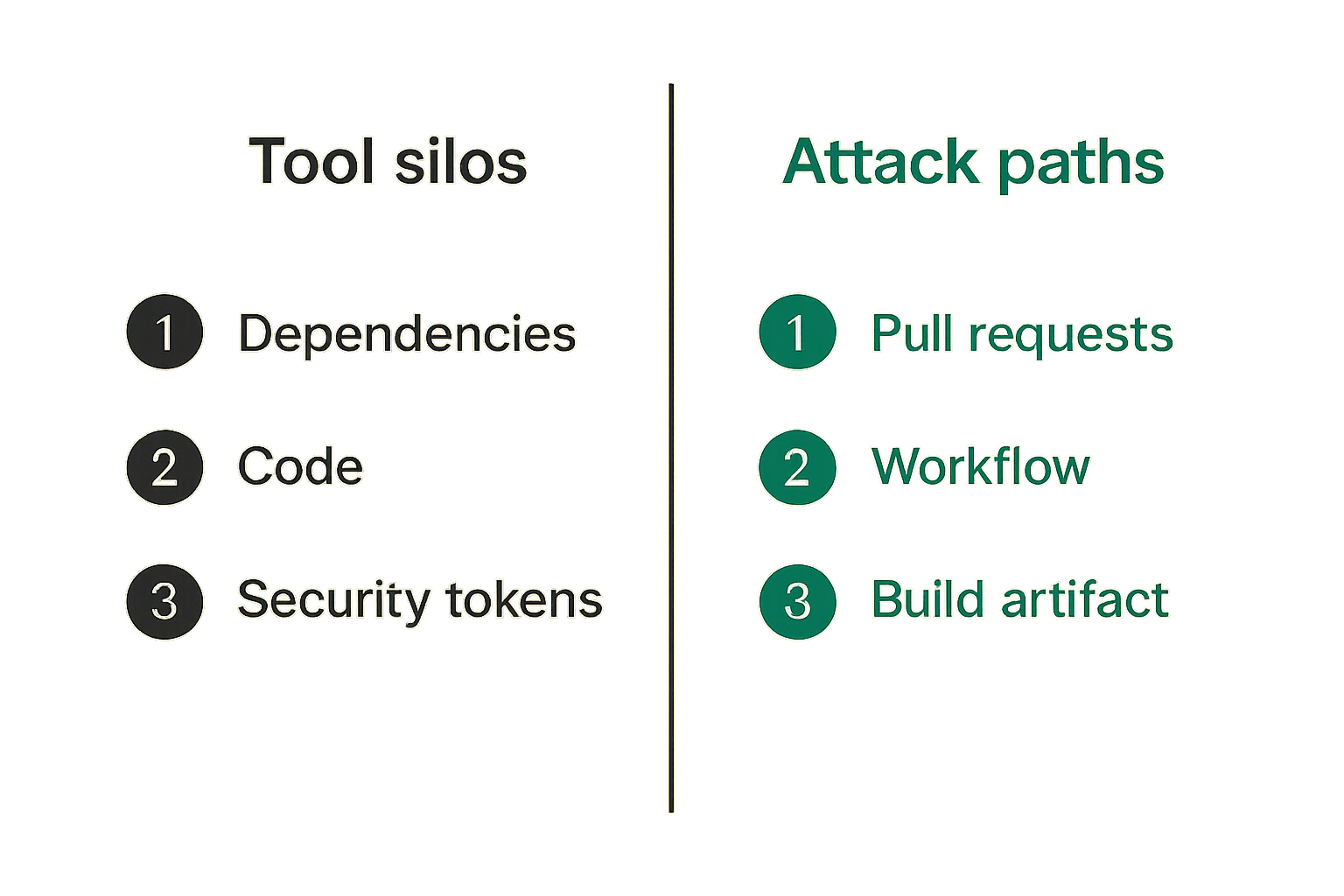
A useful way to think about vector security is this: an attack vector is a route from an attacker-controlled input to a protected asset. In a software factory, that route may not touch the running application at first. It may start in a pull request, a GitHub Actions expression, a compromised package release, a maintainer token, a build artifact, or a workflow permission.
The mistake teams make is treating each route as a separate tool category. SCA owns dependencies. SAST owns code. Secret scanning owns tokens. CI linting owns workflows. Cloud security owns runtime. That split is convenient for procurement and terrible for investigation.
Vector security asks a different question: if this change lands, what new path exists into the build, release, or runtime environment?
Why CI/CD turns small mistakes into delivery risk
CI/CD systems are force multipliers. They clone code, install packages, run scripts, load credentials, publish artifacts, comment on pull requests, and sometimes deploy directly. A small workflow mistake can become a credential exposure. A dependency lifecycle script can become command execution. A broad GitHub token can turn a test job into a repository write primitive.
What breaks in practice is not only the initial bug. It is the chain:
- untrusted input reaches a privileged workflow
- a dependency runs during install
- a token has more scope than the job needs
- logs or artifacts preserve sensitive output
- maintainers cannot tell whether the path was actually reachable
Vector security is the discipline of shortening that chain before it becomes incident response.
The assets that matter most
You cannot map every theoretical path with equal urgency. Start with assets that convert a CI/CD compromise into business impact:
| Asset | Why attackers care | Common vector |
|---|---|---|
| Release tokens | Publish malicious versions or artifacts | Over-scoped job credentials |
| Package manager tokens | Push poisoned npm, PyPI, RubyGems, Cargo, or Go modules | Exposed secrets or maintainer compromise |
| Build artifacts | Insert payloads into trusted outputs | Tampered build steps |
| Deployment credentials | Move from CI to cloud runtime | Secrets in workflow context |
| Repository write access | Modify code, tags, or workflows | Pull request automation abuse |
| Signing keys | Make malicious releases look legitimate | Weak custody and CI exposure |
Practical rule: prioritize vectors that lead to publishing, signing, deploying, or writing back to source control. Those are the paths that turn a pipeline bug into a supply-chain event.
Build the vector map around changes
Treat every pull request as a new exposure event
Vector security works best when it is attached to change review, not quarterly assessment. Every pull request should be interpreted as a possible exposure event. The practical question is not whether the repository is secure in the abstract. It is whether this diff introduces a new path an attacker can use.
Examples:
- A workflow now runs on pull_request_target and checks out attacker-controlled code.
- A package-lock.json file introduces a dependency with an install script.
- A Dockerfile downloads a binary without checksum verification.
- A job permission changes from contents: read to contents: write.
- A test step prints environment variables during failure.
The pull request is where intent, context, and ownership still exist. After merge, responders often have to reconstruct those details from logs and commits.
Map vectors to controls and owners
A vector map does not need to be fancy. It needs to be operational. For each class of vector, define the signal, control, owner, and escalation path.
| Vector class | Primary signal | Control point | Owner |
|---|---|---|---|
| Workflow injection | Trigger, checkout, expression, shell use | CI policy gate | Platform security |
| Dependency execution | New package, script, maintainer anomaly | PR package scan | App team plus security |
| Secret exposure | Added secret, log leak, broad env | Secret scanner and CI review | DevOps |
| Artifact tampering | Build step or provenance change | Release gate | Build engineering |
| Token abuse | Permission or identity change | Repository settings review | Repo admins |
The owner matters. A finding without an owner is documentation, not defense.
Keep runtime and build-time context together
Runtime severity and build-time reachability must meet. A package added to a toy script is not the same as a package added to a release builder. A workflow issue in a documentation repository is not the same as one in the repository that signs production artifacts.
This is where many teams underinvest. They know the CVE severity. They know the workflow file changed. They do not know whether the workflow can access a production publish token.
Related reading from our network: SOC teams face the same ownership and signal-routing problem when they translate broad mission terms into operating models, as described in this SOC operating model breakdown.
The CI/CD vectors teams underestimate
Workflow injection and untrusted execution
GitHub Actions, GitLab CI, Buildkite, Jenkins, and similar systems all have some version of the same problem: untrusted data can reach trusted execution if the workflow is written carelessly.
Common patterns include:
- using pull request titles or branch names inside shell commands
- checking out fork code in privileged contexts
- running generated scripts without validation
- passing untrusted inputs to composite actions
- trusting third-party actions without pinning
A safe-looking workflow can still be dangerous if the trigger and permissions are wrong.
permissions:
  contents: read
  pull-requests: read

on:
  pull_request:

jobs:
  test:
    runs-on: ubuntu-latest
    steps:
      - uses: actions/checkout@v4
      - run: npm ci
      - run: npm test
This is not perfect security. It is a safer default than giving every job write access and running untrusted code in privileged events.
Dependency introduction without behavioral review
SCA is useful, but known-vulnerability matching is not vector security. A malicious package may have no CVE. A maintainer takeover may look like a normal version bump. An install script may only activate under CI environment variables.
That is why dependency review needs behavioral signals: new lifecycle scripts, obfuscated files, network calls, unusual binary blobs, maintainer changes, typosquatting, dependency confusion risk, and suspicious postinstall behavior. We covered this gap in more detail in What Dependabot Misses, because known CVE matching is only one slice of package risk.
Practical rule: treat a new dependency as executable code entering the build system, not as metadata entering a manifest.
Secrets, tokens, and permission spread
The most expensive pipeline incidents often involve boring permission drift. A job needed read access last year. Someone added write access to automate a release. Later, the job started running on pull requests. Then an attacker found a way to influence a command.
None of those changes looked catastrophic alone. Together they formed a vector.
Look for:
- repository tokens with write permissions by default
- secrets available to jobs that do not need them
- long-lived package tokens stored as CI secrets
- cloud roles shared across unrelated workflows
- self-hosted runners reachable from untrusted jobs
The fix is rarely one magic scanner. It is permission minimization plus change-aware review.
What works in production
Shift left only where the signal is good
Shift left is useful when the developer can act on the result while the change is still in their head. It fails when CI dumps twenty generic warnings with no relationship to the diff.
For vector security, good pull request signals have three traits:
- the finding is tied to a changed line, file, package, or setting
- the blast radius is explained in CI/CD terms
- the remediation is specific enough for the author to apply
Bad signal says: insecure workflow detected. Good signal says: this workflow runs on pull_request_target, checks out fork-controlled code, and has contents: write permission. Use pull_request, split privileged labeling into a separate job, or remove write scope.
Gate on exploitability and blast radius
Not every finding should block a merge. Blocking everything teaches teams to bypass controls. Blocking nothing teaches attackers your scanner is decorative.
A practical gate considers exploitability and blast radius:
| Finding type | Exploitability | Blast radius | Suggested action |
|---|---|---|---|
| New package with postinstall and obfuscation | High | Build credentials | Block pending review |
| Workflow permission widened to write | Medium | Repo mutation | Require owner approval |
| Unpinned third-party action in low-risk repo | Medium | Limited | Warn and ticket |
| Dev dependency CVE not reachable in CI | Low | Local dev only | Track, do not block |
| Secret committed in PR | High | Depends on token | Block and rotate |
This is where vector security becomes an operating model instead of a checklist.
Use policy as code for repeatability
Human review does not scale across every repository and package ecosystem. Encode the parts you already know you want.
Example policy intent:
rules:
  - id: no-write-token-on-pr
    when:
      event: pull_request
      permissions_contains: write
    action: block

  - id: new-package-install-script
    when:
      dependency_added: true
      lifecycle_script: true
    action: require_security_review

  - id: privileged-workflow-file-change
    when:
      files_changed:
        - .github/workflows/**
      repo_class: release-critical
    action: require_platform_owner
Policy as code is not about removing judgment. It is about reserving judgment for cases that need it.
What fails when vector security is bolted on
Alert volume without ownership
The mistake teams make is buying or building another scanner and assuming coverage improves. Coverage without routing creates backlog. Backlog becomes ignored. Ignored findings become audit artifacts.
Every vector finding needs a default owner. If a workflow issue appears, does it go to the application team, platform team, repository admin, or security? If a package looks malicious, who can approve the exception? If a secret appears, who rotates it?
Related reading from our network: remote engineering teams hit similar ownership problems in collaboration tooling, where the hard part is not the app list but the rollout model and accountability described in this cloud collaboration stack guide.
Scanning after merge
Post-merge scanning has value for inventory, drift, and retrospective detection. It is the wrong place for the highest-risk CI/CD vectors. Once a malicious package lands, CI may already have installed it. Once a workflow change merges, the next run may expose tokens. Once a release job is modified, artifacts may already be published.
Pre-merge gates are not about slowing developers down. They are about catching irreversible or hard-to-verify actions before they happen.
Practical rule: anything that can execute during install, publish artifacts, modify repository state, or access secrets deserves pre-merge review.
Ignoring maintainer and package behavior
Many supply-chain attacks do not look like vulnerable code. They look like normal package ecosystem behavior until you inspect the context. A maintainer adds a new collaborator. A package gets a sudden new release after years of inactivity. A small utility starts shipping minified payloads. A dependency adds postinstall scripts that check for CI variables.
What fails is treating package names as static trust objects. Trust changes. Maintainers change. Release behavior changes. Your vector model has to notice those changes when they enter your build.
Implementation workflow for vector security
Step 1 inventory repositories and trust boundaries
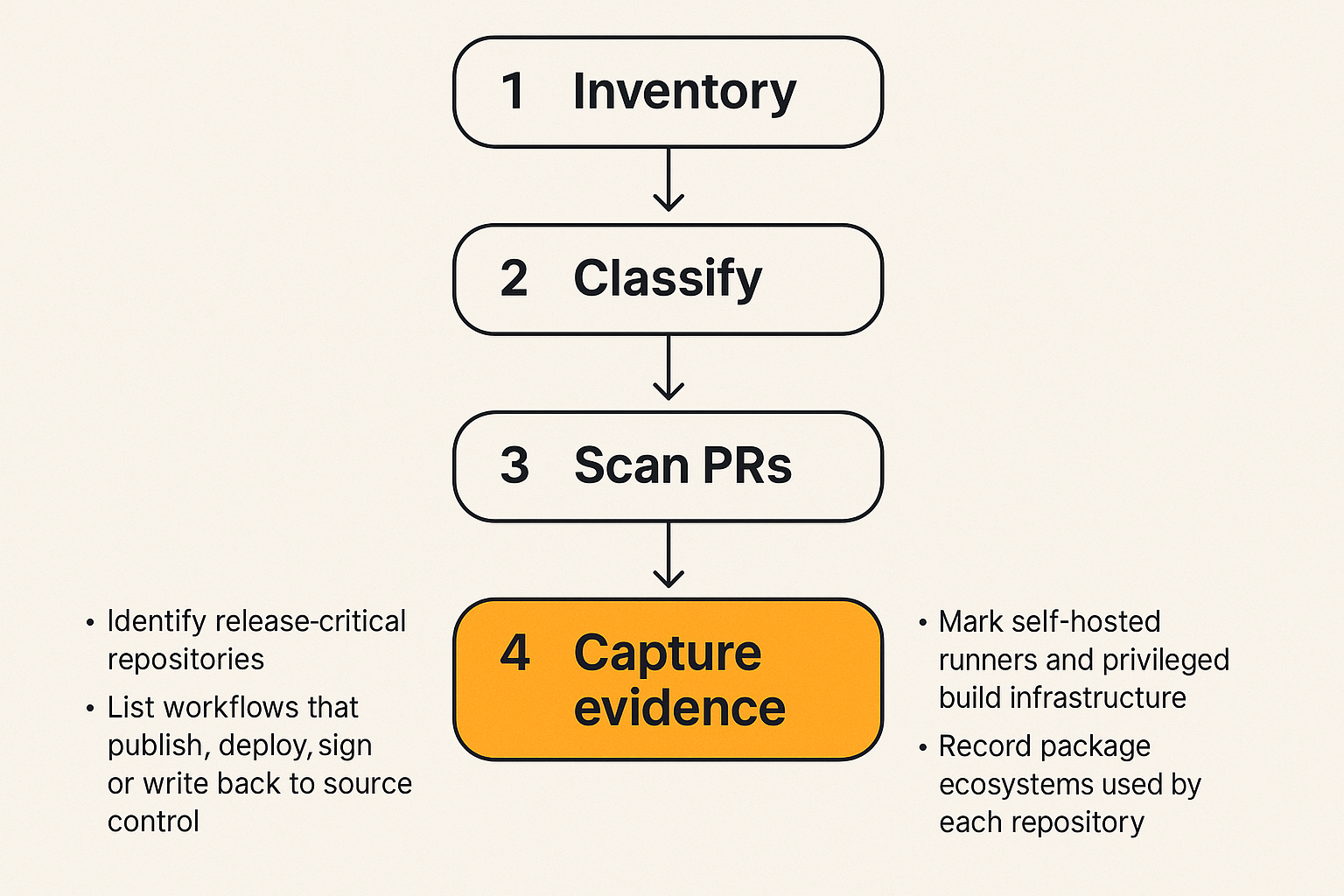
Start with the repositories that can affect production. Do not begin with every repo equally. Classify them by what they can do.
- Identify release-critical repositories.
- List workflows that publish, deploy, sign, or write back to source control.
- Identify secrets and tokens available to those workflows.
- Mark self-hosted runners and privileged build infrastructure.
- Record package ecosystems used by each repository.
This gives you a trust boundary map. It will be imperfect. That is fine. An imperfect map beats a scanner dashboard with no asset context.
Step 2 classify vectors by change type
Next, classify pull request changes. You do not need deep AI for the first pass. File paths and manifest diffs already tell you a lot.
High-signal change types include:
- .github/workflows or equivalent CI config changes
- package manager lockfile and manifest changes
- Dockerfile, build script, Makefile, and release script changes
- permission, environment, or runner label changes
- new binary files or generated artifacts
- changes to signing, provenance, or deployment logic
A useful way to think about it is that the diff determines the inspection path. A dependency diff needs package behavior analysis. A workflow diff needs trigger and permission analysis. A release script diff needs artifact and credential review.
Step 3 wire scanners into pull requests
The scanner should comment where engineers work and fail only when the policy says the risk justifies it. For GitHub-heavy teams, that usually means a GitHub Action that runs on pull requests, reads the diff, checks workflows, inspects added packages, and reports findings with remediation.
For a concrete example of this pattern, Ship Safer with vu1nz GitHub Actions shows how CI/CD workflow checks and package malware review can run directly in the pull request rather than in a separate dashboard.
The implementation sequence is straightforward:
- Add the scanner workflow to a small set of release-critical repositories.
- Run in comment-only mode for one or two sprints.
- Measure which findings are actionable and which are noise.
- Enable blocking for high-confidence vectors.
- Expand to more repositories after owners agree on escalation.
Do not start by blocking every repository. Start where blast radius is real and ownership is clear.
Step 4 close the loop with evidence
Every blocked merge should leave evidence. Not theater. Evidence.
Capture:
- the changed file or package
- the vector class
- the reachable asset or credential class
- the recommended fix
- the reviewer decision
- the exception expiry, if accepted
This is how vector security survives audits, incidents, and staff turnover. Six months later, you should be able to explain why a risky package was allowed or why a workflow permission change was rejected.
Signals and data model
Normalize findings into vector records
If every scanner emits its own vocabulary, your team cannot reason across tools. Normalize findings into a vector record.
A minimal record looks like this:
vector_id: ci-pr-write-token-001
repo: payments-api
event: pull_request
change_type: workflow_permission
entry_point: forked_pull_request
execution_context: github_actions
asset_at_risk: repository_write_token
blast_radius: source_mutation
status: blocked
owner: platform-security
The goal is not schema elegance. The goal is fast triage. A responder should know entry point, execution context, asset at risk, and current state without opening five dashboards.
Correlate weak signals before blocking
Weak signals matter when they combine. A new package is not automatically malicious. A postinstall script is not automatically malicious. Obfuscation is not automatically malicious. A new maintainer is not automatically malicious.
But a new package with a recent maintainer change, obfuscated postinstall code, network calls during install, and access to CI environment variables is a different conversation.
That changes the conversation from vulnerability scanning to attack path review. You are not proving intent. You are deciding whether this path should be allowed into a trusted build without human review.
Preserve enough context for investigation
CI logs expire. Package versions disappear. Branches are deleted. Attackers know this. Your vector security workflow should preserve the minimum evidence needed to investigate later.
Keep:
- package name, version, integrity hash, and registry URL
- workflow file diff and evaluated permissions
- event type and actor
- runner type and environment class
- scanner version and rule ID
- reviewer action and timestamp
Related reading from our network: privacy tools have their own version of metadata discipline, and teams evaluating secure communication can use this encrypted messaging coupon guide as an adjacent reminder that procurement shortcuts should not leak operational context.
Response playbooks for supply-chain vectors
When a package looks malicious
Do not debate intent in the incident channel for three hours. Use a playbook.
Immediate actions:
- Block or revert the pull request if unmerged.
- If merged, identify every CI run that installed the package.
- Check whether secrets were available to those jobs.
- Rotate exposed package, cloud, and repository tokens.
- Inspect artifacts built after package introduction.
- Pin or remove the dependency and document the decision.
The practical question is reachability: did the package execute in a context with credentials, network access, or artifact influence?
When a workflow can be hijacked
Workflow hijack response starts with the event model. Which events can trigger the job? Which actors can influence the executed code? Which token permissions are available? Which runners execute the job?
Fast containment steps:
- disable the workflow if active exploitation is plausible
- reduce permissions to read-only
- remove secrets from untrusted jobs
- split privileged automation into separate trusted workflows
- review recent runs for unusual commands, artifacts, or outbound calls
Do not only patch the line that triggered the finding. Patch the trust boundary.
When secrets may have leaked
Secret exposure is a timing problem. The longer the team debates severity, the more likely the token remains useful.
A sane default:
- revoke first for high-value tokens
- rotate package publish credentials
- invalidate cloud sessions where possible
- search logs and artifacts for the secret pattern
- identify workflows that had access to the secret
- narrow future secret availability
This is where vector security connects proactive and reactive work. The same vector map that blocks risky changes should tell responders which credentials were reachable.
Metrics that make vector security operational
Measure time to understand, not just time to detect
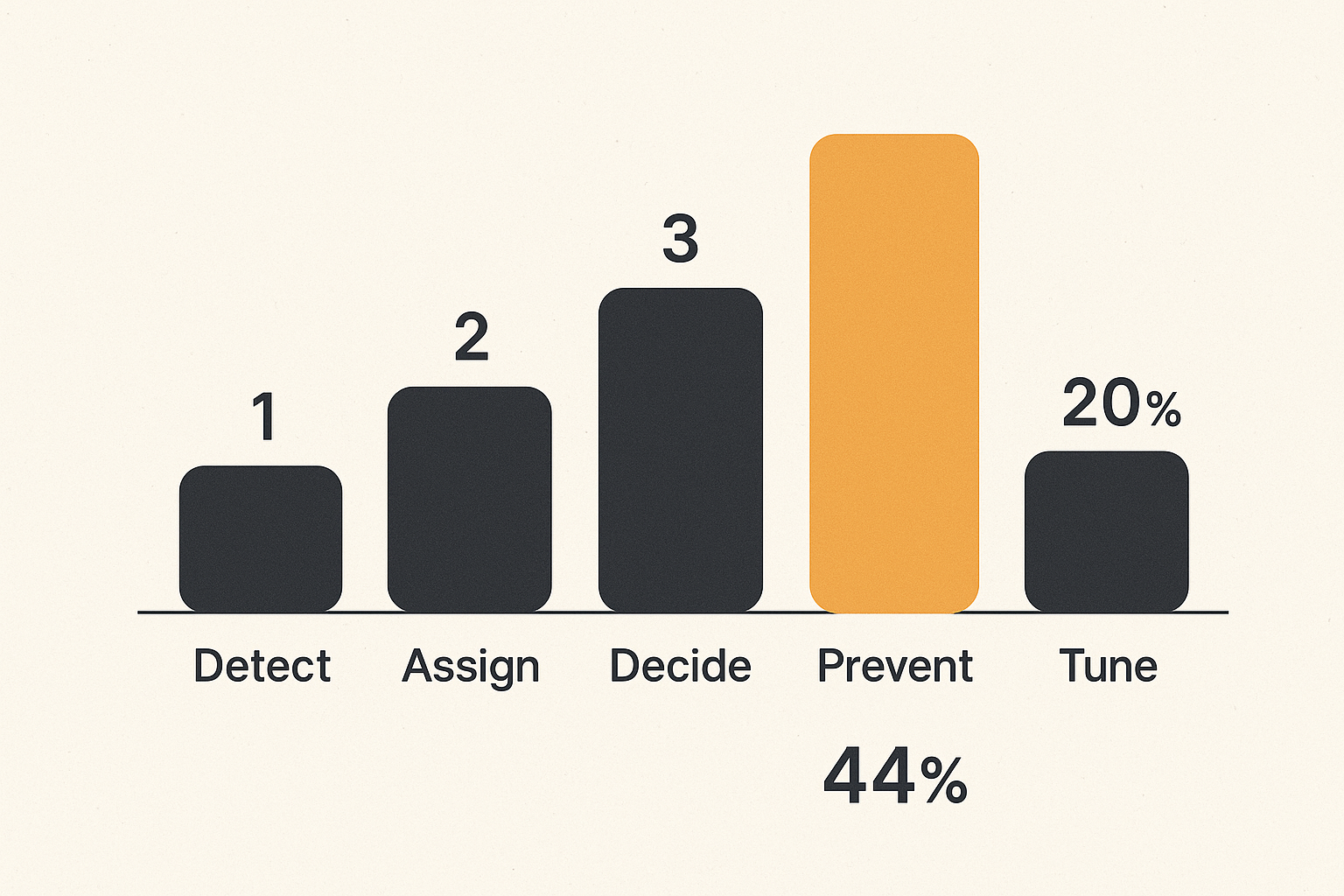
Detection speed is useful, but investigation speed is what operators feel. If a scanner finds an issue in ten seconds but the team spends two days figuring out whether it matters, the workflow is still broken.
Track:
- time from PR open to first security signal
- time from signal to owner assignment
- time from owner assignment to decision
- percentage of findings with clear remediation
- percentage of blocked findings later confirmed as valid
These metrics expose whether your vector security program is reducing uncertainty or just moving uncertainty into comments.
Track prevented merges and accepted risk
Prevented merges are not vanity metrics if you classify them correctly. Count the vectors you stopped before execution:
| Metric | Why it matters |
|---|---|
| Blocked privileged workflow changes | Shows control over CI trust boundaries |
| Blocked suspicious package additions | Shows package intake is not blind |
| Secrets caught before merge | Shows credential exposure is shrinking |
| Exceptions with expiry | Shows risk is owned, not forgotten |
| Reopened noisy rules | Shows tuning is continuous |
Accepted risk matters too. Sometimes the business will merge with an exception. That is not failure if the owner, scope, and expiry are explicit.
Review noisy rules like production incidents
Noise is not a personality flaw in developers. Noise is a system defect. If a rule wastes reviewer time, treat it as an operational issue.
Ask:
- Was the rule too broad?
- Did it lack asset context?
- Did it fire on unchanged code?
- Was the remediation unclear?
- Did ownership route to the wrong team?
Practical rule: if a vector security control cannot explain why the current change matters, it should warn, not block.
Where vu1nz.com fits
Product fit for CI/CD and package vectors
vu1nz.com is built around the part of vector security where timing matters most: pull requests that change CI/CD workflows or introduce new packages. The point is not to replace every security tool. The point is to catch high-impact pipeline and supply-chain vectors before they merge.
That includes checks for risky GitHub Actions patterns, workflow permission mistakes, dangerous trigger combinations, and package additions that deserve malware-oriented inspection rather than only CVE lookup.
For teams already running CodeQL, Dependabot, or Snyk, this is complementary. Those tools are useful. The gap is the attack path between a PR diff, CI execution, package behavior, and the credentials or artifacts exposed by the pipeline.
Rollout pattern for skeptical teams
The best rollout is small and evidence-driven.
Start with three repositories:
- one release-critical service
- one package-publishing repository
- one active application with frequent dependency changes
Run comment-only first. Tune the rules. Identify owners. Then block only the vectors that your team agrees are unacceptable: privileged PR workflows, suspicious package execution, secrets in diffs, and release-token exposure.
The mistake teams make is trying to turn vector security into a grand platform migration. It does not need to be. It needs to be a tight loop: changed vector, clear signal, correct owner, fast decision, preserved evidence.
Try vu1nz.com
vu1nz.com is for security engineers and DevSecOps teams who need to defend CI/CD pipelines and software supply chains from modern attacks. If vector security is becoming a workflow problem in your organization, Try vu1nz.com and start with the pull requests that matter most.
Catch the next supply-chain attack on the PR that adds it.
14-day free trial · no card required