If trane supply shows up in a ticket, dependency review, vendor integration, procurement thread, or pull request, the security question usually gets framed too narrowly.
Someone asks whether the supplier is legitimate. Someone else checks whether the package has a CVE. A developer says the change is only a build helper. The pull request sits there until security either blocks it with weak evidence or approves it with weak confidence.
Teams think the problem is supplier identity. The real problem is execution path control.
In modern CI/CD, a supplier-originated change does not need to be obviously malicious to become dangerous. A GitHub Actions workflow can inherit credentials. An npm package can run install scripts. A test fixture can alter code generation. A build container can pull mutable tags. That changes the conversation from vendor trust to pipeline architecture.
Table of contents
- Why trane supply belongs in your CI/CD threat model
- Model trane supply as a change path not a vendor name
- What breaks when supplier code reaches CI
- The controls that matter before merge
- A practical trane supply review workflow
- Detection logic that catches real supply chain behavior
- What works and what fails
- Operational ownership for devsecops teams
- Where vu1nz.com fits in a trane supply architecture
- Implementation checklist for 2026
- Closing the loop on trane supply
Why trane supply belongs in your CI/CD threat model
The search term is noisy but the risk is concrete
Trane supply may look like a vendor or procurement keyword, but in a software delivery environment it is better treated as a class of inbound trust. The practical question is not whether a supplier name appears familiar. The practical question is what that supplier-originated change can execute, read, publish, or mutate once it lands in your repository.
A supplier can enter the pipeline through obvious paths: a dependency, an SDK, a private package, a generated client, or a GitHub Action. It can also enter through less obvious paths: a copied workflow, a build image, a script pasted from documentation, or a transitive package introduced by a minor version bump.
The mistake teams make is treating those as separate review problems. Legal reviews the vendor. Developers review the diff. Security reviews CVEs. Platform reviews CI only after something fails. Nobody owns the combined execution graph.
Teams think the problem is supplier identity
Supplier identity matters, but it is not enough. A legitimate supplier can ship a compromised package. A legitimate maintainer can lose an npm token. A legitimate GitHub Action can change behavior under a mutable tag. A legitimate contractor can submit a pull request that expands CI token permissions without understanding the blast radius.
Security teams often ask: do we trust this supplier? That question is too broad to produce an enforceable control. A better question is: what privileges does this change receive before it is proven safe?
Practical rule: Do not turn supplier reputation into runtime permission. Treat reputation as context, not authorization.
That changes the conversation. A trusted supplier can still be restricted to read-only CI permissions. A new package can still be scanned at pull request time. A workflow copied from a vendor guide can still be pinned, sandboxed, and reviewed.
The asset is the merge path
The most valuable asset in a CI/CD supply chain is not only production. It is the path to production. That path includes pull request checks, workflow triggers, package install steps, build artifacts, release jobs, registry credentials, and deployment approvals.
Once you see trane supply as a merge-path problem, the controls become concrete. You can inventory the paths. You can detect risky changes. You can block specific behavior. You can assign ownership. You can build a review workflow that gives developers an answer before the change gets normalized into the codebase.
Model trane supply as a change path not a vendor name
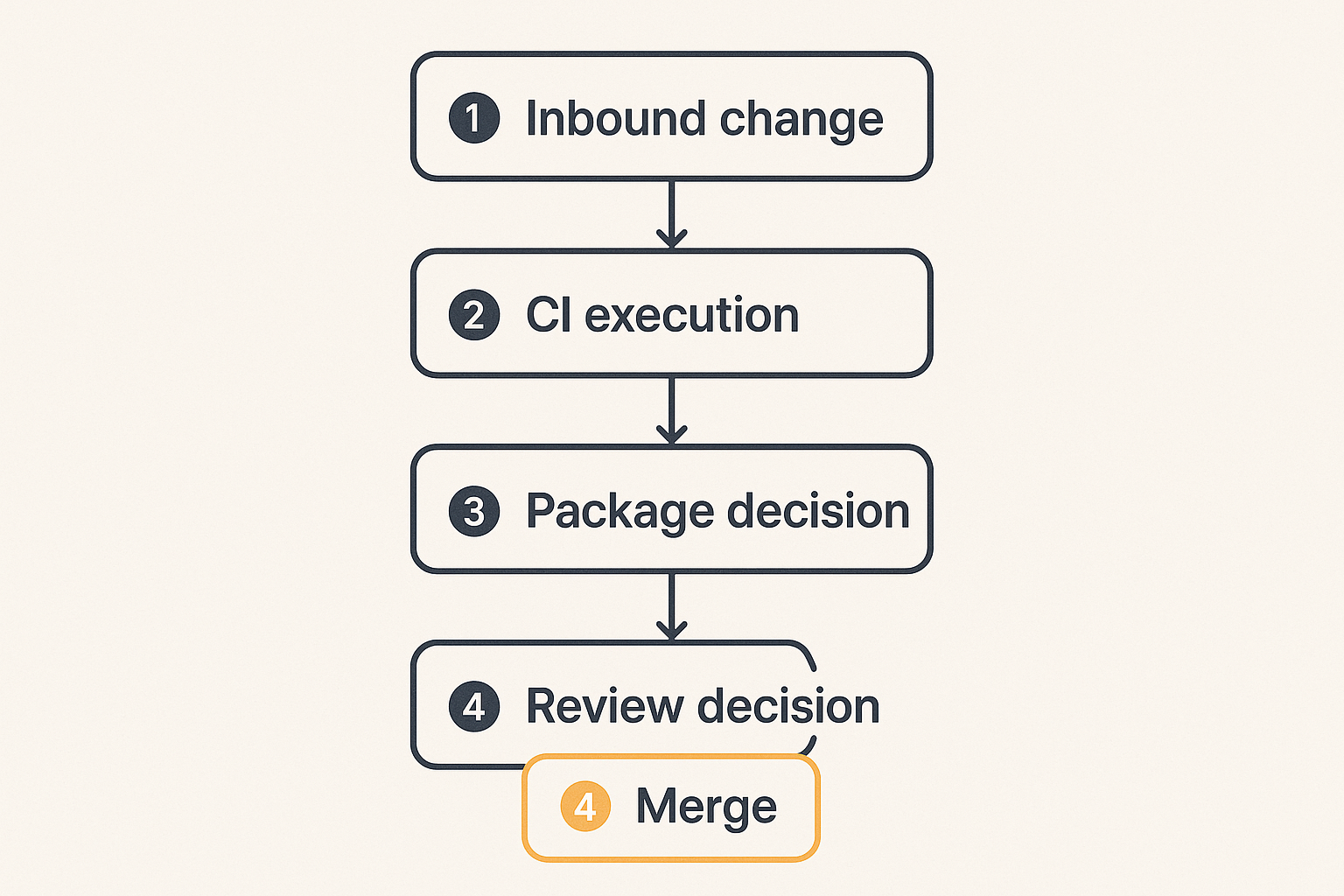
Map every inbound artifact
Start with the artifacts, not the vendor. A supplier-originated change can be one of several things:
- A direct dependency added to package.json, requirements.txt, go.mod, Gemfile, Cargo.toml, composer.json, or a lockfile.
- A GitHub Action referenced in a workflow.
- A Docker image used during build or release.
- A generated SDK or client library.
- A shell script copied from supplier documentation.
- A configuration file that changes test, build, lint, or release behavior.
- A binary artifact checked into the repository.
A useful way to think about it is: if the artifact can run during CI, influence what gets built, or affect what gets deployed, it belongs in the supply chain model.
Do not stop at application dependencies. Many real incidents begin in development dependencies, build tooling, package lifecycle hooks, release scripts, or CI actions. Those are attractive because they run in environments that often hold tokens.
Separate source trust from execution trust
There are two trust decisions happening at once. Source trust asks where the artifact came from. Execution trust asks what the artifact is allowed to do.
Those decisions should not collapse into one checkbox. A package from a known ecosystem maintainer may still deserve restricted execution. A new internal package may deserve review if it introduces a postinstall script. A vendor workflow may be acceptable for linting and unacceptable for release.
Use a simple classification:
- No execution: documentation, static config, type definitions.
- Local developer execution: scripts run manually or in dev containers.
- CI execution: build, test, lint, package installation, code generation.
- Release execution: publishing, signing, deployment, artifact upload.
- Privileged execution: access to secrets, cloud credentials, registry tokens, or write permissions.
Practical rule: The same supplier artifact can be low risk in test and high risk in release. Classify by execution context, not by file type.
Put ownership on the path
What breaks in practice is ownership. Procurement may own supplier approval. App teams own code. Platform owns CI. Security owns exceptions. Attackers do not care about that org chart.
For each path, define who can approve risk. A dependency added to a frontend package may be owned by the app team unless it introduces install scripts. A GitHub Actions permission expansion may require platform approval. A release workflow change may require security approval. A build image from a new registry may require both.
The goal is not to create bureaucracy. The goal is to prevent silent privilege changes. If a supplier-originated change moves from no execution to CI execution, someone should see that transition before merge.
What breaks when supplier code reaches CI
GitHub Actions turns metadata into execution
GitHub Actions is powerful because a YAML file can become a complete automation system. That is also why supplier-related workflow changes need serious review. A small diff can change token permissions, trigger behavior, checkout depth, artifact upload, cache keys, or whether untrusted pull request code runs with trusted credentials.
Examples that should trigger review:
- Adding
pull_request_targetto a workflow that checks out untrusted code. - Expanding
GITHUB_TOKENfrom read permissions to write permissions. - Calling an action by branch or tag instead of commit SHA.
- Running supplier-provided shell scripts with secrets available.
- Uploading build artifacts from untrusted jobs into trusted release jobs.
- Using broad cache restore keys across trusted and untrusted contexts.
The vu1nz GitHub Action is built around this pull request moment because workflow risk is easiest to stop before the YAML becomes part of the trusted automation surface.
Package managers hide behavior behind install steps
Package managers are not just download tools. They are execution frameworks. npm lifecycle scripts, Python setup hooks, Ruby gem extensions, Go module replacements, Composer scripts, and Cargo build scripts can all affect what happens during installation or build.
The common mistake is relying only on known-vulnerability scanning. CVEs matter, but supplier compromise often arrives before a CVE exists. Typosquatting, maintainer token theft, dependency confusion, malicious postinstall behavior, suspicious obfuscation, and sudden ownership changes do not need a CVE to hurt you.
This is why scanning only the current dependency inventory is noisy. The better place to inspect is the change boundary: what new package was added, what version changed, what scripts appear, what metadata shifted, and what will execute in CI.
Review queues do not scale
Manual review is necessary for ambiguous cases, but it fails as the primary control. Developers add packages constantly. CI files change during platform migrations. Vendor docs encourage copy-paste snippets. Security cannot deeply inspect every diff without becoming the bottleneck everyone routes around.
What breaks in practice is not analyst skill. It is queue design. If every supplier-related change receives the same severity, reviewers stop trusting the system. If the system blocks too often, developers learn how to bypass it. If it only comments without enforcement, risky changes merge during deadline pressure.
A working model needs automated triage, precise blocking, and a clear escalation path.
The controls that matter before merge
Pin workflows and permissions
The minimum bar for GitHub Actions security is boring and non-negotiable:
- Pin third-party actions to commit SHA where practical.
- Set explicit workflow and job-level permissions.
- Avoid default write permissions.
- Separate untrusted pull request checks from trusted release jobs.
- Avoid
pull_request_targetunless the workflow is intentionally designed for it. - Do not expose secrets to jobs that run untrusted code.
Practical rule: If a workflow can publish, deploy, sign, or write to the repository, it should not also execute unreviewed supplier code.
This is where many teams discover that their CI/CD risk is not a single bug. It is an architecture drift problem. Workflows accumulate convenience permissions. Old release jobs remain trusted. New supplier actions get added to save time. Nobody notices the combined path until an incident review.
Scan new packages not the whole universe
Dependency scanners often produce long lists. Some are useful. Many become background noise. For supplier-originated changes, the high-signal moment is the pull request that introduces or changes package behavior.
Focus on new and changed packages:
- New direct dependency.
- New transitive dependency introduced by a lockfile change.
- Version change with new scripts or changed package metadata.
- Dependency source moving from registry to Git URL or tarball.
- Package name similar to a popular package.
- Freshly published version with unusual contents.
- Obfuscated code or network behavior in install-time files.
The practical question is: what changed now that can execute before merge or during release?
If your team still treats Dependabot-style CVE alerts as the whole supply chain program, read What Dependabot Misses and compare those cases against your own PR gates. Known-vulnerability alerting is useful, but it is not the same as malicious package detection.
Treat generated files as evidence
Generated files are often waved through because nobody wants to review machine output. That is understandable and dangerous.
A supplier SDK update may generate thousands of lines. A protobuf change may alter clients across services. A build tool may regenerate lockfiles. The generated output may be too large for line-by-line review, but it still contains evidence:
- Which generator produced it?
- Did the generator version change?
- Did the generation command change?
- Did outputs include unexpected scripts, binaries, or network endpoints?
- Did lockfiles introduce packages unrelated to the supplier feature?
Generated does not mean trusted. It means you need different review signals.
A practical trane supply review workflow
Step 1 capture the change
A practical trane supply workflow starts at the pull request. Do not wait for nightly scanning or quarterly vendor review. Capture the facts while the author still remembers why the change exists.
A useful implementation sequence:
- Detect changes to workflow files, package manifests, lockfiles, build scripts, Dockerfiles, release scripts, and generated artifacts.
- Determine whether the change introduces new execution, new network access, new credentials, or new publish capability.
- Compare added packages and actions against allowed patterns.
- Run malware and behavior checks on newly added packages.
- Produce a short PR comment that states the risk, affected file, and required action.
- Block only when the risk is concrete enough to justify enforcement.
- Record the final decision for later incident review.
The output should be specific. Not supply chain risk detected. Instead: new npm package has postinstall script and was added to a job with registry publish token available.
Step 2 classify the execution surface
Classification turns vague concern into routing. For each change, decide where it can execute:
- Developer laptop only.
- CI test job with read-only repository access.
- CI job with repository write access.
- Release job with package registry credentials.
- Deployment job with cloud credentials.
Then decide whether the current control matches that surface. A new test-only dev dependency may need a warning and package scan. A new release action referenced by mutable tag should block. A Docker image used for signing should require manual approval and digest pinning.
This is also where environment separation matters. If test jobs and release jobs share caches, artifacts, or credentials, a low-risk path can become a high-risk path.
Step 3 block or route with context
Blocking should be rare enough to be respected and common enough to matter. The mistake teams make is blocking broad categories like all new packages or all third-party actions. That creates friction without precision.
Better blocking conditions include:
- Workflow adds write permissions without explicit justification.
- Untrusted PR code can run in a privileged workflow.
- Third-party action is unpinned in release or publish path.
- New package includes install-time execution and runs where secrets are present.
- Dependency source changes to Git URL, tarball, or unknown registry.
- Lockfile introduces a package with suspicious name similarity or obfuscated install code.
Everything else can be routed: platform review, app owner review, security review, or researcher reproduction.
Step 4 record the decision
Do not bury supply chain decisions in Slack. Capture them in the PR, an issue, or a security exception system. You want a durable trail:
- What signal fired.
- Who approved the risk.
- Why the decision was made.
- What compensating control exists.
- When the exception expires.
This matters during incidents. If a supplier package is later found malicious, you need to know where it entered, what review happened, and which builds consumed it.
Detection logic that catches real supply chain behavior
Signals worth collecting
Good detection starts with signals that map to attacker behavior and operational risk. For trane supply style inbound changes, collect:
- Added or modified GitHub Actions workflows.
- Workflow trigger changes.
- Permission changes at workflow and job level.
- New third-party actions and whether they are pinned.
- New or changed package manifests and lockfiles.
- Package lifecycle scripts.
- Maintainer, publish-time, and version-age metadata where available.
- New binary files, minified files, or obfuscated scripts.
- Registry, Git URL, tarball, or local path source changes.
- Docker image tag or digest changes.
- Artifact upload and download relationships across jobs.
You do not need perfect attribution to make this useful. You need enough context to say whether a change increases execution or credential exposure.
Rules that reduce noise
Noise reduction is not a dashboard feature. It is a policy design feature. Rules should be scoped to the path that matters.
Examples:
- Warn on unpinned actions in test jobs; block unpinned actions in release jobs.
- Warn on new dev dependencies; block new install scripts when secrets are exposed.
- Warn on broad cache keys; block cache sharing between untrusted PR jobs and privileged release jobs.
- Warn on generated file changes; block generated binaries without source or provenance.
- Warn on new Docker tags; block mutable tags in signing or deployment jobs.
Practical rule: Severity should come from behavior plus context. A suspicious package in a sandbox is not the same as the same package in a publish job.
Example CI policy
A simple policy can be implemented before a larger platform program exists. The point is to create a guardrail at the merge boundary.
name: supply-chain-review
on:
  pull_request:
    paths:
      - '.github/workflows/**'
      - 'package.json'
      - 'package-lock.json'
      - 'pnpm-lock.yaml'
      - 'yarn.lock'
      - 'requirements*.txt'
      - 'go.mod'
      - 'go.sum'
      - 'Cargo.toml'
      - 'Cargo.lock'
      - 'Gemfile*'
      - 'composer.*'
      - 'Dockerfile*'

permissions:
  contents: read
  pull-requests: write

jobs:
  review:
    runs-on: ubuntu-latest
    steps:
      - uses: actions/checkout@<pinned-sha>
      - name: inspect changed supply chain files
        run: ./security/review-supply-chain-change.sh
The exact scanner can vary. The architecture should not. Run on pull request. Keep permissions narrow. Inspect the changed execution surface. Comment with context. Block only where policy requires it.
What works and what fails
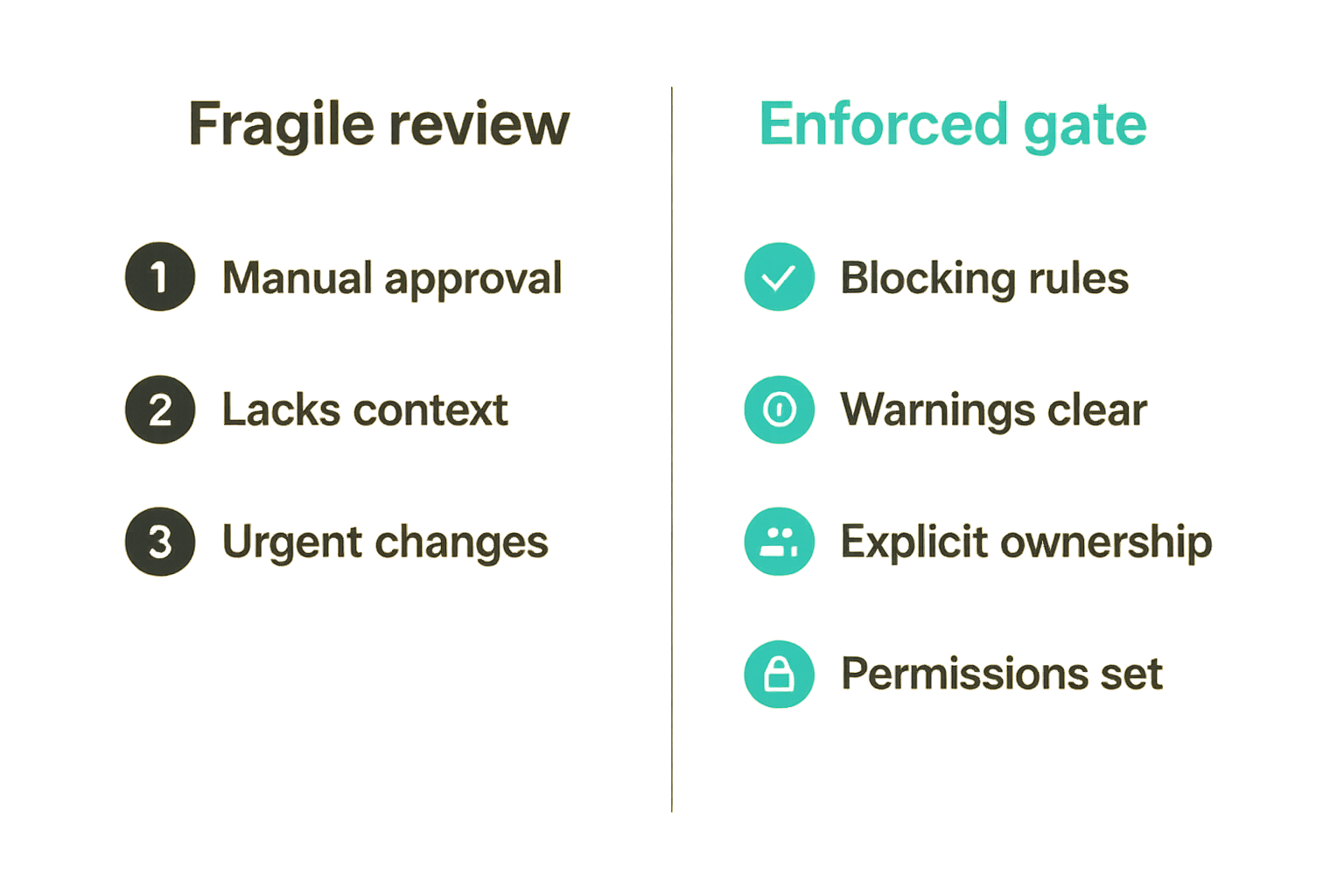
What works in production
What works is a merge-time control that developers understand. It should be close to the diff, fast enough to stay in the PR loop, and specific enough that the author knows how to fix the issue.
Patterns that hold up:
- Small number of high-confidence blocking rules.
- Clear distinction between warning, block, and manual review.
- Explicit ownership for workflow, package, and release risk.
- Pinning and permission baselines enforced automatically.
- Package behavior scanning for newly added dependencies.
- Security exceptions with expiration dates.
- Reproducible evidence for suspicious packages.
This is not glamorous. It is the difference between a supply chain program that runs during real development and one that exists only in policy documents.
What fails after the first incident
Several approaches look fine until the first investigation.
Vendor questionnaires fail when they are treated as runtime controls. They may tell you something about supplier process, but they do not tell you what a package did in your CI job yesterday.
CVE-only scanning fails when malicious behavior has no CVE. Many package attacks are operational events before they become advisories.
Manual approval fails when every change is urgent and reviewers lack context. People approve what they cannot fully evaluate.
SIEM-only detection fails when the first useful signal should have been at pull request time. By the time suspicious network traffic appears, the package may already have run with a token.
Broad blocking fails when developers cannot ship. They will find a workaround, and the workaround will be less visible than the original risk.
Comparison table
| Approach | What it catches | What it misses | Operational result |
|---|---|---|---|
| Vendor approval only | Known supplier process risk | Compromised packages, risky CI permissions, malicious updates | Good paperwork, weak runtime control |
| CVE dependency scanning | Known vulnerable versions | Pre-CVE malware, typosquats, install scripts, CI abuse | Useful baseline, incomplete coverage |
| Manual security review | Complex judgment calls | High-volume routine changes, hidden transitive behavior | Bottlenecks and inconsistent decisions |
| Merge-time CI/CD scanning | Workflow drift, new package risk, permission changes | Some business context and intent | Fast feedback with enforceable guardrails |
| Runtime-only monitoring | Post-merge suspicious behavior | Early prevention, review evidence | Late detection and harder containment |
The practical answer is not one control. It is a layered workflow where merge-time scanning reduces the number of ambiguous cases humans need to review.
Operational ownership for devsecops teams
Give developers fast answers
Developers do not need a lecture on supply chain theory in every pull request. They need actionable output:
- What changed.
- Why it matters.
- Whether it blocks merge.
- How to fix it.
- Who can approve an exception.
A good comment says: this workflow adds write-all permission to a job triggered by pull_request. Set contents: read and move publish steps to a trusted release workflow. A bad comment says: supply chain risk detected.
The shorter the feedback loop, the more likely developers are to treat the control as part of engineering rather than an external audit.
Give security durable evidence
Security needs more than a green check or red X. For investigations and trend analysis, keep evidence:
- PR number and commit SHA.
- Package or action introduced.
- Scanner finding and rule ID.
- Execution context.
- Reviewer decision.
- Exception expiration.
- Link to reproduced behavior if applicable.
This evidence helps answer harder questions later. Which repositories accepted the package? Which workflows had secrets exposed? Did the suspicious version ever reach a release build? Who approved the exception?
Give researchers a path to reproduce
Security researchers need reproducibility. If a scanner flags obfuscation or install-time network behavior, the team should be able to rerun the analysis in a controlled environment. Capture package tarballs, lockfile versions, action references, and workflow context.
This matters because supply chain attacks are often time-sensitive. Packages disappear. Maintainers yank versions. Tags move. Registries change metadata. If your evidence is only a dashboard row, you may not be able to prove what happened.
A practical research workflow stores enough artifacts to reconstruct the execution path without rerunning untrusted code in a privileged environment.
Where vu1nz.com fits in a trane supply architecture
Workflow scanning inside pull requests
vu1nz.com is designed for the pull request boundary: the point where supplier-originated changes become part of your trusted delivery system. It scans GitHub Actions workflows for CI/CD security issues such as unsafe triggers, risky permissions, unpinned actions, and patterns that allow untrusted code to reach privileged jobs.
This is not a replacement for platform engineering. It is a guardrail that helps platform and security teams enforce the baseline without reading every workflow diff by hand.
The architectural fit is straightforward: run the scanner on pull requests, keep the token permissions narrow, and make findings visible where developers already work.
Package malware checks at the right moment
Package review is most useful when a package is added or changed. vu1nz.com focuses on newly introduced packages across common ecosystems rather than treating the entire dependency tree as one undifferentiated alert pile.
That matters for trane supply workflows because the risky moment is often a small diff: one new package, one lockfile update, one install script, one copied helper. If the scanner can identify suspicious behavior before merge, security gets a chance to act while the blast radius is still small.
Product fit without another dashboard
The goal is not to create another place for engineers to check. The goal is to push useful findings into the PR and make the decision easy to audit. vu1nz.com fits when teams want CI/CD and package supply-chain checks close to code review, not buried in a separate weekly report.
If you already have SCA, keep it. If you already have CodeQL, keep it. The gap this fills is different: workflow abuse, package malware signals, and supplier-originated execution risk before merge.
Implementation checklist for 2026
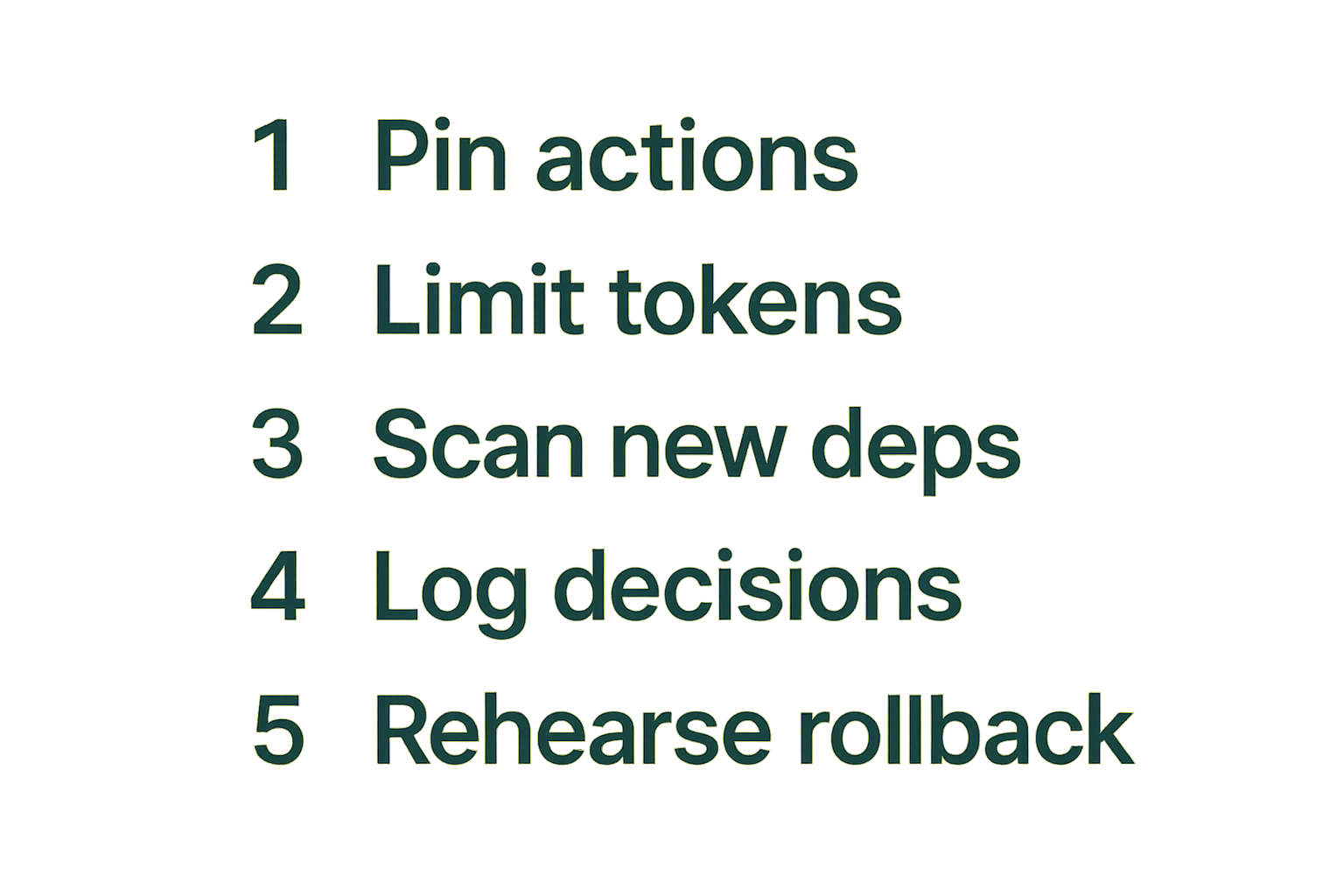
First week
Start small. Pick three repositories with active development and real CI usage. Do not begin with the most political monorepo unless you enjoy meetings.
In the first week:
- Inventory workflow files and release jobs.
- Identify which jobs have write permissions, secrets, registry tokens, or deployment credentials.
- Add explicit permissions to workflows that rely on defaults.
- Detect third-party actions referenced by mutable tag.
- Identify package manifests and lockfiles that should trigger review.
- Decide which findings warn and which block.
- Run the control in comment-only mode for a short calibration period.
The point is to learn where your current pipeline is already trusting supplier-originated code.
First month
In the first month, move from visibility to enforcement.
- Block unpinned third-party actions in release paths.
- Block workflows that expose secrets to untrusted pull request code.
- Block new install-time package behavior in privileged jobs.
- Require approval for dependency sources that are Git URLs, tarballs, or private registries outside the baseline.
- Route ambiguous findings to named owners.
- Create exception templates with expiration.
- Review false positives weekly and tune policy.
Do not tune by deleting every noisy rule. Tune by improving context. A rule that is too broad may become useful when scoped to release jobs.
Metrics that matter
Avoid vanity metrics. Counting total supply chain alerts tells you almost nothing. Useful metrics connect to workflow health:
- Time from PR open to supply chain decision.
- Number of blocked privileged workflow changes.
- Number of new packages with install-time execution.
- Percentage of release workflows with explicit minimal permissions.
- Percentage of third-party actions pinned to SHA in privileged paths.
- Exceptions opened, expired, and renewed.
- Repeated findings by team or template.
These metrics show whether the architecture is improving. They also help security justify tighter controls without relying on fear.
Closing the loop on trane supply
Trane supply is useful as a forcing function because it exposes a common weakness: teams know suppliers matter, but they often lack a concrete way to control supplier-originated execution inside CI/CD.
The mistake teams make is trying to solve that with one big trust decision. Trusted or untrusted. Approved or denied. Safe or unsafe. Real pipelines do not work that way.
The practical model is path-based. What artifact entered? Where can it execute? What credentials are nearby? What changed in this pull request? What evidence do we have? Who owns the decision? That is how trane supply becomes an architecture problem you can operate instead of a vague vendor concern.
Try vu1nz.com
vu1nz.com is for technical teams that secure GitHub Actions, npm packages, and modern software delivery pipelines. Try vu1nz.com to scan CI/CD workflow risk and newly added packages before they merge.
Catch the next supply-chain attack on the PR that adds it.
14-day free trial · no card required