A DevSecOps team does not usually search for a simplisafe security system because they want another home alarm. They search because the phrase captures a useful idea: sensors, zones, alerts, escalation, and response that ordinary people can operate under stress.
That is exactly what many CI/CD security programs are missing.
Teams think the problem is finding more vulnerabilities. The real problem is building a security system that can tell the difference between a harmless change, a risky pull request, and an active supply chain attack before the code merges.
That changes the conversation. The practical question is not whether you own another scanner. It is whether your pipeline has sensors in the right places, clear state transitions, trusted response paths, and enough context for engineers to act without turning every build into a courtroom.
This article uses the simplisafe security system as an operating model for CI/CD and software supply chain defense. Not as a product review. Not as home security advice. As an architecture pattern for teams defending GitHub Actions, package ecosystems, secrets, build artifacts, and release workflows in 2026.
Table of contents
- Why the simplisafe security system lens belongs in CI/CD
- Map simplisafe security system concepts to software supply chain controls
- Build the minimum viable pipeline security system
- Detection logic for CI workflows and dependencies
- Response workflow from pull request to incident
- What breaks when teams implement it badly
- What works in production
- Metrics that show whether the system is working
- Product fit for vu1nz.com
Why the simplisafe security system lens belongs in CI/CD
The useful part of a home alarm model is not the siren. It is the operating discipline: known entry points, sensors close to the action, a control plane, escalation rules, and an owner who can respond.
CI/CD has the same shape. A repository has doors. A workflow has motion sensors. A package update can be a broken window. A release token is a key to the house. The mistake teams make is treating these as separate tools instead of one security system.
From devices to pipeline sensors
A useful way to think about it is to map physical security primitives to pipeline primitives:
| Home security primitive | CI/CD equivalent | What it protects |
|---|---|---|
| Door sensor | Pull request policy | Protected branch entry |
| Motion sensor | Workflow behavior detection | Unexpected execution paths |
| Keypad | Approval and identity flow | Human authorization |
| Base station | CI security control plane | Policy evaluation and routing |
| Dispatch | Incident owner and runbook | Response under time pressure |
| Alarm history | Audit log and build provenance | Reconstruction after an event |
This is not a perfect analogy, but it forces the right question. If someone opens a door at 3 a.m., the system should know which door, whether the user was expected, what zone changed, and who gets called. If a pull request modifies .github/workflows/release.yml, adds a new postinstall script, and touches a lockfile, your pipeline should have the same level of operational context.
Practical rule: Do not buy more sensors until you know which entry points matter, who owns them, and what action follows an alarm.
Why perimeter thinking fails in repositories
Traditional perimeter thinking assumes bad things come from outside. Supply chain attacks often do not. They arrive as pull requests, maintainer credentials, dependency updates, compromised packages, poisoned build scripts, or workflow changes that look normal enough to pass code review.
What breaks in practice is that repositories are both product surface and production infrastructure. A GitHub Actions workflow can read secrets, publish packages, push containers, sign releases, and deploy to cloud environments. That makes the repo an execution environment, not just a code archive.
So the simplisafe security system lens helps because it treats normal workflow as a set of monitored zones. You do not protect everything the same way. You protect high-impact transitions: untrusted code becoming trusted code, a dependency becoming executable code, a token becoming available to a runner, and a build artifact becoming a release.
Map simplisafe security system concepts to software supply chain controls
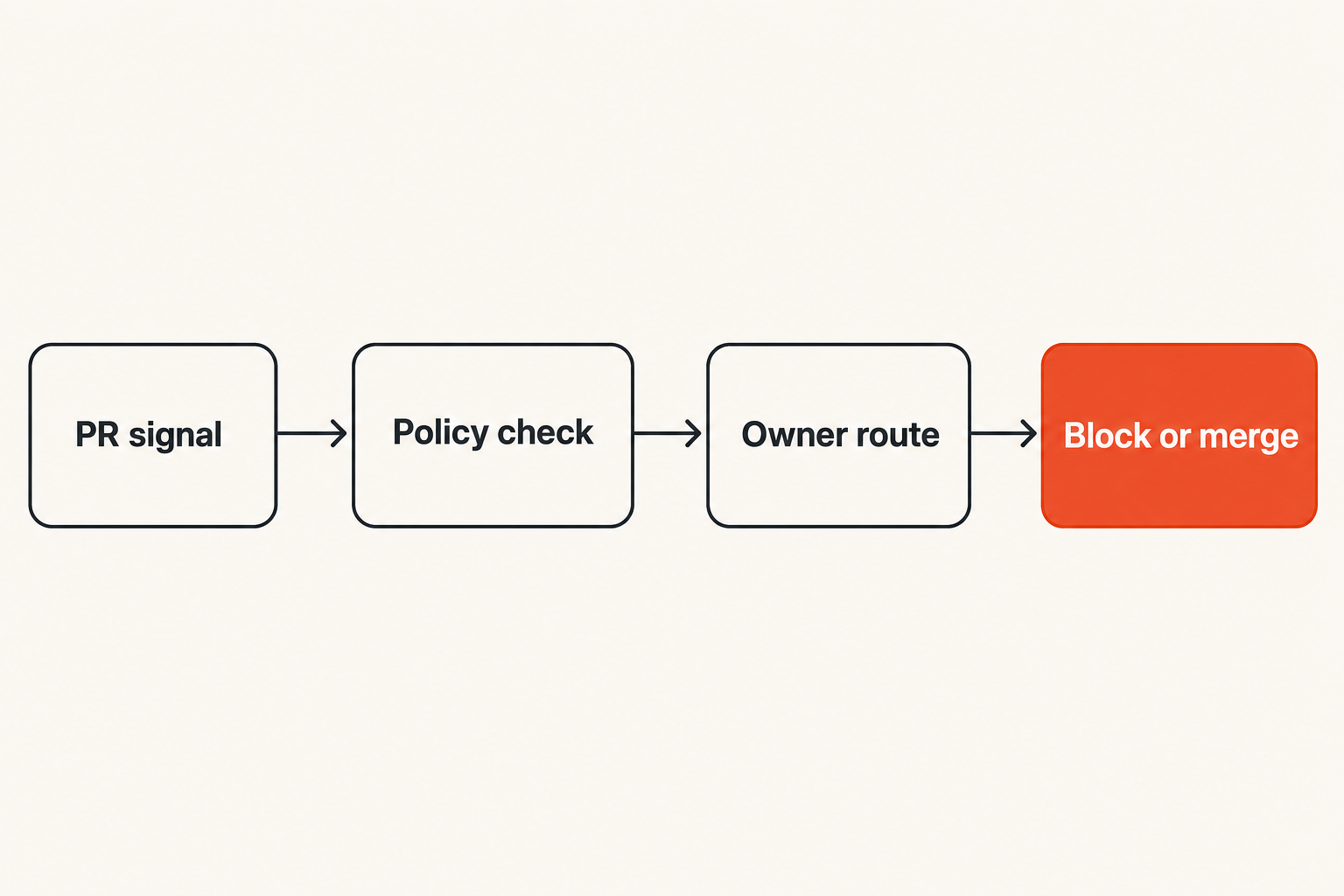
A simplisafe security system does not work because every room has a blinking light. It works when sensor data is converted into decisions. CI/CD security needs the same conversion layer.
The practical question is: what is the minimum signal that lets you decide whether to allow, block, quarantine, or escalate a change?
Sensors are checks not dashboards
Dashboards are useful after the fact. They are weak controls at merge time. A sensor should fire when a meaningful state change happens.
In CI/CD, good sensors include:
- A workflow file changed by a contributor without elevated trust.
- A job gained
contents: write,id-token: write, or broad token permissions. - A pull request introduced a new dependency with install-time execution.
- A lockfile changed without a matching manifest change.
- A build step downloads and executes remote code with
curl | shbehavior. - A release job can run on pull request context instead of a trusted tag or branch.
The mistake teams make is translating every best practice into a warning. That creates a room full of motion sensors pointed at a ceiling fan. The better approach is to decide which signals change risk enough to alter the workflow.
Dispatch is ownership not alert volume
Alerting is not response. Dispatch means a signal is routed to someone who can make a decision and has the authority to act.
For pipeline security, dispatch should answer four questions:
- Who owns the repository or workflow?
- Who can approve the risky change?
- Who can rotate the affected secret or token?
- Who can stop the release if the risk is real?
Related reading from our network: teams building location-aware SOC response face a similar ownership problem when alerts need routing to the right responder, not just more dashboards, in this SOC architecture guide.
Practical rule: An alert without an empowered owner is not a control. It is documentation that the system noticed its own failure.
Build the minimum viable pipeline security system
You do not need a giant platform to start. You need a small number of controls placed at the transitions attackers care about. The minimum viable system should protect identity, code execution, dependency intake, secrets, and releases.
A practical sequence looks like this:
- Inventory repositories that can deploy, publish, sign, or access production secrets.
- Identify CI workflows with privileged tokens, cloud credentials, package publishing rights, or OIDC trust.
- Add pull request checks for workflow changes, dependency additions, dangerous scripts, and permission expansion.
- Gate high-risk changes before merge, not after nightly scanning.
- Route findings to code owners and security owners with a short runbook.
- Record exceptions with expiration dates and owners.
- Review bypasses monthly and convert repeated exceptions into policy improvements.
If you want an example of this pattern inside GitHub Actions, the prior vu1nz writeup on how vu1nz GitHub Actions catches CI/CD vulnerabilities in 30 seconds shows how a single workflow file can become part of the control plane rather than another passive report.
Define protected assets and trust boundaries
Start with assets, not tools. In most engineering organizations, the assets that matter are:
- Release credentials and package publishing tokens.
- GitHub organization permissions and repository settings.
- Production deployment workflows.
- Build artifacts, containers, provenance, and signatures.
- Dependency manifests and lockfiles.
- Secrets exposed to CI runners.
Then draw trust boundaries. A forked pull request is different from a branch pushed by a maintainer. A scheduled workflow is different from a release workflow. A dependency used in tests is different from a package that runs install scripts during build.
That changes the conversation from generic vulnerability management to state-aware enforcement. You are not asking whether a repo is secure in the abstract. You are asking whether a specific change crosses a specific boundary with enough verification.
Put controls where state changes
Many teams put security checks where they are easy to run, not where they are useful. Nightly scanning is cheap. It is also late. If a malicious package ships at noon and your scanner runs at midnight, the alarm is reporting a burglary after the truck left.
Put controls at merge, build, publish, and deploy transitions. For example:
name: supply-chain-guard
on:
  pull_request:
    paths:
      - '.github/workflows/**'
      - 'package.json'
      - 'package-lock.json'
      - 'requirements.txt'
      - 'pyproject.toml'
permissions:
  contents: read
  pull-requests: write
jobs:
  scan:
    runs-on: ubuntu-latest
    steps:
      - uses: actions/checkout@v4
      - name: Check workflow and dependency risk
        run: ./security/check-pr-risk.sh
The implementation detail matters less than the placement. A weak check at the right transition is often more useful than a perfect report after the release.
Detection logic for CI workflows and dependencies
Detection logic should be boring enough to maintain and specific enough to block real abuse. The goal is not to invent a magic AI analyst. The goal is to catch the handful of patterns that repeatedly turn source control into an attacker execution path.
Workflow abuse patterns
GitHub Actions and similar CI systems are powerful because they glue together code, credentials, artifacts, and deployment. Attackers like them for the same reason.
High-signal workflow checks include:
pull_request_targetworkflows that check out untrusted pull request code.- Jobs with broad
permissionswhen only read access is needed. - Unpinned third-party actions in privileged workflows.
- Shell steps that execute remote scripts without verification.
- Secrets available to jobs triggered by untrusted actors.
- Release workflows triggered by mutable branch names instead of protected tags.
- New self-hosted runner labels added without review.
The mistake teams make is treating workflow YAML as configuration, not code. In reality, workflow YAML is executable infrastructure. It deserves code review, policy checks, and privileged-change handling.
A simple policy table helps keep this sane:
| Change type | Default action | Required owner |
|---|---|---|
| Add write token permission | Block until approved | Repo admin or security |
Add pull_request_target | Block until reviewed | Security |
| Add third-party action | Warn or block by repo tier | Code owner |
| Add release trigger | Block until approved | Release owner |
| Add self-hosted runner | Block until approved | Platform owner |
Package risk signals before a CVE exists
Known CVE scanning is necessary, but it is not enough. Many real supply chain attacks are malicious from the start or compromised before any advisory exists. Dependency tools that only reason over known vulnerabilities miss that class of risk.
Look for behavioral and ecosystem signals:
- New package added in a sensitive service.
- New maintainer, ownership transfer, or sudden publish pattern change.
- Typosquatting or dependency confusion indicators.
- Install scripts, postinstall hooks, or binary downloads.
- Obfuscated JavaScript, suspicious network calls, or credential harvesting strings.
- Package added directly to a lockfile without a clear manifest reason.
The vu1nz article on what Dependabot misses is relevant here because CVE-centric workflows are optimized for known badness, while modern package attacks often need detection before the ecosystem has agreed on a name.
Practical rule: Treat a new executable dependency as a code change from an unknown author until proven otherwise.
Response workflow from pull request to incident
Detection without response design becomes notification debt. A good CI/CD security system needs a workflow that engineers can follow while a release is waiting and Slack is already noisy.
The workflow should be short:
- Classify the finding as policy violation, suspicious behavior, confirmed malicious, or false positive.
- Identify the affected boundary: merge, build, secret, artifact, deploy, or publish.
- Decide the immediate action: block, quarantine, allow with owner approval, or escalate.
- Preserve evidence: diff, workflow logs, package tarball, lockfile, actor, timestamps.
- Remediate: revert, pin, rotate, disable workflow, remove package, or rebuild artifact.
- Close with an owner, exception expiry, and policy update if needed.
That is the pipeline version of alarm response. You do not debate whether alarms are philosophically valuable while the front door is open. You follow the runbook.
Triage states that engineers can execute
Ambiguous severities create confusion. Use states that map to actions:
| State | Meaning | Action |
|---|---|---|
| Informational | Context only | No block, record signal |
| Needs owner review | Risky but explainable | Require code owner approval |
| Policy block | Violates a defined rule | Block merge until changed |
| Security escalation | Suspicious or malicious | Security review and evidence capture |
| Incident | Token, artifact, or release may be compromised | Stop release and start IR |
This avoids the common failure mode where every finding is called high severity and nobody knows whether to merge.
Escalation without Slack archaeology
Slack is a bad database. It is fine for coordination, but not for control state. Your pipeline should record why a change was blocked, who approved an exception, when the exception expires, and what evidence supported the decision.
Related reading from our network: community operators run into the same routing problem when trust, asks, offers, and follow-up are spread across chat threads; the operating model in this local community network guide is surprisingly adjacent to security escalation design.
For CI/CD, the minimum record should include:
- Repository, pull request, commit SHA, and actor.
- Finding category and matched rule.
- Affected files and permissions.
- Approver identity and role.
- Expiration date for exceptions.
- Links to logs, artifacts, and package evidence.
If you cannot reconstruct the decision two weeks later, you do not have a security system. You have tribal memory.
What breaks when teams implement it badly
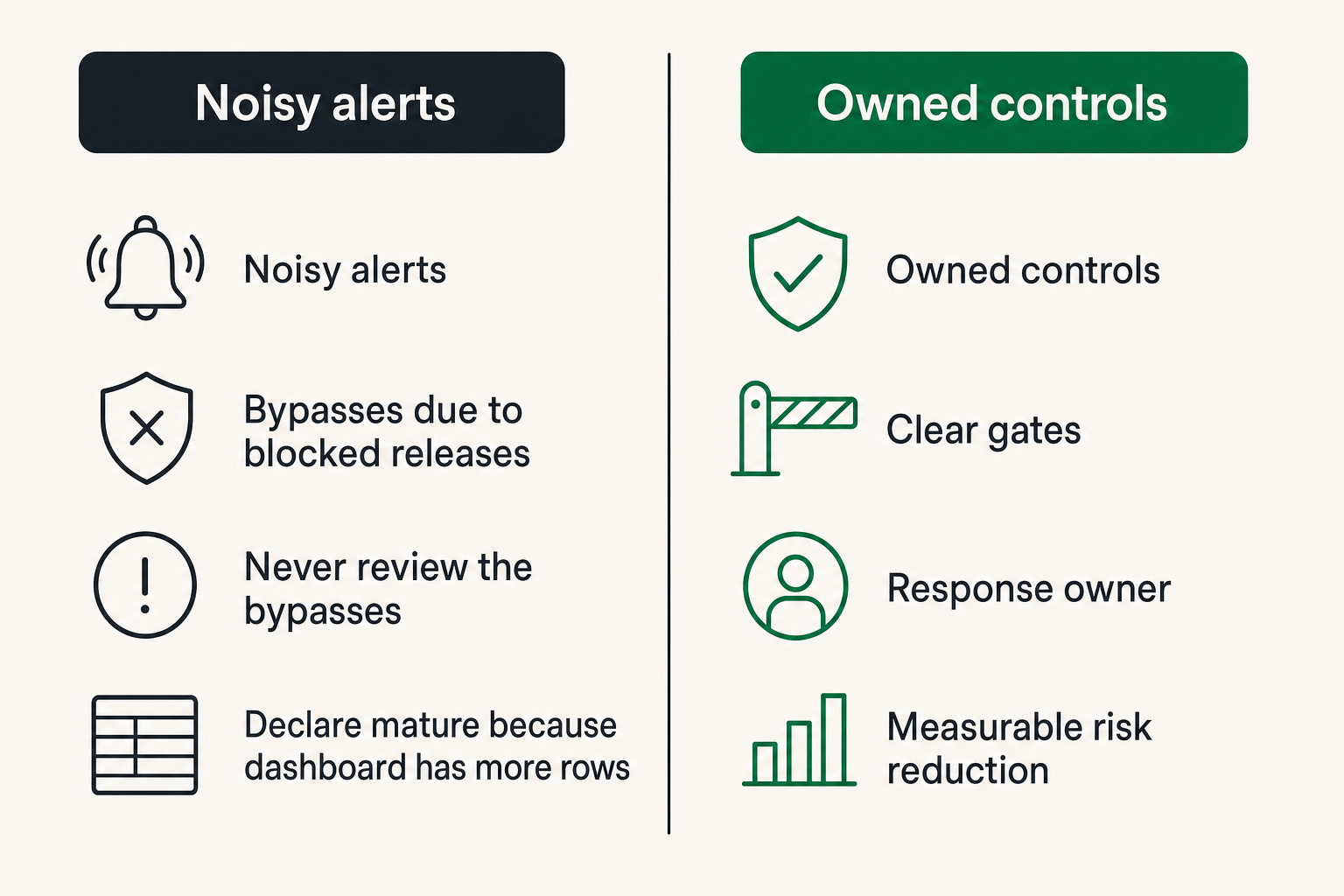
The bad version of this architecture is easy to build. Add scanners everywhere. Send findings to Slack. Mark half of them as high. Let teams bypass them because releases are blocked. Never review the bypasses. Declare the program mature because the dashboard has more rows.
What breaks in practice is not just detection. Trust breaks. Engineers stop believing the system. Security stops believing approvals. Leadership sees friction without measurable risk reduction.
Noise becomes the attacker
Attackers do not need to beat controls that everyone ignores. They only need to hide inside the normal exception stream.
Common noise patterns include:
- Blocking on low-confidence style findings.
- Flagging every dependency update equally.
- Treating dev-only packages the same as production build-time packages.
- Reopening findings with no code change.
- Failing to suppress known safe patterns with clear ownership.
- Creating alerts that have no merge consequence and no response owner.
The fix is not to lower standards. The fix is to separate advisory signals from blocking controls. A warning can be noisy. A block must be defensible.
Automation without authority creates theater
Automation can detect, comment, label, and block. But if nobody has agreed that the automation is allowed to stop a merge, teams will route around it.
You need explicit authority for:
- Which rules block protected branches.
- Who can override a block.
- Which repositories are tier one assets.
- Which secrets require rotation after exposure.
- Which artifacts require rebuild after dependency compromise.
Without that authority, the pipeline becomes security theater. The bot yells. The release manager overrides. The same risky pattern returns next week.
Practical rule: Every blocking control needs a named business owner, a technical owner, and a documented bypass path.
What works in production
Good systems are narrower than vendors imply. They enforce a few important things consistently. They make the safe path easier than the unsafe path. They produce enough evidence for a real investigation without forcing every engineer to become a forensic analyst.
Small policies with hard gates
Start with policies that are easy to explain:
- No privileged workflow changes without owner approval.
- No new package with install-time execution without review.
- No broad GitHub token permissions in pull request workflows.
- No unpinned third-party actions in release workflows.
- No secrets exposed to untrusted pull request contexts.
- No package publishing from unprotected branches.
These are not glamorous. They work because they map directly to attacker paths.
A useful control file can be simple:
policy:
  block:
    - workflow_permission_expansion
    - pull_request_target_with_untrusted_checkout
    - release_from_unprotected_ref
    - new_dependency_with_install_script
  require_review:
    - new_third_party_action
    - lockfile_only_dependency_change
    - new_self_hosted_runner_label
  owners:
    security: '@org/security'
    platform: '@org/platform'
    release: '@org/release-engineering'
The point is not the syntax. The point is that the system expresses business decisions as enforceable workflow rules.
Continuous validation against real changes
A CI/CD security system should be tested the way attackers interact with it: through changes. Create safe test pull requests that attempt to expand token permissions, add suspicious packages, modify release triggers, and introduce risky workflow patterns.
Validation should answer:
- Did the right sensor fire?
- Did the finding include enough context?
- Was the merge blocked when expected?
- Did the correct owner get routed?
- Was the exception recorded?
- Did the audit trail survive after the PR closed?
Related reading from our network: even outside security, operational systems fail when the visible interface hides fulfillment and support state; the shipping workflow discussion in this online selling systems article is a useful reminder that the UI is never the whole system.
Metrics that show whether the system is working
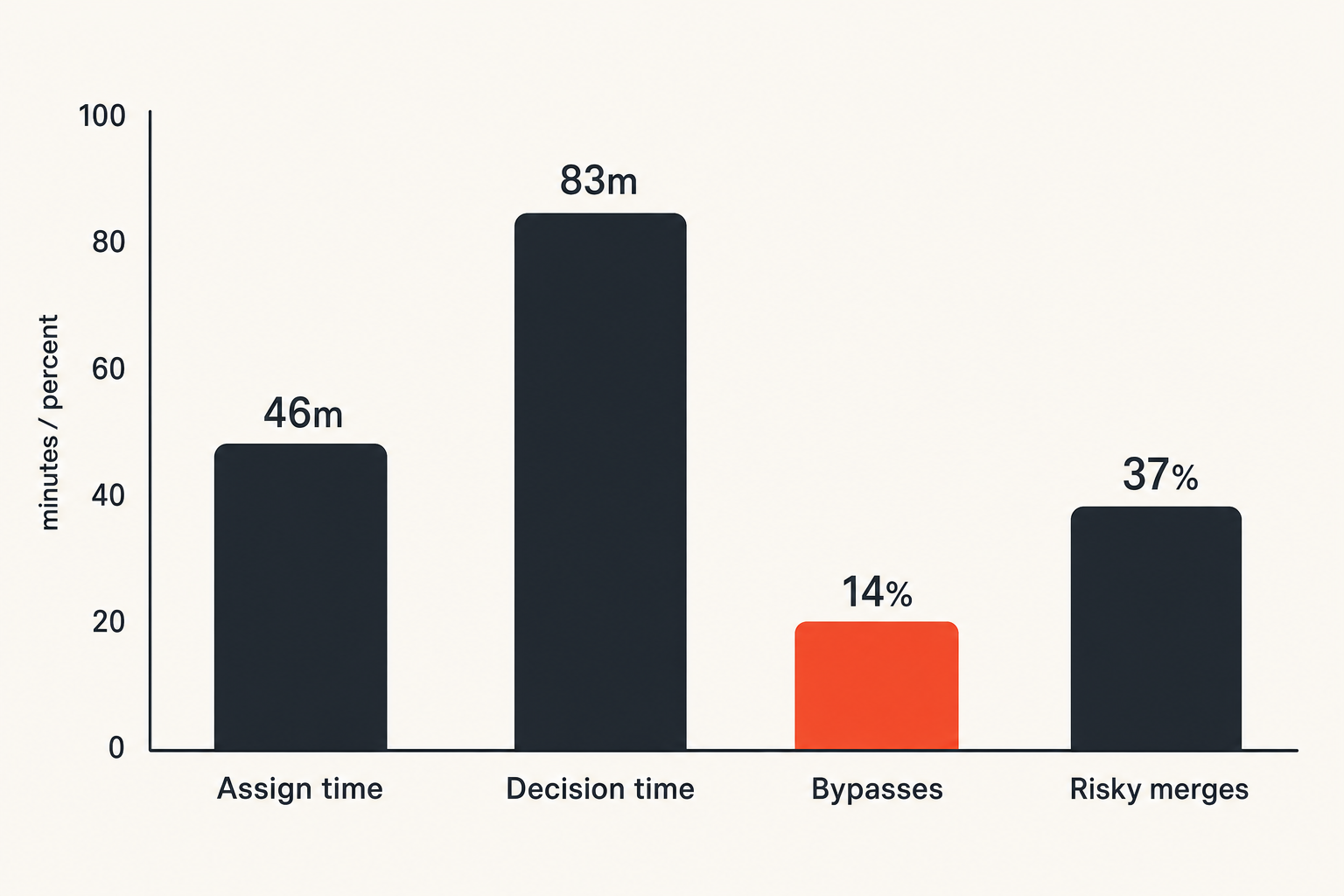
Scanner count is a vanity metric. A team with ten scanners and no response ownership is less protected than a team with three precise controls and a disciplined escalation path.
Metrics should tell you whether the security system reduces risky merges, shortens investigation time, and improves decision quality.
Measure investigation time not scanner count
Useful metrics include:
- Median time from finding to owner assignment.
- Median time from owner assignment to decision.
- Percentage of blocked findings resolved by code change versus override.
- Percentage of high-risk dependency additions reviewed before merge.
- Number of release-impacting workflow changes blocked pre-merge.
- Number of incidents where evidence was complete enough for reconstruction.
The practical question is whether an engineer can understand and resolve a finding quickly. If a finding requires reading six logs, three dashboards, and a Slack thread, the system is adding toil.
Track bypasses and exception debt
Bypasses are not failure by default. Some are legitimate. The failure is unmanaged exception debt.
Track:
- Who approved the bypass.
- Why the bypass was needed.
- Whether the bypass was temporary or permanent.
- When it expires.
- Whether the same team repeats the same bypass.
- Whether a policy should be changed because the rule is wrong.
Exception review is where security programs become honest. If 70 percent of a blocking rule is bypassed, either the rule is badly tuned or the organization has accepted a risk it has not named.
A mature system does not pretend exceptions do not exist. It makes them visible, owned, and expensive enough to discourage casual use.
Product fit for vu1nz.com
The right product for this architecture is not another dashboard that tells you your dependencies are imperfect. You already know that. The useful product sits near the pull request, inspects the change that is about to cross a trust boundary, and gives the team a decision they can act on.
Where vu1nz.com fits in the architecture
vu1nz.com is built for security engineers and DevSecOps teams defending CI/CD pipelines and software supply chains from modern attacks. Architecturally, it fits as a pipeline sensor and policy enforcement layer around GitHub Actions and dependency changes.
That means the product is most useful when you care about:
- Workflow security checks before risky YAML merges.
- Malware-oriented review of new npm, pip, cargo, gem, Go, or Composer packages added in a pull request.
- Catching package threats that do not yet have CVEs.
- Giving reviewers enough context to decide whether to block, approve, or investigate.
- Connecting proactive supply chain checks to the engineering workflow where the risky change enters.
The fit is strongest for teams that already use Dependabot, CodeQL, Snyk, or similar tools but still worry about malicious packages, CI token abuse, workflow privilege expansion, and release pipeline tampering. Those tools are useful. They are not the whole security system.
The simplisafe security system model is a reminder that the UI is not the system. The system is sensors, state, trust, ownership, and response. In CI/CD, that means pull request context, dependency behavior, workflow permissions, branch protections, release authority, and auditability.
Try vu1nz.com
vu1nz.com is for security engineers and DevSecOps teams who need to defend CI/CD pipelines and software supply chains from modern attacks. If you want the simplisafe security system idea applied at the pull request boundary, Try vu1nz.com.
Catch the next supply-chain attack on the PR that adds it.
14-day free trial · no card required