Security systems in CI/CD usually fail in a boring way. A team adds scanners, turns on alerts, writes a policy, and still misses the pull request that changes a workflow permission, adds a suspicious package, or exfiltrates a token during a build.
Teams think the problem is lack of tooling. The real problem is that the tooling is not wired into the workflow where risk is created, reviewed, merged, built, and deployed.
That changes the conversation. The practical question is not whether you own enough security products. It is whether your security systems can observe the right events, understand pipeline context, block dangerous changes before merge, and give engineers a fix path that does not require a week of security archaeology.
In 2026, CI/CD is no longer just automation around code. It is the control plane for releases, secrets, identities, packages, artifacts, and production access. If your security architecture treats it like a post-commit scanning target, it is already late.
Table of contents
- Why security systems fail in CI/CD
- Security systems as pipeline architecture
- Map the attack surface before buying tools
- The control plane: identity, permissions, and secrets
- The data plane: packages, artifacts, and provenance
- Detection that engineers will actually use
- Response workflows for bad pull requests
- What works and what fails in production
- Measure security systems by workflow outcomes
- Implementation sequence for CI/CD security systems
- Where vu1nz.com fits in CI/CD security systems
- Closing: security systems that survive contact with CI/CD
Why security systems fail in CI/CD
The tool stack is not the system
The mistake teams make is confusing a tool inventory with a security system. SAST, SCA, secret scanning, IaC scanning, artifact signing, branch protection, and runtime detection all matter. None of them automatically become a system because they are installed in the same organization.
A security system has flow. It has inputs, decisions, owners, and outputs. It knows which event matters. It distinguishes a transitive dependency already present for three years from a new package added in a pull request by a first-time contributor. It knows that a workflow permission change on a release repository is different from the same change in a sandbox.
In CI/CD, the system must sit where work happens. If findings live only in a dashboard that engineers do not check before merge, the system is advisory. Advisory controls are useful for audit, but weak for preventing supply-chain compromise.
Practical rule: A CI/CD security control is only preventive if it runs before the risky change becomes trusted code, trusted workflow, or trusted artifact.
The merge event is the control point
Most software supply-chain attacks exploit a gap between review and trust. A malicious package lands in a manifest. A GitHub Actions workflow changes permissions. A script starts curling a remote payload. A maintainer token is exposed to code that should never receive it.
The merge event is where a repository converts proposed change into trusted project state. That makes it the natural control point for security systems. You do not need to solve every security problem at merge, but you do need to stop treating merge as purely a developer productivity concern.
A useful way to think about it is simple: if the pull request changes who can execute code, what code can execute, what packages are trusted, or which secrets are reachable, it is a security event. Review tooling should reflect that.
Security systems as pipeline architecture
Assets, identities, and trust boundaries
CI/CD security starts with architecture, not product selection. You need to know what assets move through the pipeline and which identities can touch them.
Common assets include source code, workflow definitions, package lockfiles, build artifacts, deployment credentials, signing keys, container images, provenance attestations, and release tags. Common identities include human maintainers, bots, GitHub Apps, package registry tokens, cloud roles, OIDC trust relationships, and ephemeral build runners.
Trust boundaries are where the interesting failures happen. A forked pull request is not the same trust zone as a protected branch. A build job with no secrets is not the same as a release job that can publish to npm or deploy to Kubernetes. A reusable workflow pinned by branch is not the same as one pinned by digest or commit SHA.
The architecture work is to map these boundaries before you argue about scanners.
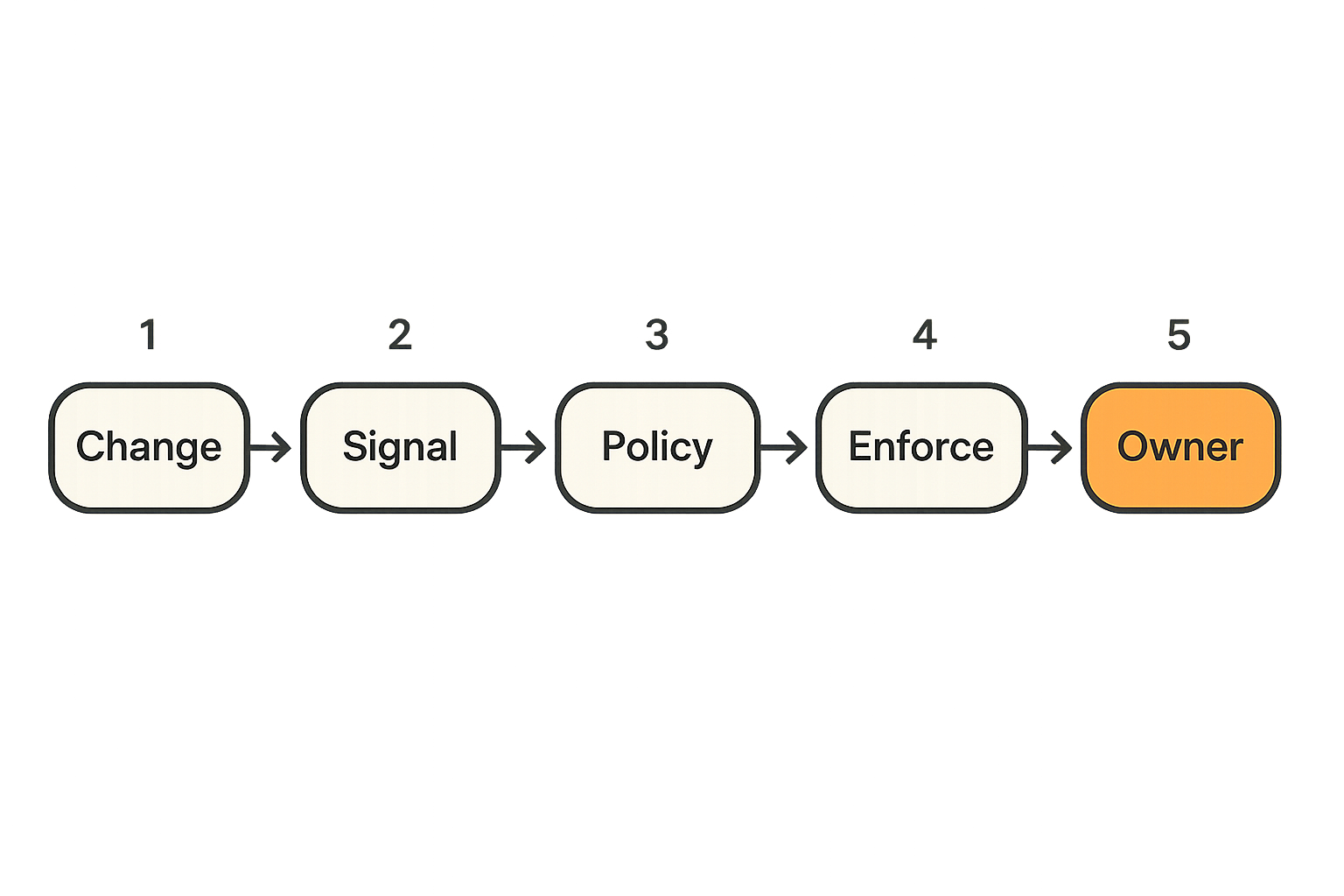
Signals, policy, and enforcement
A functional security system has three layers.
| Layer | Practical role | CI/CD example | Failure mode |
|---|---|---|---|
| Signal | Detect relevant change or behavior | New package added, workflow permission widened, script downloads remote code | Too much inventory noise |
| Policy | Decide if the signal matters in context | Block write permissions on pull requests from forks | Rules are generic and easy to bypass |
| Enforcement | Create a workflow consequence | Fail check, require owner review, quarantine artifact | Alert goes to dashboard nobody reads |
That changes the conversation. Instead of asking whether your organization has SCA, ask whether new dependency introduction is detected at review time, risk-ranked, linked to package metadata, and blocked when it violates policy.
Security systems should be boring in the best way: predictable controls at predictable pipeline boundaries.
Related reading from our network: teams thinking about operational security in messaging face a similar architecture problem where the product is not just encryption, but the workflow around devices, metadata, backups, and team behavior in end-to-end encrypted messaging privacy workflow.
Map the attack surface before buying tools
Workflow files are executable infrastructure
GitHub Actions, GitLab CI, CircleCI, Buildkite, Jenkins, and similar systems are not just configuration. They are executable infrastructure with access to privileged identities.
A small YAML change can grant broad repository write permissions, expose tokens to untrusted code, run on the wrong trigger, execute a third-party action, or publish an artifact that later becomes a release candidate. Many teams review workflow changes like formatting changes. Attackers do not.
Practical review questions:
- Did the workflow trigger change from a safe event to a privileged event?
- Did permissions move from read-only to write-capable?
- Does the job run untrusted code before secrets are available?
- Are third-party actions pinned to immutable commits?
- Does the workflow upload artifacts that another trusted workflow later consumes?
- Can a pull request modify scripts that a privileged job executes?
The answer should be computed, not guessed during review.
Package manifests are dependency admission requests
A package manifest change is not just dependency management. It is an admission request for external code into your build graph.
Dependabot and traditional SCA are useful for known vulnerable versions. They are less useful when the attack is new, the package has no CVE, the maintainer account was just compromised, or the malicious behavior is introduced in an install script. We covered this gap in more detail in what Dependabot misses in npm supply-chain attacks, but the architecture point is broader than npm.
Package risk needs to be evaluated when a new dependency is introduced or materially changed. That includes npm, pip, cargo, gem, Go modules, Composer packages, and any internal package registry where trust can be confused with proximity.
Practical rule: Treat every newly introduced package as code you did not write, running in an environment you may accidentally trust.
The control plane: identity, permissions, and secrets
Default permissions create hidden blast radius
Default permissions are where CI/CD security systems quietly rot. A repository starts small. A workflow gets added. A bot needs a token. A release process grows. Six months later, most jobs can read secrets, write contents, create releases, or comment on pull requests without anyone remembering why.
What breaks in practice is not usually one dramatic misconfiguration. It is permission accumulation. The build job that only needed checkout now has write access. The test job can reach cloud credentials. The workflow triggered by pull requests can run commands influenced by attacker-controlled files.
Good security systems continuously check for permission drift:
contents: writewhere read is enoughpull-requests: writein jobs that process untrusted inputid-token: writewithout strict cloud-side subject conditions- broad repository secrets exposed to jobs that do not deploy
- reusable workflows called without pinning or input validation
You can document least privilege once. You need automation to keep it true.
Secrets need execution context, not just storage
Secrets managers solve storage. They do not automatically solve execution context.
The practical question is: what code can run in the same job, runner, container, or shell session as the secret? If an attacker can modify a script that executes after secrets are injected, the storage system did its job and the pipeline still lost.
A safer pattern separates untrusted evaluation from privileged execution:
- Run tests, linting, package analysis, and workflow analysis with no deployment secrets.
- Persist only verified, minimal build outputs.
- Require protected branch state or manual approval before privileged jobs execute.
- Exchange OIDC tokens only under strict branch, repository, workflow, and environment conditions.
- Publish or deploy from a job that does not execute attacker-modifiable scripts from the pull request.
This is less convenient than one giant job. It is also the difference between a secret manager and an actual security system.
Related reading from our network: SOC teams have the same ownership issue when skills, tools, and response paths are disconnected; the workflow-first framing in cybersecurity certifications for SOC teams maps well to DevSecOps training and pipeline ownership.
The data plane: packages, artifacts, and provenance
A package diff is a supply-chain event
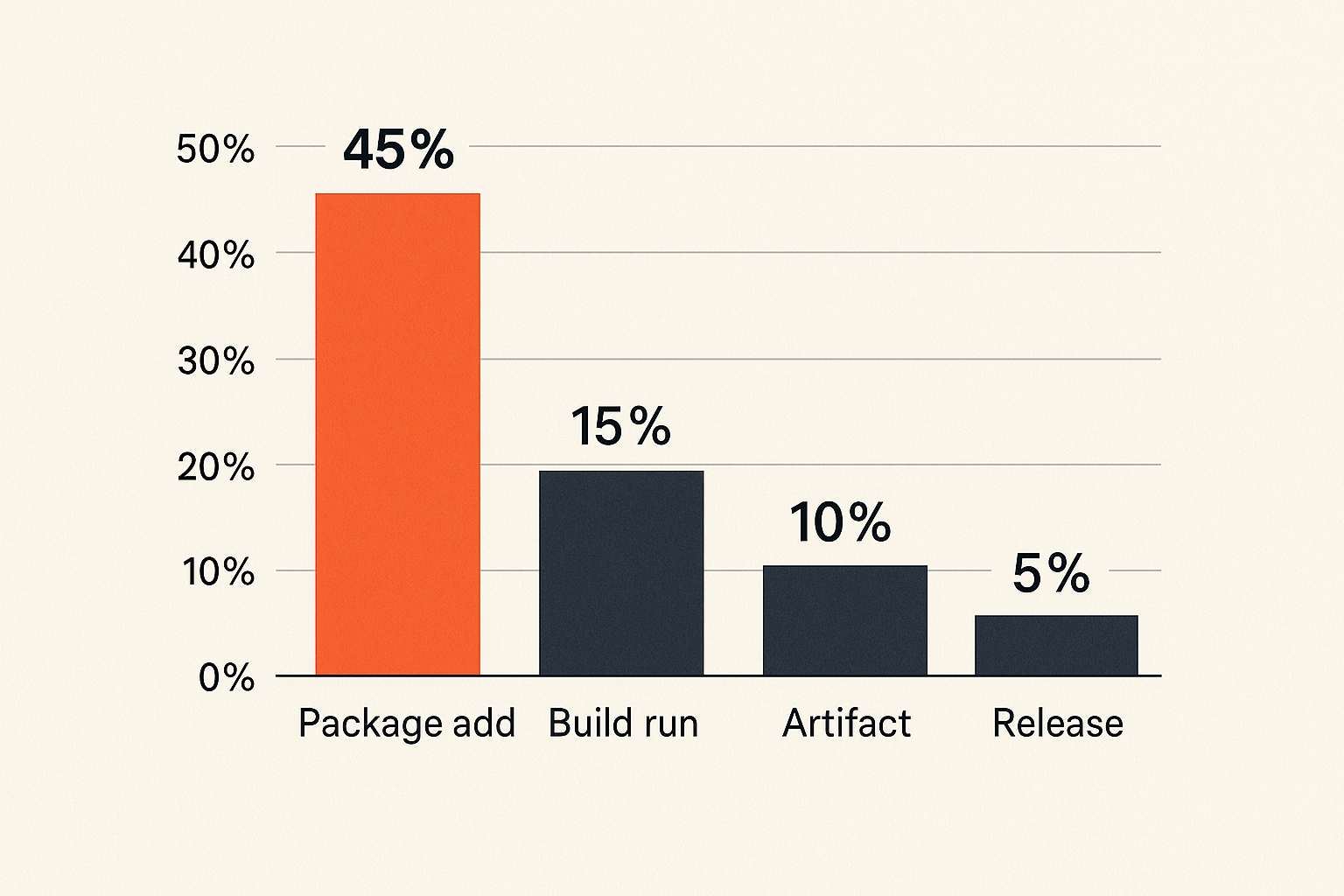
Many teams scan dependency inventories nightly. That is useful, but it is not enough. Inventory scanning tells you what you have. Pull request scanning tells you what you are about to trust.
The difference matters because supply-chain risk is time-sensitive. A malicious package can be published, merged, installed, and executed before a vulnerability database catches up. A dependency confusion issue can happen without a CVE. A typosquat can pass basic version checks. A compromised maintainer can ship hostile code through a familiar package name.
Your system should inspect package changes as events:
- new direct dependency
- new transitive dependency with install behavior
- registry source change
- lockfile change without manifest explanation
- package with low history, suspicious maintainer activity, or unexpected scripts
- dependency replacing a standard library function or common internal package name
The goal is not to ban all new packages. The goal is to make dependency admission explicit.
Artifacts need a chain of custody
Artifacts are where build systems become production risk. A container image, binary, tarball, SBOM, or release archive should carry enough context to answer basic questions later:
- Which commit produced it?
- Which workflow produced it?
- Which runner executed the build?
- Which dependencies were present?
- Which checks passed before publication?
- Was the artifact modified after build?
Provenance and signing help, but only if the upstream pipeline is trustworthy. Signing a compromised artifact proves that your compromised process produced it. That is not nothing, but it is not the outcome teams imagine when they say they have supply-chain security.
Practical rule: Artifact trust depends on the trustworthiness of the workflow that produced it, not just the signature attached to it.
Detection that engineers will actually use
Reduce noise by detecting change, not inventory
Engineers ignore noisy security systems because they have real delivery work. Security teams sometimes interpret that as culture failure. Often, it is signal failure.
A nightly list of every vulnerable dependency across every repository is useful for backlog planning. It is bad as a merge-blocking control. A pull request check that says this PR adds a new package with an install script and no meaningful project history is much more actionable.
High-value CI/CD detections are usually change-oriented:
- workflow permission widened
- privileged trigger introduced
- third-party action changed or unpinned
- shell command added to release path
- new package added to manifest
- lockfile changed unexpectedly
- artifact upload path modified
- deployment environment changed
Change detection gives reviewers context. It also reduces the emotional cost of enforcement. Blocking a risky diff is easier to defend than blocking a repository because it contains old technical debt.
Make findings reviewable inside the pull request
Findings need to appear where the decision is being made. For most teams, that is the pull request.
A good PR finding should include:
- what changed
- why it matters
- what exploit path it enables
- whether it blocks merge or requests review
- the smallest safe fix
- who should approve the exception if needed
Long scanner output is not the same thing. Engineers need a review artifact, not a forensic report. Security researchers may want raw evidence, and they should have access to it, but the merge decision needs a compact explanation.
For GitHub Actions specifically, a drop-in workflow can be the most practical way to put checks at the right boundary; the vu1nz GitHub Action is designed around PR-time CI/CD workflow checks and package scanning rather than another disconnected dashboard.
Response workflows for bad pull requests
Triage should answer who owns the fix
Detection without ownership creates alert compost. It piles up, decomposes, and eventually produces a dashboard nobody wants to open.
For CI/CD and supply-chain findings, ownership is usually one of four groups:
| Finding type | Likely owner | Security role | Engineering fix |
|---|---|---|---|
| Workflow permission risk | Platform or repo maintainer | Define safe permission pattern | Narrow permissions or split job |
| Suspicious package | App team | Validate risk and policy | Remove, replace, or pin dependency |
| Secret exposure path | DevOps or cloud owner | Confirm blast radius | Move secret to protected job |
| Artifact custody gap | Release engineering | Define provenance requirement | Sign, attest, or rebuild from trusted path |
A useful response workflow routes by fix ownership, not just severity. Severity says how bad it is. Ownership says who can make it stop.
Containment starts before merge
In runtime security, containment often means isolating a host or revoking a credential. In CI/CD, containment can be earlier and cheaper.
Before merge, containment actions include:
- Fail the required check.
- Add a security review label.
- Require CODEOWNERS review for workflow or release path changes.
- Block artifact publication from the untrusted branch.
- Prevent secrets from being injected into the job.
- Ask for package justification or replacement.
After merge, the same issue becomes incident response. You may need to rotate tokens, inspect build logs, rebuild artifacts, invalidate releases, or search for package execution across runners.
The cost difference is the reason security systems should operate at pull request time.
What works and what fails in production
What works
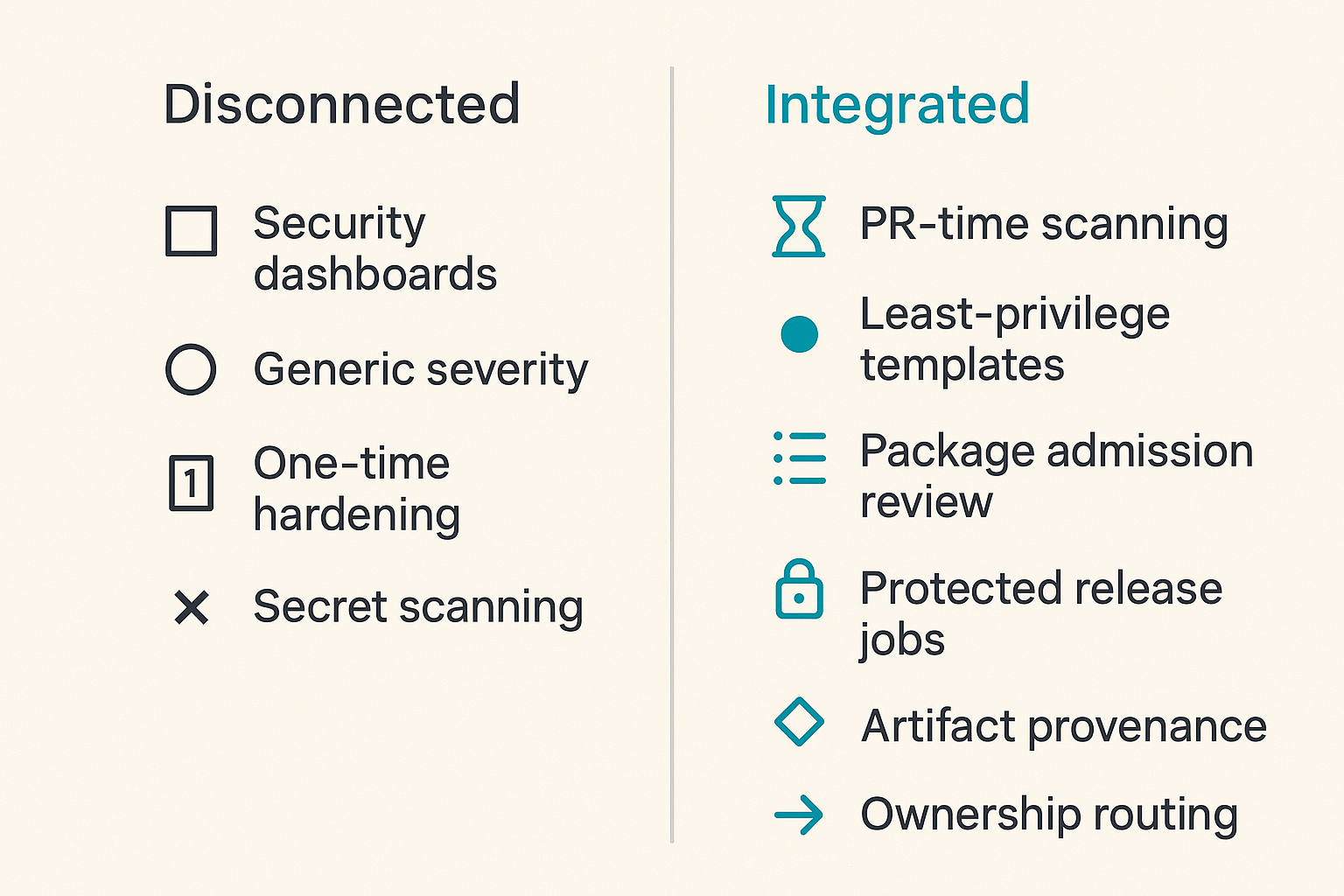
What works is boring, explicit, and close to the developer workflow.
| Approach | Why it works | Implementation detail |
|---|---|---|
| PR-time scanning | Catches risk before trust changes | Run on every pull request that changes workflows or manifests |
| Least-privilege templates | Reduces permission drift | Provide reusable workflow patterns with locked permissions |
| Package admission review | Treats dependencies as external code | Require justification for new direct dependencies |
| Protected release jobs | Separates untrusted tests from privileged publishing | Deploy only from protected branches or environments |
| Artifact provenance | Gives investigation context | Attach commit, workflow, runner, and dependency metadata |
| Ownership routing | Speeds remediation | Map finding class to repo, platform, or release owner |
The pattern is consistent: detect the risky change, explain it in context, and route it to someone who can fix it before merge.
What fails
What fails is also predictable.
Security dashboards fail when they are not tied to merge decisions. Generic severity fails when it ignores pipeline context. One-time hardening projects fail when workflows keep changing. Secret scanning fails when the secret never appears in source but is exposed at runtime to attacker-controlled commands.
The worst failure mode is performative control: a check exists, appears in audit evidence, but does not block the exploit path. For example, a team may require dependency scanning while allowing lockfile-only changes to pass without review. Or it may sign artifacts while letting pull requests modify the build script that produces the signed release.
A scanner can be correct and still operationally useless if the system around it is wrong.
Related reading from our network: AI and automation teams run into similar contract problems when terms like standards, schemas, and protocols are not treated as architecture decisions; synonyms of standards for AI agent architecture is adjacent reading for teams designing reusable security interfaces.
Measure security systems by workflow outcomes
Useful metrics for DevSecOps teams
The metrics that matter are the ones that show whether the system changes outcomes.
Useful metrics include:
- percentage of workflow changes reviewed by required owners
- number of new package introductions blocked or escalated
- median time from PR finding to fix
- number of privileged jobs with explicit minimal permissions
- percentage of release artifacts with provenance attached
- number of secrets reachable from untrusted execution paths
- exception count by repository and age
These are not vanity metrics. They reveal whether risk is being reduced at the point of change.
A practical dashboard should separate backlog hygiene from merge protection. Old vulnerabilities are a remediation program. New risky changes are an admission-control problem. Mixing them creates bad prioritization.
Metrics that create bad incentives
Avoid metrics that reward teams for hiding risk or suppressing alerts.
Bad incentives include:
- counting total findings closed without tracking exploitability
- rewarding low alert volume without measuring coverage
- measuring scanner adoption without measuring enforcement
- treating all repositories as equal risk
- counting signed artifacts without validating build trust
- measuring dependency freshness without evaluating package behavior
The mistake teams make is optimizing for a cleaner dashboard rather than a safer pipeline. A clean dashboard is nice. A blocked malicious workflow change is better.
Implementation sequence for CI/CD security systems
Start with one repository class
Do not start by boiling the ocean. Pick one repository class where CI/CD compromise would matter: release repositories, package publishing repositories, deployment automation, infrastructure modules, or core libraries consumed by many services.
Then build a working control loop.
- Inventory workflow files, package manifests, secrets, environments, and release jobs.
- Classify trust boundaries: fork PR, internal branch, protected branch, release tag, deployment environment.
- Define risky change types: workflow permissions, privileged triggers, new packages, artifact path changes, deployment script changes.
- Add PR-time checks for those risky changes.
- Route findings to CODEOWNERS or platform owners.
- Require documented exceptions with expiration dates.
- Review bypasses monthly and convert repeated exceptions into better templates.
This sequence is not glamorous. It works because it turns security systems into a repeatable operating model.
Codify controls as reusable pipeline components
Once the control loop works, codify it. Reusable workflows, organization rulesets, branch protections, package policies, and review templates are how you scale without asking every repo owner to become a CI/CD security expert.
A minimal GitHub Actions permission baseline might look like this:
permissions:
  contents: read
  pull-requests: read

jobs:
  test:
    runs-on: ubuntu-latest
    steps:
      - uses: actions/checkout@v4
      - run: npm ci
      - run: npm test
Privileged jobs should be explicit and isolated:
permissions:
  contents: read
  id-token: write

environment: production
The point is not that these snippets are universal. The point is that privilege should be visible, reviewable, and rare.
Where vu1nz.com fits in CI/CD security systems
Use it at the pull request boundary
vu1nz.com fits best where CI/CD risk is introduced: the pull request. The site is built for security engineers and DevSecOps teams who need to defend pipelines and software supply chains from attacks that do not wait for a CVE.
The product approach is intentionally narrow: scan workflow security patterns and newly added packages before they merge. That makes it a component in a larger security system, not a replacement for every control you already run.
If you want the broader research context, the vu1nz blog publishes technical writeups on GitHub Actions security, package ecosystems, and practical testing guidance.
Pair scanner output with ownership
The scanner should not be the owner. It should produce evidence that your workflow can route.
A practical integration model looks like this:
- run checks on pull requests
- fail or warn based on repository risk tier
- require platform review for workflow control-plane changes
- require app owner review for dependency admission
- log exceptions with an expiration date
- feed repeated findings into reusable templates and education
This is the part many teams skip. They install detection and assume behavior will change. Behavior changes when detection has a consequence and the fix path is clear.
Closing: security systems that survive contact with CI/CD
The operating model to keep
Security systems for CI/CD are not defined by how many scanners you own. They are defined by whether risky changes are caught before merge, understood in context, assigned to the right owner, and either fixed or explicitly accepted.
The practical model is straightforward:
- treat workflow files as executable infrastructure
- treat package additions as dependency admission requests
- treat artifacts as custody objects
- treat secrets as execution-context problems
- treat pull requests as the primary control boundary
- treat exceptions as temporary design debt
That is the difference between security tooling and security systems. One produces findings. The other changes what can safely become trusted software.
If your 2026 roadmap includes supply-chain defense, start with the pipeline. It is where code becomes release, where dependencies become trusted, and where security systems either work or become another dashboard.
Try vu1nz.com
vu1nz.com is for security engineers and DevSecOps teams who need to defend CI/CD pipelines and software supply chains from modern attacks. Try vu1nz.com.
Catch the next supply-chain attack on the PR that adds it.
14-day free trial · no card required