A security service sounds like something you buy, turn on, and route alerts into Slack. That is how teams end up with another dashboard nobody owns.
In CI/CD and software supply chain security, the pain is more specific. A pull request adds a new dependency. A workflow gets a broader token. A release job starts running unpinned third-party actions. The build still passes, the merge button is still green, and the risk moves forward with the code.
Teams think the problem is choosing a security service. The real problem is deciding where security has authority inside the delivery workflow.
That changes the conversation. A useful security service is not a badge, a scanner, or a PDF. It is an operating boundary: what it observes, what it decides, what it blocks, who owns exceptions, and how it proves the pipeline got safer without slowing every release.
Table of contents
- A security service is an operating boundary, not a badge
- Where a security service sits in the CI/CD path
- What the security service must observe before it can protect you
- The workflow for evaluating a security service
- What works in production
- What fails when teams implement a security service badly
- Build, buy, or compose the security service
- Metrics that prove the security service is helping
- Product fit for vu1nz.com
- Implementation checklist for 2026
- Closing: make the security service part of delivery
A security service is an operating boundary, not a badge
Security service is a broad term, which is exactly why it gets misused. In software delivery, the useful question is not whether a vendor calls itself managed, automated, AI-powered, or continuous. The useful question is whether the service can influence the moment risk enters the system.
Teams think they are buying coverage
The mistake teams make is treating coverage as a spreadsheet problem. They list SAST, SCA, secret scanning, container scanning, IaC scanning, cloud posture, and runtime detection. Then they map tools to boxes.
That can be useful for procurement. It is not enough for defense.
A CI/CD attacker does not care that the organization has seven security tools. They care whether a malicious package can land in package-lock.json. They care whether a GitHub Actions workflow can run pull_request_target with write permissions. They care whether a maintainer can approve a risky change because the check that noticed it is advisory.
Coverage without enforcement is documentation.
The real boundary is where delivery can be stopped
A security service becomes meaningful when it has a defined boundary. For CI/CD and supply chain security, common boundaries are:
- Pull request checks before merge.
- Required status checks on protected branches.
- Release job approval gates.
- Package allowlists or deny rules.
- Workflow policy enforcement.
- Artifact signing and provenance checks.
- Runtime detection tied back to repository changes.
The boundary does not always need to block. Sometimes it warns, opens an issue, requests review, or routes to an owner. But the action must be explicit.
Practical rule: If a security service cannot change the state of a risky change, it is monitoring, not control.
Treat findings as state transitions
A finding is not the end product. It is an input to a state machine.
A dependency risk might move through states like detected, triaged, allowed temporarily, fixed, or escalated. A workflow risk might move through detected, blocked, reviewed by platform security, merged with exception, or rejected. The service should preserve those states so teams can learn from them.
This sounds operational because it is. Supply chain security fails when findings are treated as messages instead of workflow objects.
Where a security service sits in the CI/CD path
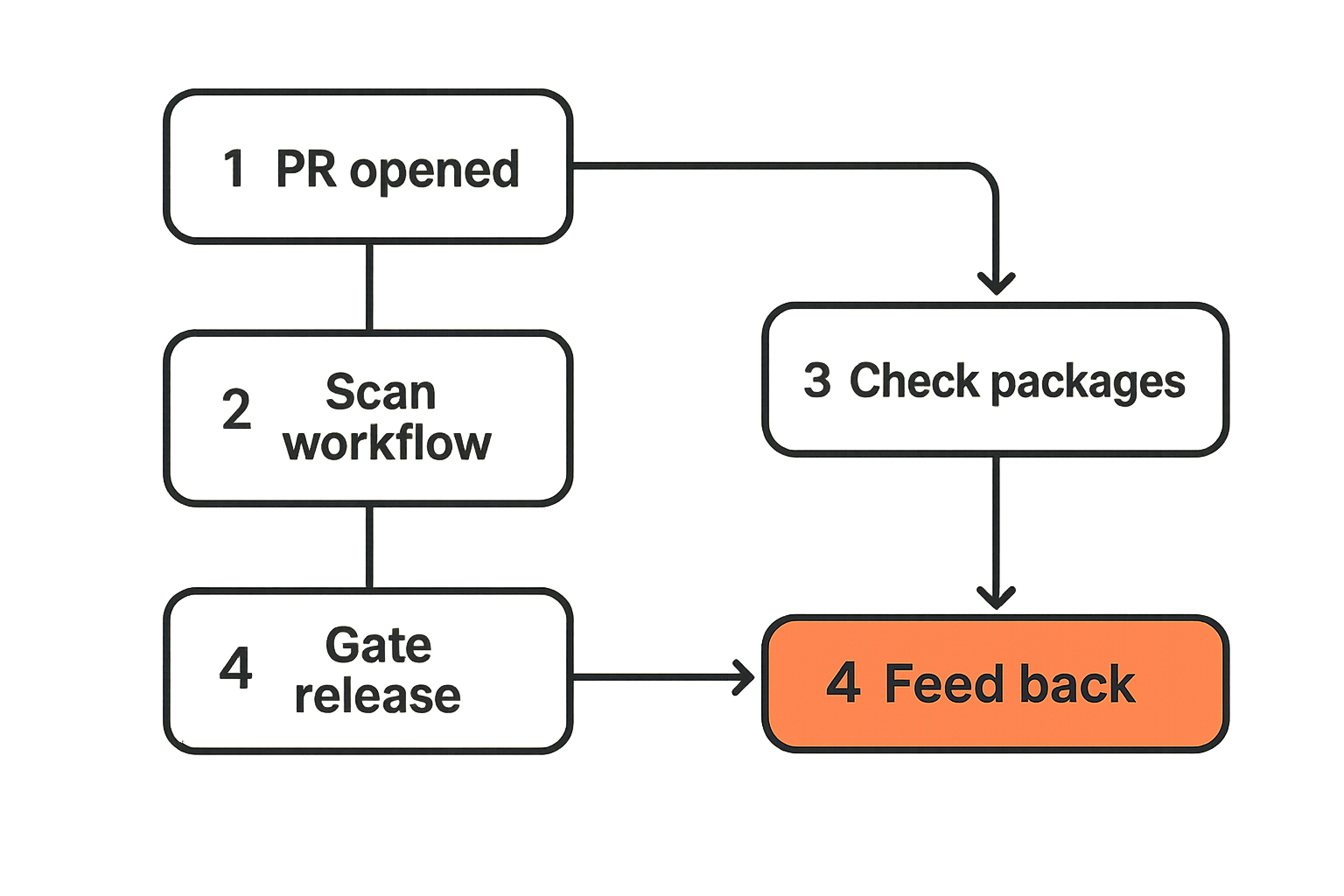
The best place for a security service is usually where risk is introduced, not where it is easiest to report. For modern teams, that is often the pull request and the workflow execution layer.
Pre-merge is where supply chain risk is cheapest
Pre-merge checks have one major advantage: the developer still has context. They remember why a package was added, why a workflow changed, and what release pressure exists.
A pre-merge security service should inspect:
- New or modified CI/CD workflow files.
- New packages introduced by a PR.
- Lockfile changes.
- Permission changes in automation tokens.
- Use of unpinned actions or scripts fetched at build time.
- Secrets exposure patterns.
- Build steps that execute code from dependency lifecycle hooks.
This is why teams using GitHub Actions should think about security controls as part of branch protection, not as a separate weekly report. The vu1nz GitHub Action is built for that kind of placement: it runs in the PR path, where a risky workflow or dependency change can still be stopped.
Runtime signals still matter
Pre-merge does not see everything. A package can change behavior after install. A release artifact can be tampered with later. A cloud credential can be abused outside the repository.
Runtime security still matters, but it should feed back into delivery. If a production detection shows suspicious package behavior, the security service should help answer:
- Which repository introduced the package?
- Which PR added it?
- Which workflow built the artifact?
- Which token or secret was available during the build?
- Which owners approved the change?
Related reading from our network: Cloud Computing Security Operations: A Practical SOC Architecture for 2026 covers the adjacent SOC side of telemetry, ownership, and response when cloud runtime signals need to connect back to engineering workflows.
Post-incident feedback must change the pipeline
The practical question is what changes after a near miss. If the answer is only a wiki update, the security service is not learning.
Post-incident lessons should become controls:
- A blocked workflow pattern.
- A package risk rule.
- A tighter token permission default.
- A required review by platform security.
- A new test fixture in the scanner.
Security research is only useful operationally when it becomes a repeatable check.
What the security service must observe before it can protect you
A service cannot protect what it cannot see. In CI/CD, the important context is not just source code. It is the execution environment around the code.
Workflow files are executable infrastructure
GitHub Actions workflows, GitLab CI files, CircleCI configs, and similar pipeline definitions are not documentation. They are executable infrastructure with access to credentials, source code, artifacts, deployment targets, and package registries.
A security service should parse workflow behavior, not just search for suspicious strings. It should understand:
- Trigger types such as pull_request, pull_request_target, workflow_run, and schedule.
- Permission scopes granted to GITHUB_TOKEN or equivalent tokens.
- Third-party actions and whether they are pinned to immutable commits.
- Shell commands that fetch and execute remote content.
- Environment access and secret exposure.
- Artifact upload and download boundaries.
What breaks in practice is that workflow files are reviewed like config, while attackers treat them like code.
Dependency diffs are more useful than dependency inventories
A full dependency inventory is helpful for audit and incident response. But for prevention, the diff matters more.
When a PR adds one npm package and changes 900 transitive entries, the security service should focus on the new trust decision. Who is the maintainer? Is the package new? Does it run install scripts? Does it include obfuscated code? Does it unexpectedly access network, filesystem, shell, or credentials?
Known CVE scanning is necessary but incomplete. We wrote about this problem in What Dependabot Misses: many supply chain attacks do not have a CVE when they first hit production, so the pre-merge question must include behavior and provenance, not just vulnerability IDs.
Identity and permissions decide blast radius
A mediocre workflow bug with read-only permissions is annoying. The same bug with write tokens, package publish rights, or cloud deploy credentials becomes an incident.
The service should connect findings to identity:
- What token exists in this job?
- Can the job write to the repository?
- Can it publish packages?
- Can it deploy infrastructure?
- Can it read secrets from protected environments?
- Is the job triggered by untrusted input?
Practical rule: Severity in CI/CD is not only about the bug. It is about the bug plus the token plus the trigger.
The workflow for evaluating a security service
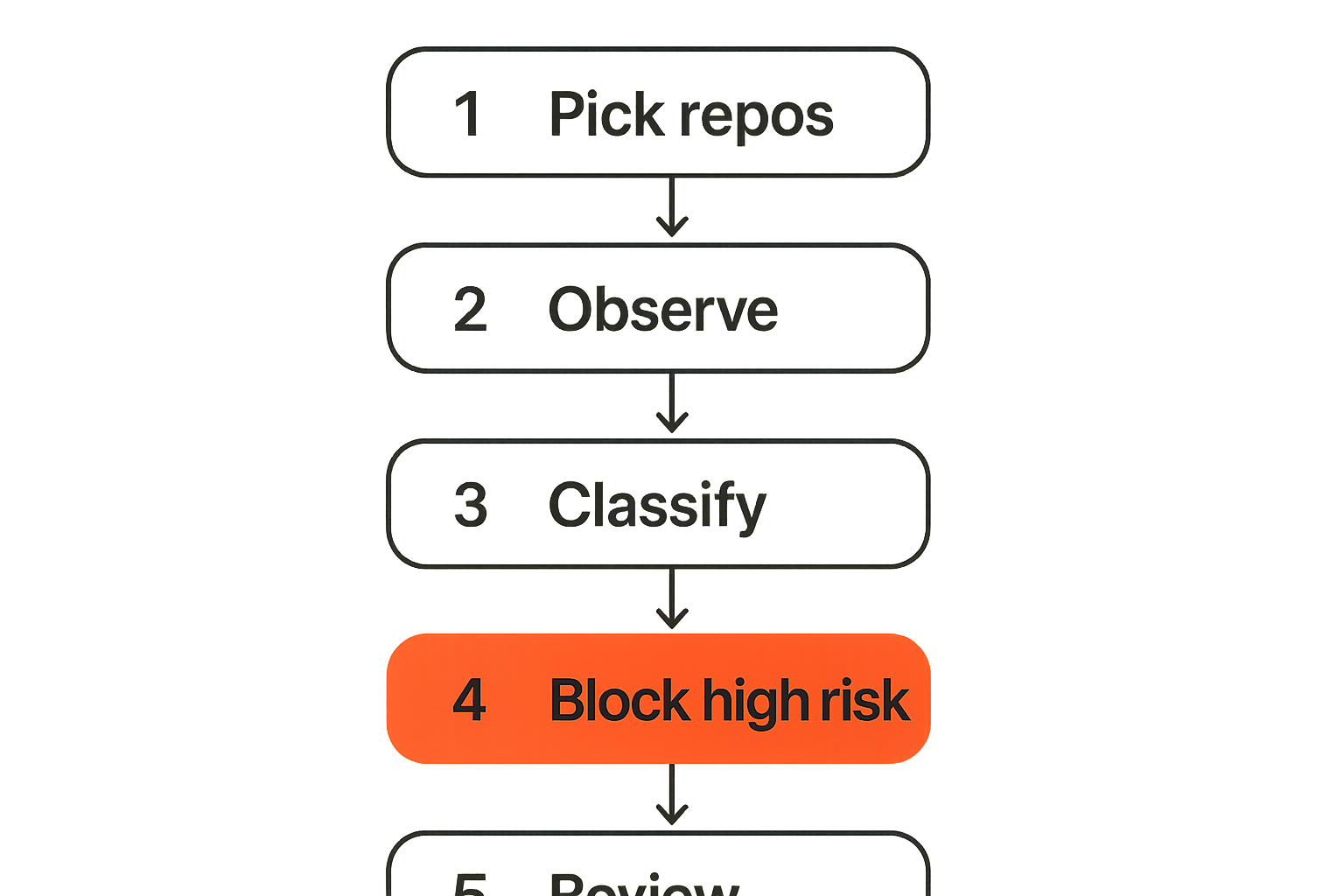
Most evaluations fail because teams ask for feature demos instead of operational proof. The goal is not to see the prettiest dashboard. The goal is to answer whether the service changes delivery behavior without causing constant bypasses.
Start with decisions, not features
Before looking at tools, write down the decisions you need the service to support.
Examples:
- Should this PR be allowed to merge?
- Should this workflow require security review?
- Should this new package be blocked, warned, or allowed?
- Should this release artifact be promoted?
- Should this exception expire automatically?
- Should this incident create a new pipeline rule?
Now map features to decisions. A feature that does not support a decision may still be useful, but it should not drive the architecture.
Run the service on real pull requests
Synthetic demos miss the hard parts: noisy lockfiles, monorepos, generated code, flaky workflows, internal packages, and developers who need to ship.
A practical evaluation sequence looks like this:
- Pick three repositories: one critical service, one noisy legacy repo, and one active application.
- Run the security service in non-blocking mode for one week.
- Classify every finding as block, warn, ignore, or needs policy.
- Turn on blocking only for the highest-confidence classes.
- Require owners for exceptions.
- Review bypasses and false positives after two release cycles.
- Expand to more repositories only after the first set is stable.
This sequence prevents the classic failure mode where a team enables every check at once, breaks delivery, and then disables the service under pressure.
Related reading from our network: CI/CD Security Product Launch: How to Ship Fast Without Turning Your Pipeline Into the Risk is useful for teams that need to introduce pipeline controls while a product launch is already in motion.
Measure ownership before measuring volume
Finding count is a weak metric. Ownership is stronger.
Ask:
- Does each finding have a repository owner?
- Does each blocked class have a documented remediation path?
- Can developers see why a check failed without opening a separate console?
- Can security approve an exception without editing pipeline code manually?
- Are repeated exceptions converted into policy work?
A service that generates 40 findings with clear owners is better than a service that generates 400 alerts routed to a shared channel.
What works in production
The teams that get value from a security service usually keep the design narrower than vendors recommend. They start with controls that are easy to explain and hard to argue with.
Small gates with clear severity rules
Do not block every warning. Block the classes where the organization has low tolerance and high confidence.
Good initial block candidates include:
- Unpinned third-party actions in privileged workflows.
- pull_request_target workflows that run untrusted code.
- Newly added packages with obvious malware indicators.
- Workflows granting write-all permissions without justification.
- Secrets exposed to jobs triggered by untrusted forks.
Warnings can cover lower-confidence behavior, such as unusual package metadata, new maintainers, suspicious install scripts, or workflow complexity.
Practical rule: Start by blocking the risks you can explain in one sentence to the developer who just opened the PR.
Inline context for developers
Developers do not need a compliance paragraph. They need the failing line, the risk, and the fix.
Bad message:
- Policy violation: workflow security issue detected.
Better message:
- This job uses pull_request_target and checks out code from the fork before running npm install. That lets untrusted code run with repository token privileges. Use pull_request, move privileged work to a separate workflow, or require maintainer approval before executing fork code.
Inline context reduces back-and-forth. It also teaches the organization what the service is protecting.
Exceptions with expiry dates
Exceptions are not a failure. Permanent exceptions are.
A usable exception process should include:
| Exception field | Why it matters | Bad version | Good version |
|---|---|---|---|
| Owner | Someone must defend the risk | security-team | platform-security-alice |
| Scope | Avoid global bypasses | ignore this check | ignore workflow release.yml only |
| Reason | Preserve context | needed for launch | vendor action not yet pinned |
| Expiry | Force review | none | expires in 14 days |
| Compensating control | Reduce blast radius | none | environment approval required |
The difference between mature and immature programs is not whether exceptions exist. It is whether exceptions decay.
What fails when teams implement a security service badly
A poorly implemented security service can make the organization less secure. It creates alert fatigue, encourages bypasses, and teaches developers that security checks are arbitrary.
Alert routing without decision rights
Routing every finding into Slack is not ownership. It is notification.
If nobody can approve, reject, suppress, or convert the finding into a rule, the alert becomes background noise. The service needs decision rights aligned with repository ownership and platform security.
A useful routing model looks like this:
- Repository owner handles application dependency risk.
- Platform security handles workflow permission and runner risk.
- AppSec handles code-level exploitability questions.
- Incident response handles active compromise indicators.
- Engineering leadership handles repeated unresolved exceptions.
The mistake teams make is making security responsible for every finding but giving developers all the delivery authority. That mismatch guarantees friction.
Scanning everything but blocking nothing
Some teams scan every repository, every branch, every dependency, and every artifact. Then they make all checks informational because they fear breaking builds.
This creates the appearance of maturity without operational leverage.
A smaller set of required checks on protected branches is usually more valuable than broad advisory scanning. If a control is accurate enough to trust, put it where it can matter. If it is not accurate enough to trust, tune it before scaling it.
Ignoring package behavior until after release
Package supply chain attacks often abuse the gap between dependency management and execution. A package can look harmless by name, version, or CVE status, then execute install scripts, fetch remote payloads, read environment variables, or modify build artifacts.
A security service that only checks whether a package has a known vulnerability will miss a large class of live supply chain risk.
What works better is layered package analysis:
- Diff newly introduced direct dependencies.
- Inspect install scripts and postinstall behavior.
- Flag obfuscation and suspicious payload patterns.
- Check maintainer and release anomalies.
- Compare package behavior with expected ecosystem norms.
- Treat build-time execution as privileged code.
This is not about paranoia. It is about recognizing that package installation happens inside trusted automation.
Build, buy, or compose the security service
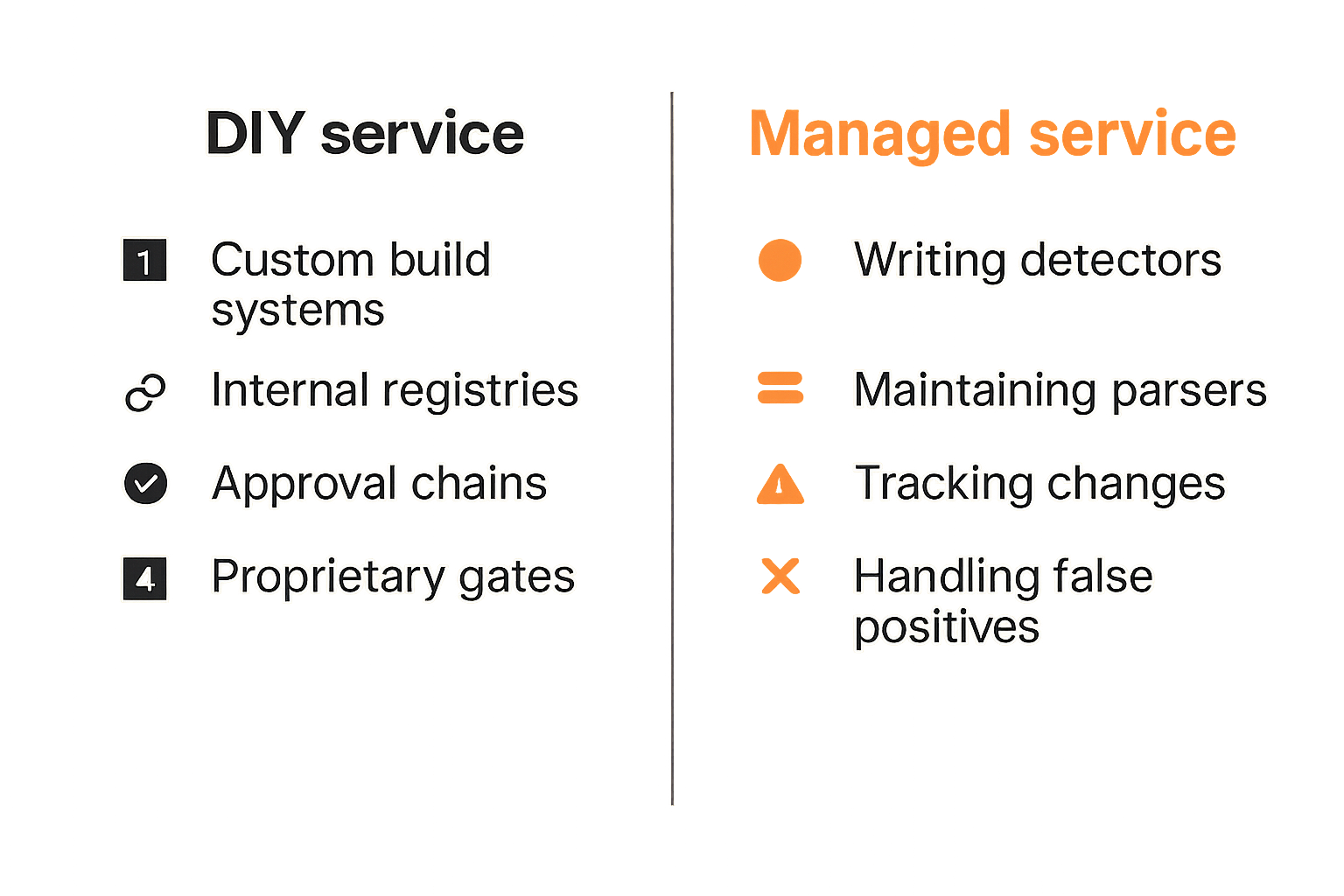
There is no universal answer. The practical question is where your team has unique risk, where you have operational maturity, and where maintenance will quietly consume the program.
Build when the risk model is unique
Build internal controls when your environment has constraints a vendor will not understand quickly:
- Custom build systems.
- Internal package registries with unusual trust rules.
- Regulated release approval chains.
- Proprietary artifact signing or deployment gates.
- Highly specialized attacker models.
Internal services can be excellent when a platform security team owns them like production systems. That means tests, documentation, support, on-call expectations, and depreciation plans.
If the service is a script owned by one engineer, be honest. That is not a platform control yet.
Buy when maintenance is the hidden cost
Buying makes sense when the problem is common, fast-moving, and expensive to track manually. CI/CD misconfigurations, malicious package patterns, third-party action risks, and ecosystem-specific package behavior all change frequently.
The comparison is not vendor cost versus zero. It is vendor cost versus:
- Writing detectors.
- Maintaining parser coverage.
- Tracking ecosystem changes.
- Handling false positives.
- Updating policy logic.
- Integrating with developer workflows.
- Supporting teams when checks fail.
Related reading from our network: Cloud Computing Software: A Practical Buying and Workflow Guide for SaaS Teams discusses similar workflow-first buying tradeoffs, even though the category is broader than security tooling.
Compose when ownership is mature
Many strong teams compose services: one tool for workflow scanning, another for secrets, another for package behavior, another for artifact provenance, and internal policy glue around all of it.
This can work if there is a clear control plane. Without one, composed tooling becomes fragmented tooling.
| Approach | Works when | Fails when | Operator note |
|---|---|---|---|
| Build | Risk model is unique and platform team can maintain it | One engineer owns a pile of scripts | Treat it like production software |
| Buy | Problem is common and changing quickly | Vendor cannot sit in the PR path | Evaluate workflow fit, not screenshots |
| Compose | Security engineering has mature ownership | Findings scatter across tools | Create one policy and exception layer |
A useful way to think about it is this: buy detection you cannot maintain, build policy that is specific to your business, and compose only when you can own the seams.
Metrics that prove the security service is helping
Security metrics often drift into theater. For CI/CD defense, the best metrics are close to workflow outcomes.
Track lead indicators in pull requests
Useful lead indicators include:
- Percentage of protected repositories with required security checks.
- Number of high-confidence blocks per month.
- Median time to remediate blocked PRs.
- Exception count by team and policy.
- Expired exceptions still active.
- New dependency risk by ecosystem.
- Workflow permission reductions over time.
These metrics show whether risk is being intercepted before merge.
Separate noise from actionable risk
Do not celebrate alert volume. Track action quality.
A simple classification model helps:
| Finding class | Expected action | Metric to watch |
|---|---|---|
| Blocked true positive | Fix before merge | Remediation time |
| Warned true positive | Fix or accept risk | Conversion to policy |
| False positive | Tune detector | Repeat false-positive rate |
| Accepted exception | Review before expiry | Expired exception count |
| Duplicate | Suppress or correlate | Duplicate rate |
If false positives rise, developers will route around the service. If warnings never become policies, the service is only producing commentary.
Use incidents to tune controls
Every incident or near miss should ask pipeline questions:
- Could this have been detected pre-merge?
- Was the risky change visible in a PR?
- Did a workflow permission make impact worse?
- Did a dependency install step execute unexpected code?
- Did an exception hide the signal?
- Should a new required check exist?
This is how reactive work improves proactive control. Without that loop, the same class of issue returns under a different package name or workflow file.
Product fit for vu1nz.com
A security service should be judged by fit. vu1nz.com is not trying to replace your SOC, your entire AppSec program, or your incident response process. Its fit is narrower and more useful: pre-merge CI/CD and package supply chain risk.
The fit is pre-merge CI/CD and package risk
For teams using GitHub Actions and modern package ecosystems, the risky moment is often a small diff. A workflow changes. A package appears. A permission becomes broader. A lockfile shifts. A third-party action is introduced.
vu1nz is designed around that moment. The public writeup Ship Safer with vu1nz GitHub Actions explains the practical model: automated CI/CD workflow checks plus package scanning in the pull request path.
That is the right level for many DevSecOps teams because it catches risk while the author, reviewer, and CI context are still connected.
Where it should sit in your workflow
A common starting configuration is straightforward:
name: supply-chain-security
on:
  pull_request:
    branches: [main]
permissions:
  contents: read
  pull-requests: write
jobs:
  scan:
    runs-on: ubuntu-latest
    steps:
      - uses: actions/checkout@v4
      - name: Run vu1nz scan
        uses: vu1nz/action@v1
        with:
          fail-on: high
          scan-packages: true
          scan-workflows: true
Treat that as the start, not the finish. The important part is deciding which findings fail the build, which findings warn, and who owns exceptions.
What not to outsource
Do not outsource your risk appetite. A service can detect a dangerous pattern, but your organization decides whether a release can wait, whether a vendor package is acceptable, and whether a temporary exception is justified.
Keep these responsibilities internal:
- Branch protection strategy.
- Which repositories are critical.
- Which teams can approve exceptions.
- Which package ecosystems are allowed.
- Which deployment environments require extra review.
- How incident lessons become policy.
The service should make those decisions enforceable. It should not hide them behind vendor defaults.
Implementation checklist for 2026
This is the minimum practical checklist for adding or rebuilding a security service around CI/CD and supply chain defense in 2026.
Baseline the current delivery path
Before adding controls, map the path:
- Where does code enter?
- Which branches are protected?
- Which checks are required?
- Which workflows run on untrusted pull requests?
- Which jobs receive secrets?
- Which jobs can write to the repository?
- Which jobs publish packages or deploy infrastructure?
- Which package managers and lockfiles are in use?
You cannot secure the pipeline if you do not know where trust changes.
Add controls in the order attackers use them
A practical rollout order:
- Protect default branches and require status checks.
- Review workflow triggers and token permissions.
- Block high-risk workflow patterns.
- Scan newly added dependencies and lockfile changes.
- Add secret exposure checks in CI context.
- Require approval for privileged release jobs.
- Add artifact provenance and signing where release risk justifies it.
- Feed incident learnings back into pre-merge policy.
This order is not glamorous, but it follows the attack path. Attackers look for execution, credentials, package trust, and release authority.
Keep the service boring
Boring is good. Boring means developers know what will happen. Boring means exceptions expire. Boring means the same risky pattern fails the same way across repositories.
The service should have:
- Documented severity rules.
- Clear remediation messages.
- Required checks only where confidence is high.
- A visible exception process.
- Versioned policy changes.
- Ownership mapped to teams.
- Regular review of false positives and bypasses.
Practical rule: A security service that developers can predict is easier to enforce than one that surprises them with clever detections.
Closing: make the security service part of delivery
The security service that matters is the one that changes what happens before risky code, packages, workflows, and credentials move into production.
The practical test
Ask five questions:
- Does the service see the risky change when it is introduced?
- Can it act before merge or release?
- Does the finding have an owner?
- Can exceptions expire?
- Do incidents create better future controls?
If the answer is no, you do not have a delivery security service. You have another source of security output.
The practical goal is not more alerts. It is a tighter delivery path where CI/CD risk is visible, package trust is reviewed, and the organization knows exactly who can accept risk when the pipeline objects.
Try vu1nz.com
vu1nz.com is for security engineers and DevSecOps teams who need to defend CI/CD pipelines and software supply chains from modern attacks. Try vu1nz.com and put the security service where supply chain risk enters: the pull request.
Catch the next supply-chain attack on the PR that adds it.
14-day free trial · no card required