A security license looks boring until it is sitting inside a CI job that runs on every pull request.
Then it becomes a credential. It decides which scanners run, which repositories get coverage, which findings block a merge, and which contributors can trigger paid or privileged analysis. If that license key leaks into logs, forked PRs, cached build artifacts, or a self-hosted runner, your licensing problem has turned into a security incident.
Teams think the problem is buying the right security license. The real problem is designing the workflow around it.
That changes the conversation. A license is not just an invoice line or a portal setting. In 2026 CI/CD environments, it is part of the control plane for software supply-chain defense. The practical question is whether your license model helps enforce the merge boundary, or quietly creates another secret that attackers can reach.
Table of contents
- Why a security license is a CI/CD architecture problem
- Map the security license boundary before you scan
- Designing a security license workflow for pull requests
- Reference architecture for license-aware scanning
- Policy-as-code for security license enforcement
- Dependency license checks are not supply-chain security
- Secrets, forks, and runner isolation
- Implementation workflow for DevSecOps teams
- Metrics that show your security license is working
- Common failure modes
- Where vu1nz.com fits
Why a security license is a CI/CD architecture problem
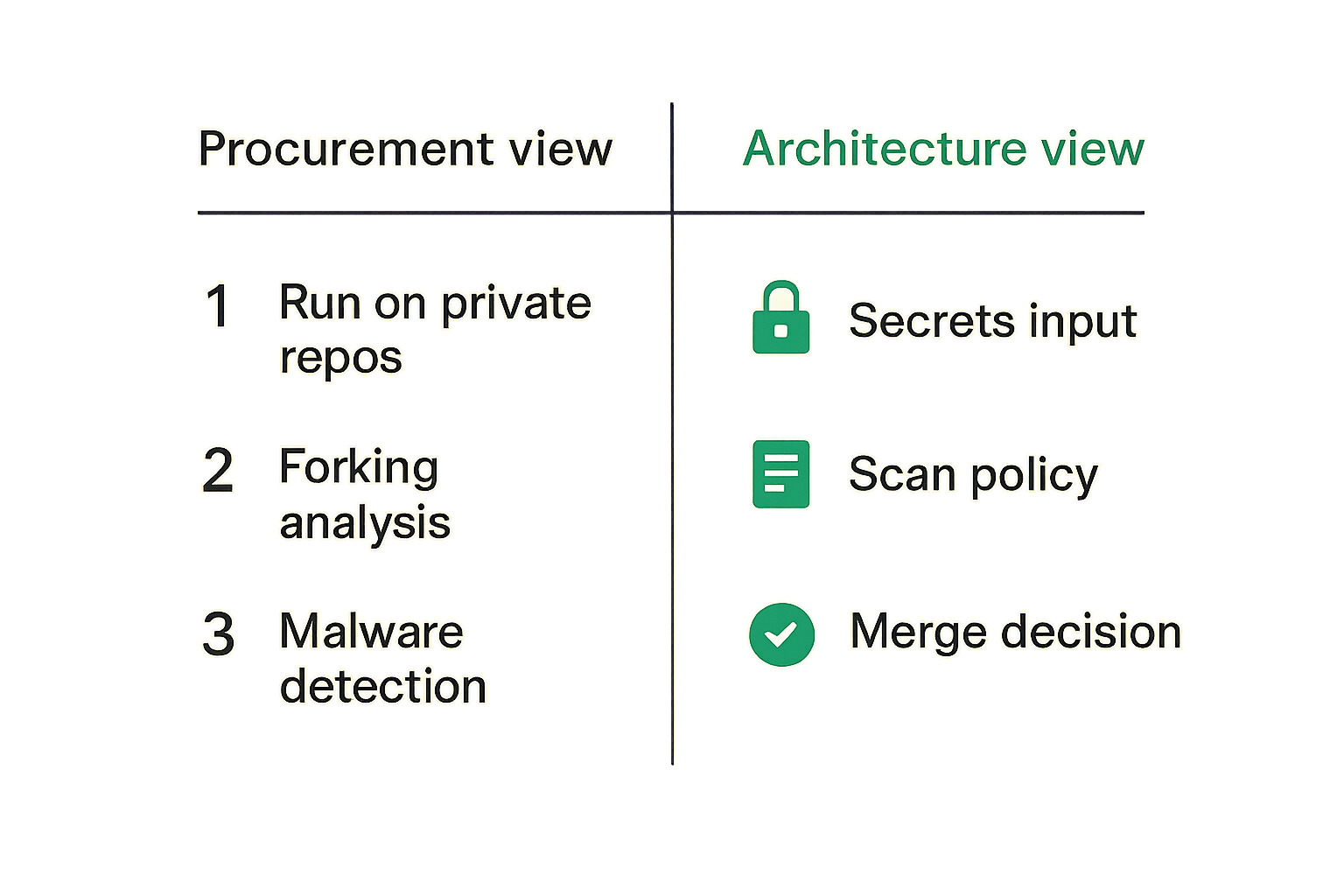
The procurement view misses the attack surface
The mistake teams make is treating a security license as something procurement owns until renewal time. That works for desktop software. It does not work for scanners embedded in CI/CD.
In a modern pipeline, a license can influence:
- whether scans run on private repositories
- whether forked pull requests are allowed to trigger analysis
- whether malware detection is enabled or skipped
- whether findings are informational or merge-blocking
- whether API calls are rate-limited, retried, or dropped
- whether logs contain sensitive entitlement details
That means the license is not isolated from security architecture. It touches secrets management, GitHub Actions permissions, repository ownership, package review, developer experience, and incident response.
A useful way to think about it is simple: if losing the value would let an attacker run privileged analysis, bypass controls, impersonate your organization, or drain paid quota, it belongs in your credential threat model.
Practical rule: if a security license is required to scan code before merge, design it like a production secret with policy attached, not like a billing token.
The license becomes a policy input
The security license also changes enforcement. Many tools expose different capabilities by plan, license key, repository scope, or organization entitlement. That is normal commercially, but it has architectural consequences.
If one repo has deep package malware scanning and another only runs known-CVE checks, you do not have one security posture. You have tiers of visibility. That can be fine, but it needs to be explicit.
The hard part is not whether paid features exist. The hard part is whether developers, security engineers, and release owners understand which controls are active for a given change.
For example, a pull request adding a new npm package should not silently skip behavioral package analysis because the repo is outside the licensed org scope. The check should say what happened:
- scan executed and passed
- scan executed and failed
- scan skipped by policy
- scan unavailable due to entitlement
- scan unavailable due to service failure
Those are different states. Treating all of them as green is how teams build false confidence.
What changes in 2026
CI/CD systems have become the practical merge point for security decisions. Developers add dependencies, change workflows, introduce tokens, update build scripts, and modify deployment paths in pull requests. Attackers know this.
Security tooling has also moved closer to the PR. That is good, but it means license failures now affect engineering flow. A license outage can block merges. A mis-scoped license can create blind spots. A leaked license key can expose org metadata or allow unauthorized usage.
Related reading from our network: teams buying remote access tools face a similar architecture trap where the UI looks like the product, but the workflow and ownership model decide the security outcome in this remote access software workflow guide.
The point is not to overcomplicate licensing. The point is to stop pretending licensing is separate from runtime control.
Map the security license boundary before you scan
Define what the license can authorize
Before installing another scanner, write down what the security license actually grants. Not the marketing description. The operational permissions.
A useful inventory looks like this:
| License capability | Security question | Bad default |
|---|---|---|
| Organization access | Which repos are covered? | Assume all repos are covered |
| Feature access | Which detections are active? | Hide disabled checks |
| API quota | What happens under load? | Fail open without audit |
| User seats | Who can view findings? | Share accounts or tokens |
| CI execution | Which events can consume license? | Let forks trigger paid scans |
| Reporting | What metadata leaves CI? | Upload secrets or full artifacts |
This table should live near your CI/CD security design, not only in a procurement folder.
What breaks in practice is ambiguity. Security believes a scanner is enabled across the org. Platform engineering installed it in a subset of repos. Developers assume green checks mean all policies ran. No one notices until a malicious package or workflow change lands in the gap.
Separate entitlement from execution
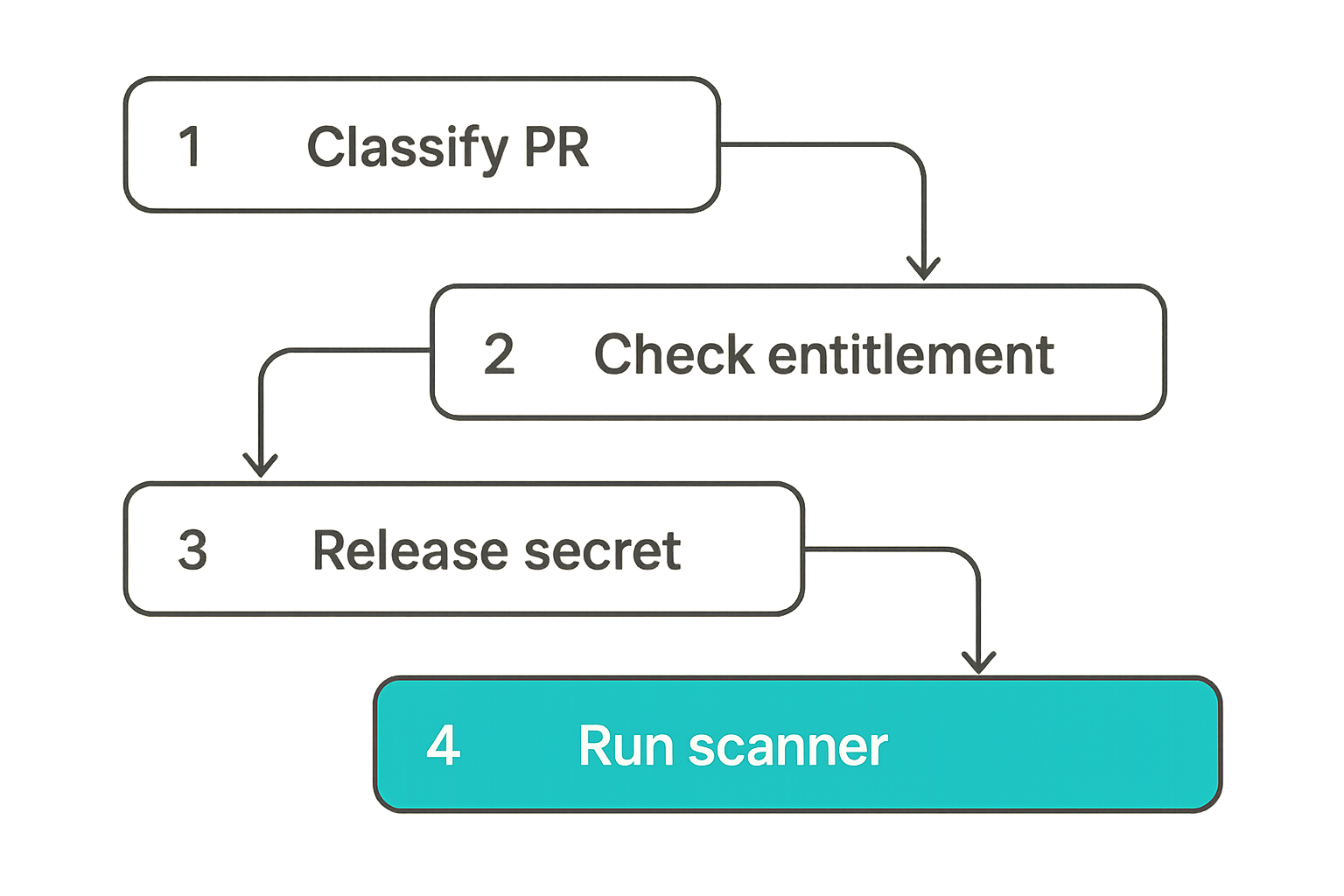
Entitlement answers whether the organization is allowed to use a feature. Execution answers whether a specific job should run that feature on a specific event.
Do not collapse those into one decision.
A license may allow scanning every private repository. That does not mean every event should receive the same secret. A push to a protected branch, an internal pull request, a forked pull request, a scheduled scan, and a release job have different trust levels.
The design should look more like this:
- Entitlement is checked against org, repo, plan, and feature.
- Event policy is checked against actor, branch, fork status, file changes, and permissions.
- CI secrets are released only when both checks pass.
- Scan output is normalized into clear status states.
Practical rule: entitlement should say what you paid for; execution policy should say what is safe to run right now.
Treat license keys like production credentials
A security license key may not deploy infrastructure, but it can still be abused. It can burn quota, expose account details, unlock proprietary analysis, or let attackers probe your scanning behavior.
Store it in the same class of system you use for production secrets:
- GitHub organization secrets or environment secrets with scoped access
- cloud secret managers for self-hosted runners
- short-lived tokens when the vendor supports them
- repository allowlists for sensitive credentials
- automated rotation procedures
Avoid passing a raw license through shell scripts where it can be echoed, included in crash output, or captured by debug mode. Disable command tracing around license use. Be careful with third-party composite actions that receive environment variables by default.
Designing a security license workflow for pull requests
Start with the event model
Pull requests are not one thing. The security properties differ depending on where the code came from and what event triggered the job.
For GitHub Actions, teams commonly confuse these cases:
pull_requestfrom a branch in the same repopull_requestfrom a forkpull_request_targetrunning in the base repository contextpushto a protected branchworkflow_dispatchby an authorized user- scheduled scans
The mistake teams make is choosing the event that makes the scanner work, then retrofitting security later. pull_request_target is especially dangerous when used casually because it can expose base repository privileges while evaluating attacker-controlled changes if the workflow checks out the wrong code.
A safer pattern is to run untrusted analysis with limited permissions and reserve license-backed privileged scanning for trusted contexts or carefully constrained paths.
Gate by change type, not repository habit
Every repository has habits. Some teams scan everything. Some scan only main. Some skip docs repos. Habits drift.
Change type is more reliable. A pull request that modifies package manifests, lockfiles, CI workflows, deployment scripts, or build tooling deserves more scrutiny than a CSS-only change. That is true even in a low-risk repo.
Security license consumption should reflect that. If scanning is metered or expensive, use path-aware triggers before reducing coverage blindly.
Example trigger logic:
on:
  pull_request:
    paths:
      - package.json
      - package-lock.json
      - pyproject.toml
      - requirements*.txt
      - Cargo.toml
      - Cargo.lock
      - .github/workflows/**
      - scripts/**
This does not replace full scanning. It gives you a baseline for high-signal checks where licensing, runtime, or quota matter.
Make failure states explicit
A security check that cannot run should not pretend it passed. This is where many teams accidentally fail open.
Define status behavior before rollout:
| State | Meaning | Merge behavior |
|---|---|---|
| Passed | Scan ran and no blocking issue found | Allow |
| Failed | Blocking issue found | Block |
| Soft failed | Scanner unavailable, retry exhausted | Warn or block by repo tier |
| Skipped by policy | Event or path did not require scan | Allow with annotation |
| Skipped by entitlement | License does not cover repo or feature | Block for protected repos |
The key is visibility. Developers can work with clear failure modes. They cannot work with mysterious red checks or fake green checks.
Reference architecture for license-aware scanning
Control plane responsibilities
The control plane owns decisions. It should know which repositories exist, which ones are covered, which features are enabled, and which policies apply.
For a security license, the control plane should answer:
- Is this organization entitled to use the scanner?
- Is this repository in scope?
- Which scan modules are enabled?
- Is this PR event trusted enough to receive credentials?
- What severity or confidence level blocks merge?
- Where should findings and audit logs be written?
This does not have to be a huge platform. For many teams it is a combination of GitHub organization settings, reusable workflows, repository topics, policy files, and a vendor API.
The important point is ownership. If every repository implements licensing differently, the control plane does not exist. You have copy-pasted secrets with hope.
Data plane responsibilities
The data plane does the work. It checks out code, inspects manifests, analyzes workflow files, calls scanner APIs, uploads findings, and reports status.
Keep it boring:
- minimal permissions
- no write token unless required
- no broad secret injection
- no privileged self-hosted runner for untrusted code
- deterministic output
- structured artifacts with redaction
- retry behavior with idempotency where the scanner API supports it
The scanner should not need to understand your entire company. It should receive enough context to make the current decision and no more.
Related reading from our network: privacy systems run into the same split between surface UI and operational metadata, as covered in this end-to-end encrypted messaging workflow.
Minimal GitHub Actions pattern
A practical GitHub Actions implementation should separate detection of risk from use of the licensed scanner.
name: supply-chain-security

on:
  pull_request:
    branches: [main]

permissions:
  contents: read
  pull-requests: read
  checks: write

jobs:
  classify:
    runs-on: ubuntu-latest
    outputs:
      needs_scan: ${{ steps.diff.outputs.needs_scan }}
    steps:
      - uses: actions/checkout@v4
        with:
          fetch-depth: 2
      - id: diff
        run: |
          changed=$(git diff --name-only HEAD~1 HEAD)
          echo "$changed" | grep -E '(^package-lock.json$|^requirements|^Cargo.lock$|^.github/workflows/)' \
            && echo 'needs_scan=true' >> $GITHUB_OUTPUT \
            || echo 'needs_scan=false' >> $GITHUB_OUTPUT

  licensed-scan:
    needs: classify
    if: needs.classify.outputs.needs_scan == 'true' && github.event.pull_request.head.repo.full_name == github.repository
    runs-on: ubuntu-latest
    steps:
      - uses: actions/checkout@v4
      - name: Run licensed scanner
        env:
          SECURITY_LICENSE_KEY: ${{ secrets.SECURITY_LICENSE_KEY }}
        run: |
          set +x
          ./scanner --license-env SECURITY_LICENSE_KEY --format sarif
This is only a sketch. The important properties are visible: classify first, restrict fork access, scope permissions, avoid command tracing, and keep license use in one step.
For teams that want a drop-in scanner instead of maintaining every check themselves, the vu1nz GitHub Action is built around PR-time CI/CD and package supply-chain checks, including workflow security issues and newly added dependencies.
Policy-as-code for security license enforcement
Express policy in terms developers can debug
Policy-as-code fails when it reads like a legal contract or a vendor entitlement file. Developers need to know why a merge is blocked and what to change.
Bad message:
- License policy violation: module unavailable.
Better message:
- This PR adds a new npm package, but package malware scanning is not enabled for this repository. Protected repositories require this scan before merge. Ask the repo owner to attach the org security license or remove the dependency change.
That message tells the developer:
- what triggered the policy
- what control is missing
- why the repo is blocked
- who can fix it
- what workaround is acceptable
Use tiers without hiding risk
Not every repository needs identical enforcement. A public demo repo, internal build tool, production service, and deployment automation repo have different risk profiles.
Tiers are useful if they are explicit:
| Repo tier | Example | Required behavior |
|---|---|---|
| Tier 0 | Deployment workflows, release tooling | Block on scanner unavailable or failed |
| Tier 1 | Production services | Block on malicious package or CI/CD critical |
| Tier 2 | Internal tools | Warn on unavailable, block on confirmed critical |
| Tier 3 | Experiments | Scan best effort, no secret exposure |
What fails is using tiers as an excuse to ignore unknown risk. A Tier 3 repo can still publish a package, leak a token, or become a dependency of a production service later.
Practical rule: repository tiers should change enforcement behavior, not erase telemetry.
Keep exceptions small and dated
Exceptions are necessary. Permanent exceptions are usually abandoned risk.
Every exception should include:
- repository
- policy being bypassed
- reason
- approver
- expiration date
- compensating control
- ticket or audit reference
Example policy fragment:
exceptions:
  - repo: payments/reports-worker
    policy: package-malware-scan-required
    reason: scanner false positive on internal package namespace
    approver: appsec-oncall
    expires: 2026-08-15
    compensating_control: manual package review by release owner
If the security license does not cover a repository, do not hide that fact as an exception unless someone has accepted the risk.
Dependency license checks are not supply-chain security
Legal license risk and malicious package risk differ
The phrase security license creates confusion because teams also talk about open source licenses. SPDX identifiers, GPL obligations, attribution, and commercial use restrictions matter. They are not the same as malicious package detection.
A dependency can have a permissive MIT license and still steal tokens during install. Another package can have a restrictive legal license and no malicious behavior. Those are different review paths.
A healthy pipeline separates at least three concerns:
- legal license compliance
- known vulnerability detection
- malicious package and supply-chain behavior detection
Known CVE tools are useful, but they do not cover every attack path. We have written about this gap before in What Dependabot Misses, where the issue is not whether CVE matching works, but whether the package had a known advisory at the moment it entered the build.
Where scanners overlap
Some scanners report all three categories in one interface. That can be convenient, but the workflow should still distinguish the decision.
| Finding type | Typical source | Primary owner | Merge decision |
|---|---|---|---|
| Legal license issue | SPDX or package metadata | Legal, engineering manager | Depends on policy |
| Known vulnerability | CVE, advisory, version range | AppSec, service owner | Severity and exploitability |
| Malicious package signal | Static behavior, install scripts, reputation, diff | AppSec, DevSecOps | Usually block or quarantine |
| CI/CD workflow weakness | Workflow YAML, permissions, actions usage | Platform, DevSecOps | Block for critical paths |
The mistake teams make is collapsing all of this into a single pass or fail. That creates noise and bad incentives. Developers start ignoring the scanner because a license attribution warning feels the same as a credential exfiltration finding.
What works and what fails
What works:
- separate policy categories
- clear severity mapping
- blocking only on risks that are actionable and material
- annotations that point to the changed file
- security review for new packages in sensitive services
- audit logs for skipped scans
What fails:
- blocking every legal license warning as a critical security issue
- letting malicious package checks fail open because the license tier is wrong
- hiding disabled premium features from developers
- treating lockfile churn as low risk without package diffing
- relying only on advisory databases for fresh supply-chain attacks
Related reading from our network: when incidents do happen, SOC teams need an operational response path rather than heroics, and this piece on critical incident stress debriefing for SOC teams is a useful adjacent reminder that tooling failures become people problems fast.
Secrets, forks, and runner isolation
Forked pull requests are hostile by default
Forked PRs are useful for open source. They are also untrusted code execution requests.
Do not expose a paid security license key to arbitrary forked PR code. Even if the key cannot modify production, it may unlock vendor APIs, consume quota, expose scan behavior, or reveal metadata about private policy.
Common safer patterns:
- run unauthenticated lightweight checks on forks
- require maintainer approval before privileged scans
- use vendor-supported token exchange instead of static keys
- scan the merge commit only after review for high-risk changes
- avoid
pull_request_targetunless the workflow is tightly constrained
If you maintain open source projects, document this clearly. Contributors should know why some checks run only after maintainer review.
Self-hosted runners need separate trust zones
Self-hosted runners are often where the worst licensing shortcuts happen. A team installs a scanner, exports a license key globally, and lets many repositories use the runner. That is convenient. It is also a broad credential exposure path.
Separate runners by trust zone:
- public untrusted PRs
- internal PRs
- protected branch builds
- release jobs
- production deployment jobs
Do not let untrusted code run on the same persistent machine that holds long-lived scanner credentials. Container isolation helps, but it does not fix a sloppy trust model by itself.
Do not print entitlement metadata
Debug output is underrated as a leak source. Scanner logs often include organization IDs, plan names, feature flags, API endpoints, repository lists, or token validation responses.
Redact aggressively:
- license keys
- token prefixes
- account IDs when not needed
- private package names
- internal repository names in public logs
- URLs containing signed parameters
The practical question is not whether each value is a secret in isolation. It is whether the collection helps an attacker map your controls.
Implementation workflow for DevSecOps teams
Step sequence
Use a sequence, not a big-bang rollout.
- Inventory every security scanner running in CI/CD and identify which ones require a license, token, or entitlement.
- Map each license to repositories, features, API scopes, quotas, and owners.
- Classify CI events by trust level: forked PR, internal PR, protected branch, release, scheduled job.
- Define which events may receive license-backed credentials.
- Move license keys into organization or environment-level secret storage with repository allowlists.
- Create a reusable workflow that handles classification, scan execution, redaction, and status reporting.
- Add policy-as-code for repo tiers, blocking behavior, and exceptions.
- Test failure modes: expired license, invalid token, scanner outage, quota exhaustion, forked PR, and malicious log output.
- Roll out to high-risk repositories first, especially deployment workflows and package-publishing repos.
- Review telemetry weekly until skipped scans and soft failures are understood.
This workflow turns licensing into an engineering control. That is the point.
Rollout plan
Start where the blast radius is highest:
- repositories that publish packages
- repositories with deployment workflows
- services with production credentials in CI
- monorepos with many dependency changes
- internal tooling that has broad cloud permissions
Do not begin with the easiest repo just to show adoption. Begin where a license misconfiguration would matter.
A practical rollout plan:
| Phase | Scope | Goal |
|---|---|---|
| Pilot | 3 to 5 high-risk repos | Validate event model and secret handling |
| Expand | All Tier 0 and Tier 1 repos | Enforce blocking policy |
| Normalize | Shared reusable workflow | Remove custom scanner glue |
| Audit | All repos | Identify gaps, stale exceptions, skipped scans |
Operational owner
Someone must own the security license in production. Not just the contract. The workflow.
Usually this is a shared responsibility:
- AppSec owns policy and risk thresholds.
- Platform owns reusable workflow mechanics.
- Repository owners own remediation.
- Procurement owns renewal and vendor relationship.
- Security operations owns incident response if keys leak.
Write this down. License expiry should not surprise the release team on a Friday. Scanner quota exhaustion should not be discovered by a developer trying to merge a hotfix.
Metrics that show your security license is working
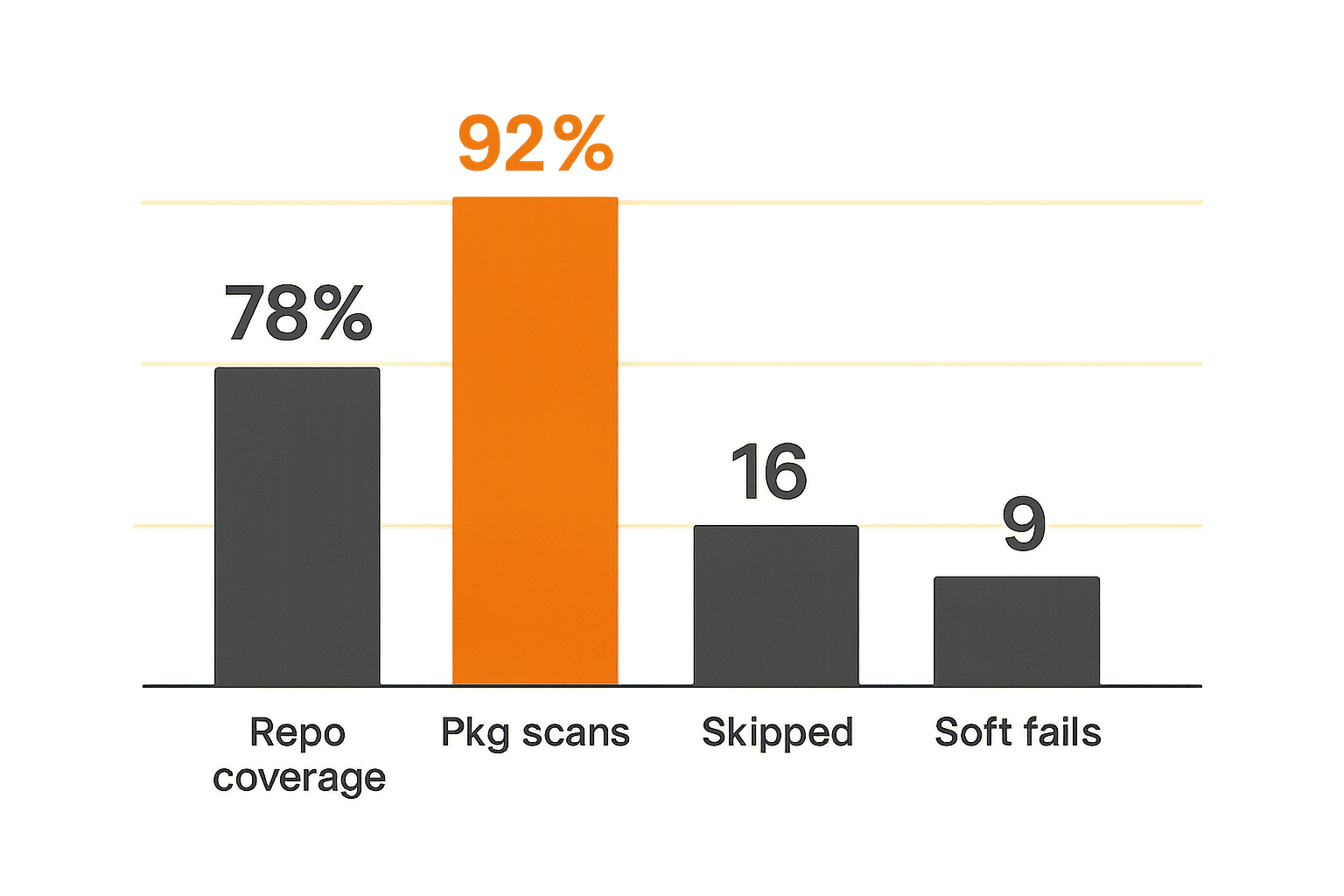
Coverage metrics
Coverage is not just number of repos with a scanner installed.
Track:
- percentage of protected repositories covered by the security license
- percentage of package manifest changes scanned before merge
- percentage of workflow file changes scanned before merge
- repositories with disabled licensed features
- repositories with no recent scan despite active development
These metrics expose gaps between intended coverage and actual enforcement.
Decision metrics
Decision metrics tell you whether the scanner is producing useful outcomes.
Track:
- blocking findings by category
- warnings converted to fixes
- false positives by rule
- average time to resolve blocked PRs
- number of soft failures
- number of skipped scans by reason
A security license that produces constant noise will be bypassed. A license that quietly skips hard cases will look good in dashboards and fail in production.
Abuse and reliability metrics
Because the license behaves like a credential, track abuse indicators:
- unexpected API usage spikes
- scans from unknown repositories
- license validation failures
- token use outside expected CI ranges
- repeated quota exhaustion
- scanner calls from unapproved runners
You do not need perfect telemetry on day one. You need enough to detect when the license is being used outside the intended workflow.
Common failure modes
The license key is copied everywhere
This is the classic failure. A team starts with one repo, then copies the same secret into ten more. Another team adds it to a local .env file for debugging. A self-hosted runner exports it globally. Six months later no one knows where the license lives.
What breaks:
- rotation becomes risky
- revocation breaks unknown workflows
- audit logs are incomplete
- fork exposure is harder to reason about
- incident response slows down
Better pattern: centralize the license key, restrict repository access, use reusable workflows, and rotate on a schedule.
The scanner blocks without context
Security teams sometimes overcorrect. They configure a licensed scanner to block everything but do not provide useful annotations. Developers see red checks, generic messages, and no remediation path.
What breaks:
- developers rerun jobs blindly
- maintainers bypass branch protection
- security gets pulled into low-value triage
- real findings are mixed with policy plumbing errors
Better pattern: every blocking result should include category, file, changed object, policy, owner, and next step.
Renewal breaks the pipeline
Licenses expire. Credit cards fail. Vendor APIs change. Entitlements get moved between organizations. If your pipeline has no graceful handling, renewal becomes an outage.
What breaks:
- protected branches cannot merge
- release jobs fail during deploy windows
- developers disable checks to ship
- security loses credibility
Better pattern: monitor license validity before expiry, test renewal in staging, and define whether each repo tier fails open or closed during vendor outages.
Practical rule: if a security license can block a merge, its health belongs in your CI/CD reliability monitoring.
Where vu1nz.com fits
Use the license to protect the merge boundary
vu1nz.com writes for security engineers and DevSecOps teams defending CI/CD pipelines and software supply chains. In that environment, the merge boundary is where security controls need to be concrete.
A security license should help answer one question: is this change safe enough to merge under the policies this repository requires?
That means checking more than known CVEs. It means looking at CI/CD workflow weaknesses, newly added packages, suspicious install behavior, and the practical ways attackers reach build systems.
Keep the developer workflow boring
Good security tooling should make the dangerous path obvious and the safe path routine. Developers should not need to understand your license contract to fix a blocked PR.
The license architecture should be mostly invisible when everything is healthy:
- checks run on the right changes
- findings appear where developers already work
- secrets are not exposed to untrusted code
- skipped scans are explained
- policy exceptions expire
- security can audit coverage without chasing YAML across every repo
That is boring in the best possible way.
Closing the security license loop
The closing lesson is straightforward: a security license is part of your CI/CD security architecture once it gates scans, unlocks features, or handles secrets. Treat it as a policy-bearing credential. Scope it, monitor it, rotate it, and make its failure states visible.
Teams think the problem is buying coverage. The real problem is proving the coverage ran before the risky change merged.
Try vu1nz.com
vu1nz.com is for security engineers and DevSecOps teams who need to defend CI/CD pipelines and software supply chains from modern attacks. Try vu1nz.com and make your security license part of the merge workflow, not another forgotten secret.
Catch the next supply-chain attack on the PR that adds it.
14-day free trial · no card required