Security awareness training is usually treated like an annual interruption. Developers click through a module, answer obvious questions about phishing, and get back to shipping code. A few weeks later, the same organization approves a pull request that adds an unpinned GitHub Action, grants broad workflow permissions, or introduces a package with install scripts nobody reviewed.
Teams think the problem is knowledge. The real problem is workflow design.
In CI/CD and software supply chain security, awareness only matters if it changes what happens at merge time, build time, publish time, and incident time. The practical question is not whether engineers can define dependency confusion. The practical question is whether they notice the pattern while reviewing a diff under deadline pressure.
That changes the conversation. Security awareness training becomes less like corporate education and more like an operating system for secure delivery: signals, review prompts, ownership, automation, and feedback loops embedded into the pipeline.
Table of contents
- Why security awareness training fails in software teams
- Security awareness training for CI/CD needs a threat model
- What developers actually need to recognize
- Turn awareness into controls at review time
- Build the security awareness training workflow
- What works and what fails
- Measure security awareness training by pipeline outcomes
- Common failure modes in security awareness training
- Make it continuous with automation
- Product fit for vu1nz.com
Why security awareness training fails in software teams
The checkbox model does not match the attack path
Most security awareness training was built for broad enterprise behavior: phishing, password reuse, device handling, clean desk policies, and suspicious links. Those topics still matter. But they do not map cleanly to how modern engineering teams get compromised.
A software supply chain attack rarely announces itself as a suspicious email. It may arrive as:
- A pull request that modifies
.github/workflows/release.yml. - A new npm package with a familiar name and an unexpected maintainer.
- A transitive dependency that executes a postinstall script.
- A build job that gains
contents: writeorid-token: writewithout justification. - A release workflow that runs untrusted code before secrets are protected.
- A package publishing token that is available to more jobs than necessary.
The mistake teams make is assuming that awareness is a memory problem. If developers remember enough security facts, they will make secure choices. In production, the harder problem is recognition under context. Engineers need to recognize that a normal-looking delivery change has security meaning.
Practical rule: If training does not change what reviewers inspect in a pull request, it is not security awareness training for software teams. It is compliance content.
Attackers do not need every engineer to be careless. They need one path where the system relies on a human noticing something subtle without tooling, ownership, or a review habit.
The real unit of behavior is the delivery workflow
A useful way to think about it is this: the behavior you want is not individual vigilance. The behavior you want is secure workflow execution.
For DevSecOps teams, that means awareness should attach to the actions engineers already perform:
- Opening a pull request.
- Reviewing workflow changes.
- Approving new dependencies.
- Rotating secrets.
- Publishing packages.
- Responding to failed checks.
- Investigating suspicious build behavior.
This is why generic training decays quickly. The material is detached from the environment where decisions are made. A developer may know that least privilege matters, but still approve permissions: write-all because the review UI does not highlight the change, the build is blocked, and nobody owns the policy.
Related reading from our network: SOC teams face a similar architecture problem when escalation depends on humans noticing weak signals without a reliable workflow, which is why this operator guide to a personal emergency response system for SOC teams is a useful adjacent model for ownership and response design.
Security awareness training for CI/CD needs a threat model
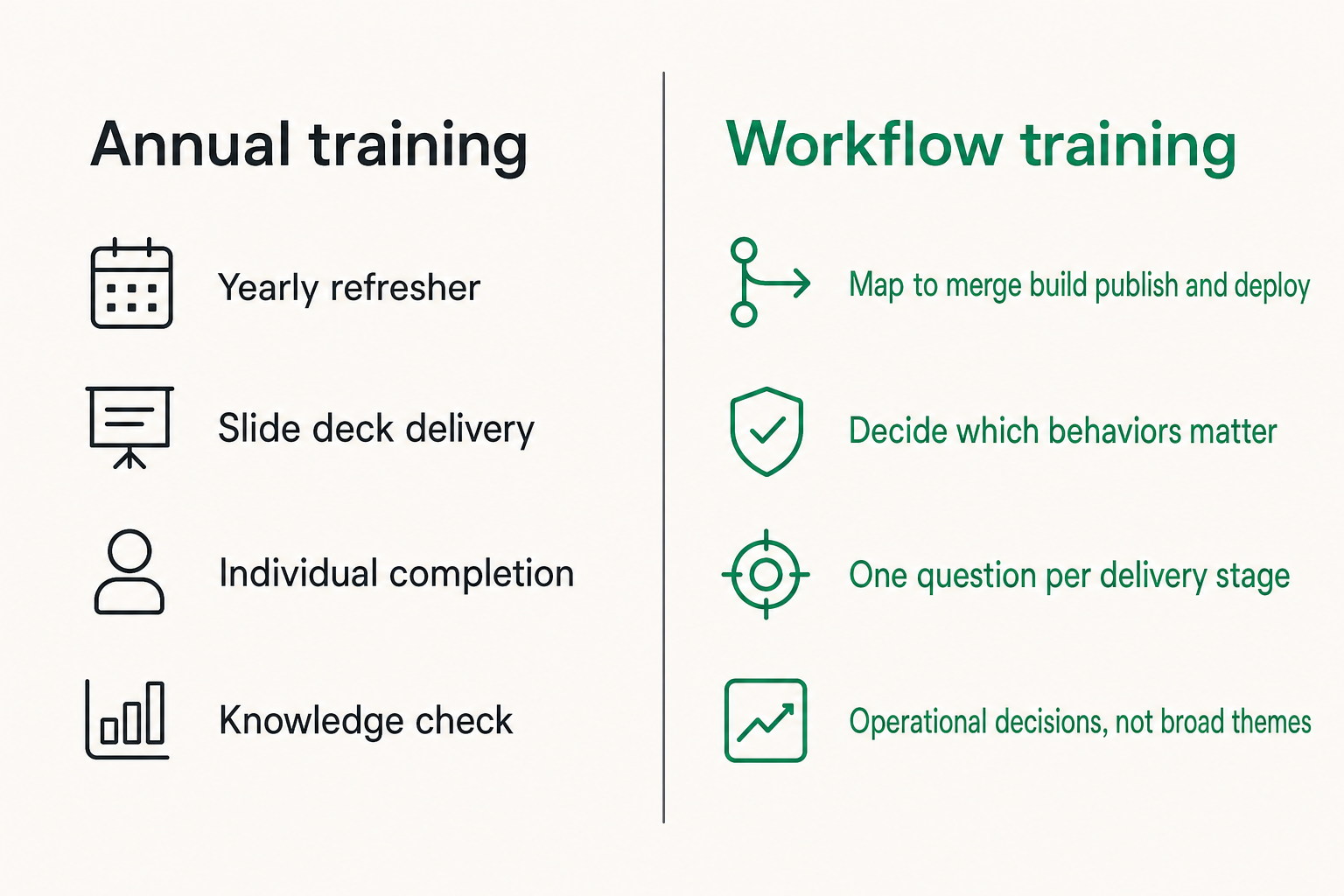
Map training to merge build publish and deploy
Security awareness training for CI/CD should start with a threat model, not a slide deck. The point is to decide which behaviors matter because they protect specific parts of the delivery system.
A practical map looks like this:
| Delivery stage | Common risky change | Awareness objective | Control to pair with training |
|---|---|---|---|
| Merge | Workflow file edited | Reviewer recognizes privilege and trigger changes | CODEOWNERS plus CI workflow scan |
| Build | New build dependency added | Reviewer checks package provenance and scripts | Package diff scanner |
| Test | Untrusted code runs in privileged job | Engineer understands trust boundary | Job isolation and permission defaults |
| Publish | Token available too broadly | Maintainer detects secret exposure path | Scoped tokens and environment protection |
| Deploy | Manual override used repeatedly | Team sees exception drift | Exception review and expiry |
This turns awareness from a broad theme into a list of operational decisions. Each training module should answer one question: what should the engineer do differently when this change appears?
The practical question is not whether a developer can recite the OWASP Top 10. The practical question is whether they can look at a GitHub Actions diff and say: this job now runs on pull_request_target, checks out attacker-controlled code, and has access to secrets. That is the review moment that matters.
Separate human error from system design
Many teams blame humans for mistakes that the delivery system made easy. That is usually the wrong lesson.
If a developer approves a risky workflow change because the diff is noisy, the reviewer lacks context, and no scanner flags the permission change, the failure is not only awareness. The failure is system design.
Good training separates three categories:
- Knowledge gaps: the engineer did not understand the risk.
- Attention gaps: the engineer knew the risk but did not notice it in context.
- Control gaps: the system allowed the risky change without friction or ownership.
Each category needs a different response. Knowledge gaps need explanation. Attention gaps need prompts and review patterns. Control gaps need automation, policy, or architectural change.
Practical rule: Do not use training to compensate for missing guardrails. Use training to explain the guardrails and make exceptions safer.
This distinction matters politically too. Developers will ignore security programs that feel like blame transfer. They are more likely to participate when training helps them ship safely without becoming full-time security analysts.
What developers actually need to recognize
Dangerous workflow patterns
In CI/CD security, the most valuable awareness is pattern recognition. Engineers do not need a lecture on every historical incident. They need a short list of patterns that should slow down a review.
Examples include:
- Workflows triggered by untrusted pull requests with elevated permissions.
pull_request_targetworkflows that check out code from the pull request branch.- Broad repository permissions where a job only needs read access.
- Secrets available to jobs that run third-party actions or untrusted scripts.
- Release workflows modified in the same PR as application code.
- New use of
curl | bash, remote scripts, or unsigned binaries in CI. - Cache keys that allow poisoning across trust boundaries.
- Self-hosted runners exposed to untrusted forks.
What breaks in practice is that reviewers see these as YAML details, not security decisions. Training should give reviewers a mental model: a workflow file is executable infrastructure with access to code, credentials, artifacts, and release paths.
A small example is enough:
permissions: write-all
on:
  pull_request_target:
jobs:
  test:
    steps:
      - uses: actions/checkout@v4
        with:
          ref: ${{ github.event.pull_request.head.sha }}
      - run: npm install && npm test
The lesson is not simply that this is bad. The lesson is why it is bad: privileged event, untrusted code checkout, dependency execution, and broad permissions combine into an exploit path.
Suspicious package changes
Dependency review has the same problem. Developers are trained to look for known vulnerabilities, but many real supply chain attacks are not known CVEs at merge time.
The behavior you want is broader:
- Notice newly added direct dependencies.
- Review packages with low usage, new maintainers, or suspicious naming.
- Check install scripts, binary downloads, and obfuscated code.
- Treat lockfile churn as meaningful, not as noise.
- Verify whether the package is needed at runtime, build time, or only in tests.
- Ask why an established package was replaced with a near-name alternative.
This is where awareness must pair with tooling. A human reviewer cannot manually investigate every transitive package on every PR. But they can make better decisions when the system highlights the right delta. For example, teams relying only on CVE matching should understand what Dependabot misses in npm supply-chain attacks, because several practical attack paths appear before a vulnerability database can help.
Related reading from our network: teams working on answer-engine optimization deal with a less hostile but similar graph problem, where paths and signals determine what gets discovered; this piece on ant colony optimization algorithms for crawl paths is a useful analogy for thinking about how small signals accumulate across a system.
Turn awareness into controls at review time
Pull request prompts beat annual recall
The best place for security awareness training is the pull request. Not because every PR should become a classroom, but because that is where decisions happen.
Annual recall asks an engineer to remember abstract advice later. PR-time prompts tell the engineer why a specific change matters now.
Useful prompts are short and tied to the diff:
- This PR changes a GitHub Actions workflow. Review triggers, permissions, secrets, and third-party actions.
- This PR adds a new package. Review package age, scripts, maintainer history, and whether the dependency is necessary.
- This PR changes release automation. Confirm token scope, environment protection, and artifact provenance.
- This PR modifies lockfiles heavily. Confirm the dependency graph change is expected.
The mistake teams make is turning these prompts into generic warnings. If every PR gets the same security banner, developers stop reading it. The prompt should appear only when the change touches a meaningful risk area.
Practical rule: Put security guidance where the risky decision is made, and make the guidance specific to the diff.
This approach also scales better. A small security team cannot attend every review. It can, however, encode review questions into comments, templates, checks, and required approvals.
Ownership must be explicit
Awareness without ownership becomes discussion. Ownership turns it into action.
For CI/CD and supply chain changes, define who can approve what:
- Workflow trigger changes: DevSecOps or platform owner.
- Permission expansions: repository owner plus security reviewer.
- New release job: release engineering owner.
- New build dependency: service owner or package owner.
- Self-hosted runner changes: infrastructure owner.
- Secret exposure changes: security or platform owner.
CODEOWNERS helps, but it is not enough by itself. The owner needs a checklist and the authority to block the change. Otherwise they become a rubber stamp.
A useful review comment is not: looks risky. A useful review comment is: this job now grants contents: write on a PR-triggered workflow; either reduce permissions to read-only or move the publishing step behind a protected environment.
That is awareness converted into an engineering decision.
Build the security awareness training workflow
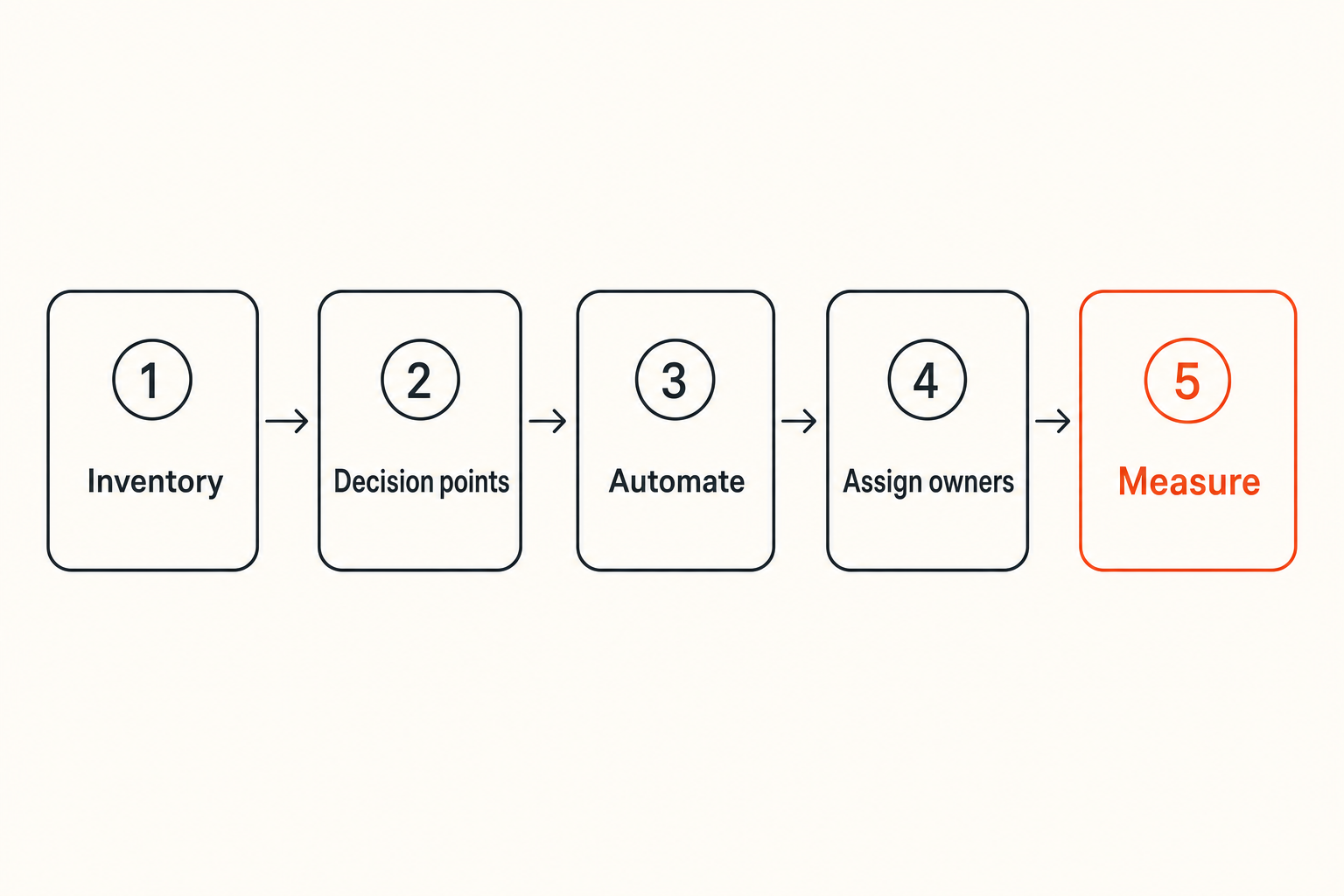
A practical implementation sequence
If you are starting from generic training, do not boil the ocean. Build around the highest-risk workflow decisions first.
Inventory delivery paths. List how code moves from PR to production or package publication. Include GitHub Actions, package registries, container builds, deployment tools, and manual release steps.
Identify security decision points. Mark where humans approve changes that affect permissions, dependencies, secrets, artifacts, runners, or publishing.
Convert each decision point into a review question. Example: does this workflow run untrusted code with write permissions? Keep the question short enough to use in a PR.
Add automation that detects the condition. Do not rely on humans to notice every workflow file change or dependency delta. Use checks to surface the risky diff.
Assign owners for each condition. A warning without an owner becomes noise. Decide who must review workflow changes, dependency additions, and release automation changes.
Create micro-lessons from real findings. When a scanner flags an issue, link to a short explanation that shows the exploit path and the safe pattern.
Measure whether behavior changes. Track repeated findings, time to fix, exception rates, and risky changes caught before merge.
Feed incident lessons back into review prompts. If an incident or near miss happens, update the workflow checklist, not just the slide deck.
This is not complicated, but it requires discipline. The training asset is not only the content. The asset is the connection between content, detection, ownership, and review.
Minimum artifacts to maintain
A lean program can run with a small set of artifacts:
- CI/CD threat model: one page describing trust boundaries, privileged workflows, secrets, runners, and publication paths.
- Secure workflow patterns: approved examples for common GitHub Actions jobs.
- Dangerous patterns list: short examples of patterns that require review.
- Dependency review checklist: what to inspect for new packages and lockfile changes.
- PR prompt library: reusable comments triggered by risky changes.
- Exception register: who approved what, why, and when it expires.
- Post-incident lesson log: concise writeups that become new prompts or controls.
Keep these close to the code. A security wiki that nobody opens during review has limited value. Store patterns in repository templates, engineering docs, or bot comments where they are actually used.
Related reading from our network: payment teams run into a similar workflow problem when the checkout UI hides the hard parts of state, settlement, and support; this crypto checkout architecture guide for wolverine peptide payments is adjacent but useful for thinking about operational controls beyond the visible interface.
What works and what fails
What works
Effective security awareness training for DevSecOps teams is usually narrow, contextual, and repetitive in the right places.
What works:
- Short lessons attached to real PR findings.
- Secure examples developers can copy.
- Review prompts triggered by specific file or dependency changes.
- Threat models that explain why the control exists.
- Owners who can approve, block, or request redesign.
- Automation that catches risky patterns early.
- Post-incident updates to checklists and scanners.
The tone matters. Engineers do not need to be told that security is important. They need clear guidance on what safe looks like in the system they operate.
For example, a useful lesson on GitHub Actions permissions should show:
- The risky configuration.
- The exploit path.
- The safer configuration.
- The review question.
- The automated check that should catch it next time.
That gives the developer a mental model and a practical action.
What fails
The failure pattern is familiar:
| Approach | Why it feels reasonable | What breaks in practice |
|---|---|---|
| Annual generic module | Easy to roll out and track | Not connected to CI/CD decisions |
| Long policy documents | Comprehensive coverage | Nobody reads them during review |
| Security champions without time | Creates local advocates | Champions become unpaid reviewers with no authority |
| Tool alerts without explanation | Scales detection | Developers treat findings as arbitrary gates |
| Blame-heavy incident reviews | Signals seriousness | Engineers hide uncertainty and avoid security discussions |
| CVE-only dependency education | Familiar vulnerability model | Misses malicious packages and pre-CVE attacks |
The mistake teams make is optimizing for proof of training completion instead of proof of safer delivery behavior. Completion records may satisfy a compliance request, but they do not tell you whether a risky release workflow would be caught before merge.
Measure security awareness training by pipeline outcomes
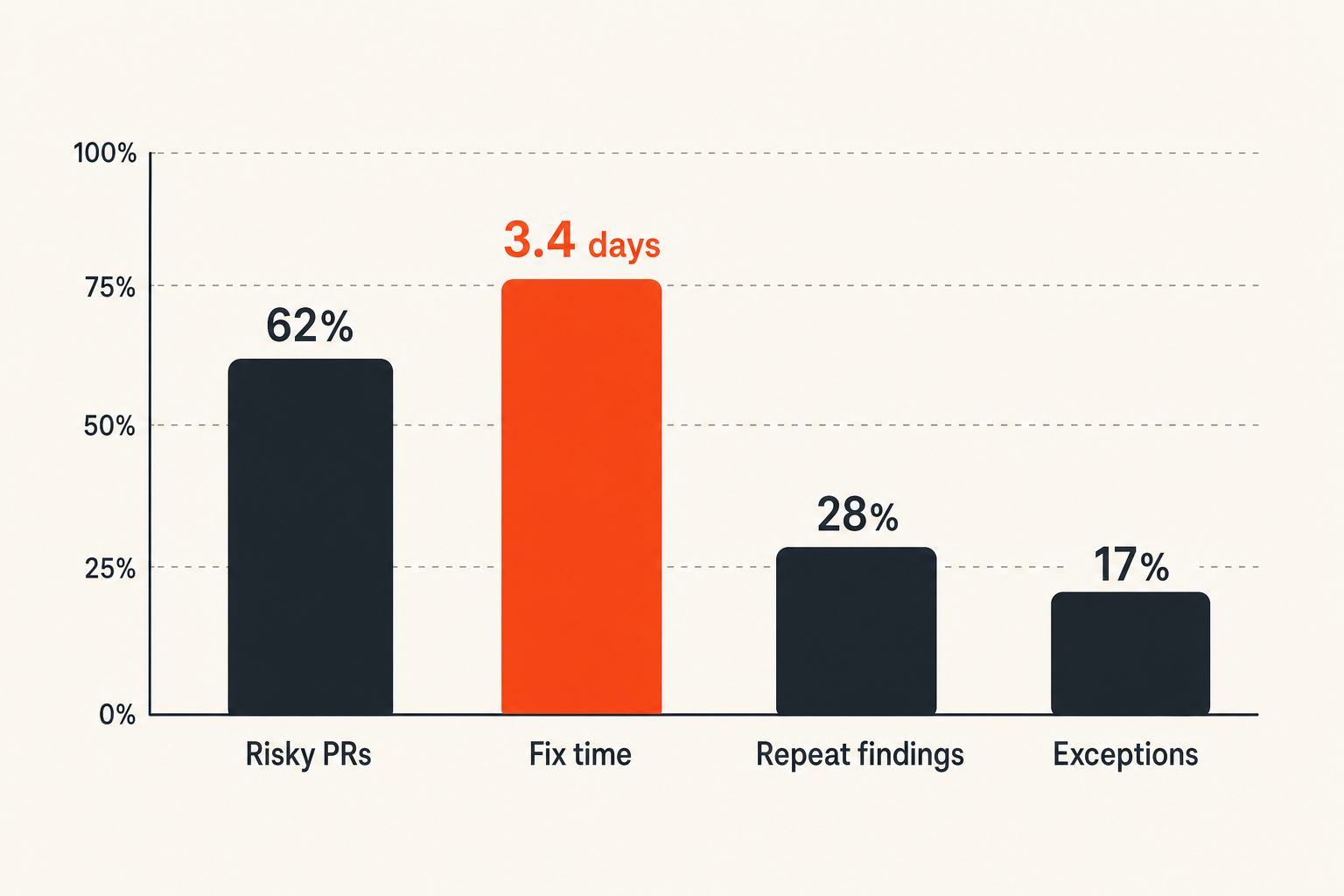
Metrics that prove behavior changed
Security awareness training should be measured by workflow outcomes. You do not need invented precision. You need operational signals that show whether behavior is improving.
Useful metrics include:
- Risky workflow changes caught before merge.
- New dependency findings fixed before merge.
- Repeat findings by repository or team.
- Mean time from finding to safe remediation.
- Percentage of exceptions with owners and expiry dates.
- Number of incident lessons converted into controls.
- Reduction in broad CI permissions over time.
- Reduction in unpinned or unreviewed third-party actions.
These metrics are not perfect, but they are closer to reality than quiz scores. They show whether the delivery system is learning.
A good dashboard answers operator questions:
- Which teams keep hitting the same CI/CD pattern?
- Which controls generate the most exceptions?
- Which repositories have the riskiest release paths?
- Which lessons should become automated checks?
- Which alerts are noisy enough to need tuning?
That changes the conversation from did everyone take the training to where is the pipeline still teaching us the same lesson repeatedly?
Metrics that create theater
Some metrics create the appearance of maturity while hiding risk.
Be skeptical of:
- Training completion percentage as the primary metric.
- Average quiz score across the company.
- Number of security pages published.
- Number of champions appointed.
- Number of alerts generated.
- Number of meetings held after incidents.
These may be administratively useful, but they are weak indicators of secure behavior. A team can score well and still merge a workflow that leaks a publishing token.
The better question is: when the risky condition appeared, did the system detect it, route it, explain it, and resolve it before damage?
Practical rule: Measure awareness by the decisions it changes, not by the content people consumed.
Common failure modes in security awareness training
Alert fatigue from vague lessons
What breaks in practice is usually not lack of content. It is too much undifferentiated content.
If every dependency warning says be careful with open source, nobody learns anything. If every workflow change says review security implications, reviewers still have to guess what matters.
Make lessons specific:
- Bad: Be cautious with GitHub Actions.
- Better: This workflow uses
pull_request_target; do not check out untrusted PR code before secrets are isolated. - Bad: Review dependencies carefully.
- Better: This package adds a postinstall script and was introduced only for test tooling; confirm it is necessary and inspect the script.
- Bad: Follow least privilege.
- Better: This job only reads repository contents; set
contents: readinstead ofwrite-all.
Specificity reduces fatigue because it gives the engineer a next action. Vague warnings create anxiety without resolution.
Tooling without context
The opposite failure is over-automation. Teams deploy scanners, block PRs, and assume awareness will emerge from friction. It usually does not.
Developers need to know why a finding matters and how to fix it safely. Otherwise they learn the wrong behavior: bypass the tool, add exceptions, or wait for security to tell them what to do.
A good finding should include:
- What changed.
- Why it creates risk.
- What attack path it enables.
- What safe pattern to use.
- Who owns approval if an exception is required.
This is where security researchers and DevSecOps engineers can add real leverage. Convert vulnerability knowledge into reviewable patterns. The goal is not to make every developer an exploit writer. The goal is to make exploit paths visible at the moment the path is created.
Make it continuous with automation
Connect scanners to teachable moments
Continuous training does not mean constant meetings. It means the system teaches at the point of change.
In a GitHub-centric environment, that usually means:
- Scan workflow files when they change.
- Scan new dependencies and lockfile deltas.
- Comment on PRs with concise explanations.
- Require owners for high-risk changes.
- Provide safe examples inline.
- Track whether the same finding returns.
A scanner is not a replacement for awareness. It is the trigger that makes awareness timely. For teams that want a drop-in example, the vu1nz GitHub Action for CI/CD and package security scanning is designed around this model: workflow checks plus package scanning on pull requests, where the review decision actually happens.
You can start with a lightweight pattern:
name: supply-chain-review
on:
  pull_request:
    paths:
      - .github/workflows/**
      - package.json
      - package-lock.json
      - pyproject.toml
      - requirements.txt
permissions:
  contents: read
  pull-requests: write
jobs:
  review:
    runs-on: ubuntu-latest
    steps:
      - uses: actions/checkout@v4
      - name: Scan CI and package changes
        run: ./security-review.sh
The exact tool matters less than the workflow principle: detect risky delivery changes early, explain them clearly, and route them to the right owner.
Close the loop after incidents
Incident response should feed training, but not as a long postmortem PDF that disappears into a folder.
For every CI/CD or supply chain incident, extract the operational lesson:
- What change created the path?
- Could a reviewer have recognized it?
- Could automation have detected it?
- Was ownership clear?
- Was the safe pattern documented?
- Did an exception process contribute?
Then update one or more of the following:
- Scanner rule.
- PR prompt.
- Secure example.
- CODEOWNERS rule.
- Repository template.
- Exception policy.
- Micro-lesson.
This is how security awareness training becomes cumulative. Each near miss should make the next similar mistake harder to merge.
The mistake teams make is treating incidents as one-time education events. The better response is to turn the incident into a system change. If the lesson stays in a meeting, it will fade. If it becomes a check, prompt, or ownership rule, it persists.
Product fit for vu1nz.com
Where vu1nz fits
vu1nz.com is built for security engineers and DevSecOps teams defending CI/CD pipelines and software supply chains. That puts it in the part of the awareness problem where generic training is weakest: the pull request, the workflow file, and the package delta.
A practical security awareness training program needs three things working together:
- Research-grade understanding of attack paths.
- Automation that detects risky patterns before merge.
- Explanations developers can act on without leaving the review flow.
That is the product fit. Not replacing training with a scanner. Not pretending a bot can solve culture. The useful architecture is scanner plus review prompt plus owner plus safe pattern.
Teams that want to see how this looks in a concrete workflow can also read the prior walkthrough on how vu1nz GitHub Actions catches CI/CD vulnerabilities quickly, which shows the security-check model as part of normal pull request handling.
The architecture to aim for
The target state is simple to describe and hard to fake:
- Developers know which delivery changes are security-sensitive.
- Reviewers get prompts only when the diff warrants attention.
- CI/CD scanners catch dangerous workflow patterns automatically.
- Package changes are evaluated beyond known CVEs.
- Owners are required for high-risk approvals.
- Exceptions expire and are reviewed.
- Incidents update controls instead of only updating slides.
This is security awareness training as delivery architecture. It respects how engineers actually work. It reduces dependence on memory. It gives the security team leverage without forcing them into every PR manually.
The closing point is blunt: security awareness training only matters if it changes the way software moves through your pipeline. For CI/CD and supply chain teams in 2026, the training surface is the workflow, the dependency graph, the review process, and the release path.
Try vu1nz.com
vu1nz.com is for security engineers and DevSecOps teams who need to defend CI/CD pipelines and software supply chains from modern attacks. Try vu1nz.com.
Catch the next supply-chain attack on the PR that adds it.
14-day free trial · no card required