Searches for securitas security services usa usually come from a physical security problem: too many sites, too many entrances, inconsistent patrols, unclear escalation, and leadership asking whether anyone actually knows what is happening on the ground.
CI/CD security has the same shape. Different perimeter, same operating failure.
Teams think the problem is finding another scanner. The real problem is building a security service model around the software delivery system: checkpoints, patrol routes, evidence collection, escalation, validation, and ownership.
That changes the conversation. Instead of asking, “Which tool finds the most issues?” the practical question is, “Where can an attacker enter our delivery path, who notices, who decides, and what happens before the change ships?”
Table of contents
- Why securitas security services usa is the wrong query and the right analogy
- What a CI/CD security service actually protects
- The operating model behind securitas security services usa applied to DevSecOps
- Where CI/CD security breaks in practice
- A practical CI/CD checkpoint architecture
- Package supply chain inspection is the loading dock problem
- What works and what fails
- Implementation sequence for security engineers
- Metrics that matter more than vulnerability counts
- How vu1nz.com fits the CI/CD security service model
Why securitas security services usa is the wrong query and the right analogy
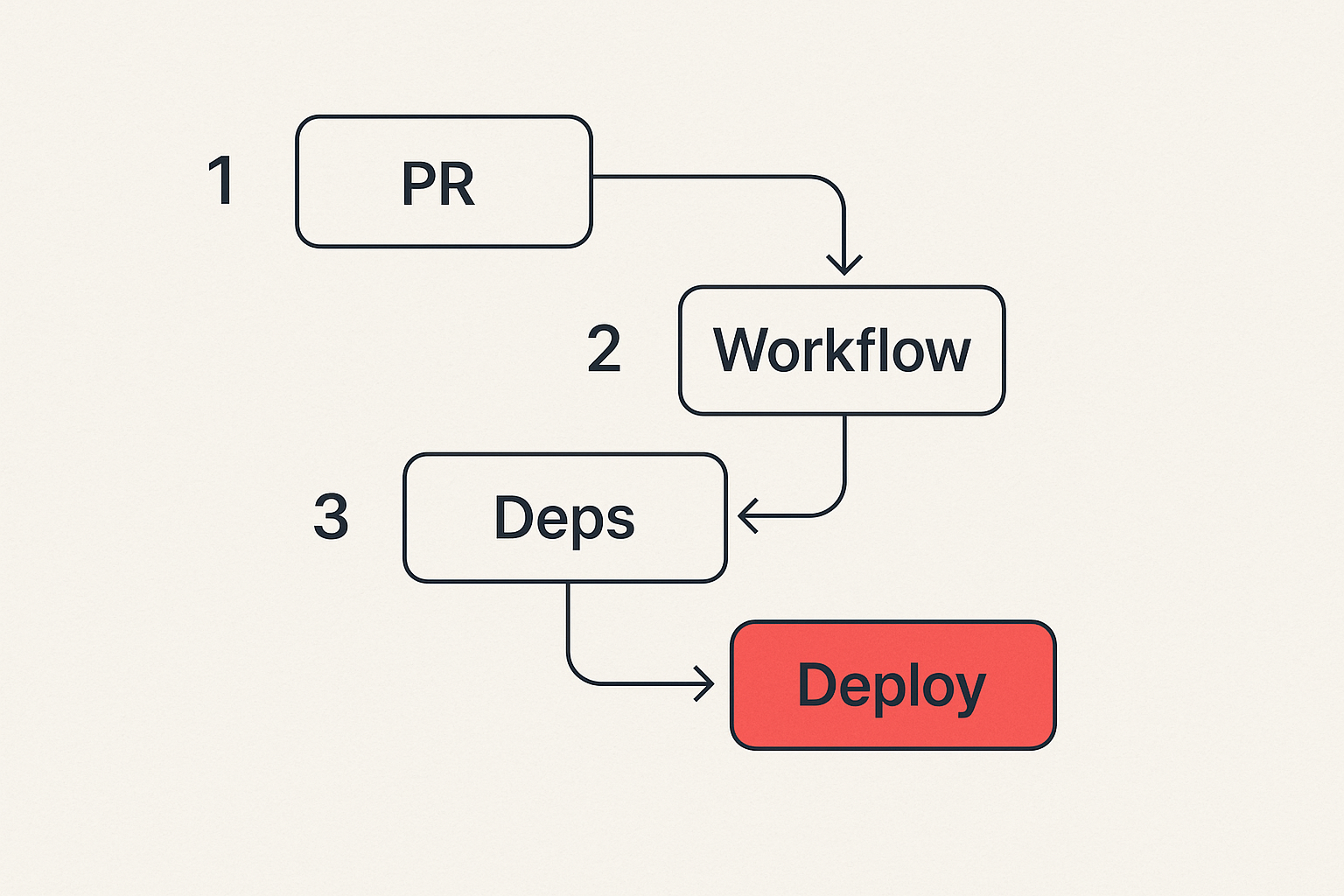
The physical security pattern maps cleanly to pipelines
A company looking at a national guard service is usually not buying “a person at a desk.” It is buying coverage: assigned posts, patrol schedules, badge checks, incident logs, escalation trees, site-specific procedures, and proof that the work happened.
That is the useful part of the securitas security services usa analogy for DevSecOps. Your delivery system has doors. Some are obvious: GitHub organization membership, branch protection, repository settings, release credentials. Others are less obvious: reusable workflows, package install scripts, self-hosted runner labels, artifact permissions, pull request triggers, bot tokens, and cloud deployment roles.
The mistake teams make is treating each door as a separate tooling problem. They add SCA here, secret scanning there, IaC scanning somewhere else, and maybe a runtime alert after deployment. What they do not build is the service layer connecting those controls into an operating model.
Practical rule: If nobody can explain the patrol route through your CI/CD system, you do not have CI/CD security. You have tools waiting to be ignored.
The software perimeter is not a wall
Physical sites have gates. Software delivery has state transitions. A commit becomes a pull request. A pull request invokes workflows. A workflow receives tokens. Tokens fetch dependencies. Dependencies execute code during install or build. Artifacts are produced. Releases are signed, published, deployed, or consumed downstream.
The perimeter is not the repository. It is the chain of trust between identities, automation, dependencies, artifacts, and deployment targets. Attackers understand this. They do not need to “hack production” if they can alter a build script, poison a dependency, steal a CI token, or modify a workflow that runs with elevated permissions.
A useful way to think about it is: every automated transition is a checkpoint. If a checkpoint can execute untrusted code with trusted credentials, it needs a guardrail.
Security services are workflows, not products
This is where the analogy becomes practical. Security service providers are judged by coverage and response quality, not by whether they own flashlights. In CI/CD, scanners are the flashlights. They matter, but they are not the service.
A real CI/CD security service answers:
- Which repositories are covered?
- Which workflows are allowed to run on untrusted input?
- Which dependencies are newly introduced?
- Which tokens are exposed to pull request code?
- Which findings block merges, and which create tickets?
- Who can approve exceptions?
- How are bypasses reviewed?
- How do runtime incidents update pipeline policy?
Related reading from our network: teams designing private communication systems face a similar architecture-vs-feature trap in end-to-end encrypted messaging architecture, where trust boundaries and operational workflows matter more than the label on the product.
What a CI/CD security service actually protects
Identity paths are entrances
In CI/CD, identity is the front door. Repository admins, maintainers, GitHub Apps, deploy keys, bot accounts, OIDC trust relationships, and cloud roles all define who can cause code to become production behavior.
Many teams spend more time scanning application code than reviewing who can change the scanner configuration. That is backwards. If an attacker can modify a workflow, disable a required check, or change the path filters that decide when security jobs run, the rest of the program becomes theater.
Identity review should cover:
- Organization owners and repository admins
- GitHub App permissions
- Fine-grained PAT usage
- Branch protection administrators
- Required workflow maintainers
- Cloud role trust policies for CI OIDC
- Self-hosted runner administrators
- Package registry publishing credentials
Practical rule: Treat CI administrators like production administrators. They can often reach production by changing the route rather than touching the destination.
Build runners are guarded rooms
Build runners execute code from your repository and often handle secrets, tokens, artifacts, caches, and deployment credentials. Hosted runners reduce persistence risk, but they do not remove workflow design risk. Self-hosted runners add capacity and network access, but they also create a larger attack surface.
What breaks in practice is runner trust confusion. A team labels a self-hosted runner linux-large or deploy, then allows broad workflow access. A forked pull request, compromised maintainer account, or malicious workflow change can route untrusted code into a sensitive execution environment.
The key questions are operational:
- Which workflows can target privileged runners?
- Are runner labels descriptive or security-sensitive?
- Can untrusted pull requests reach any self-hosted runner?
- Are caches shared across trust boundaries?
- Are artifacts from untrusted jobs consumed by trusted jobs?
- Are secrets scoped to environments with approval gates?
Packages are deliveries through the loading dock
Dependency updates are not paperwork. They are deliveries into the build environment. Some are legitimate. Some are compromised. Some are typo-squats. Some are maintainer takeovers. Some are benign packages that later become malicious.
Known-vulnerability scanning is necessary, but it is not enough for supply chain security. A package can be malicious before it has a CVE. A dependency can execute during install. A transitive dependency can add network behavior. A new maintainer can publish a poisoned version.
This is why pull request context matters. Reviewing dependency changes after merge is like inspecting a delivery after it has already been distributed across the building.
The operating model behind securitas security services usa applied to DevSecOps
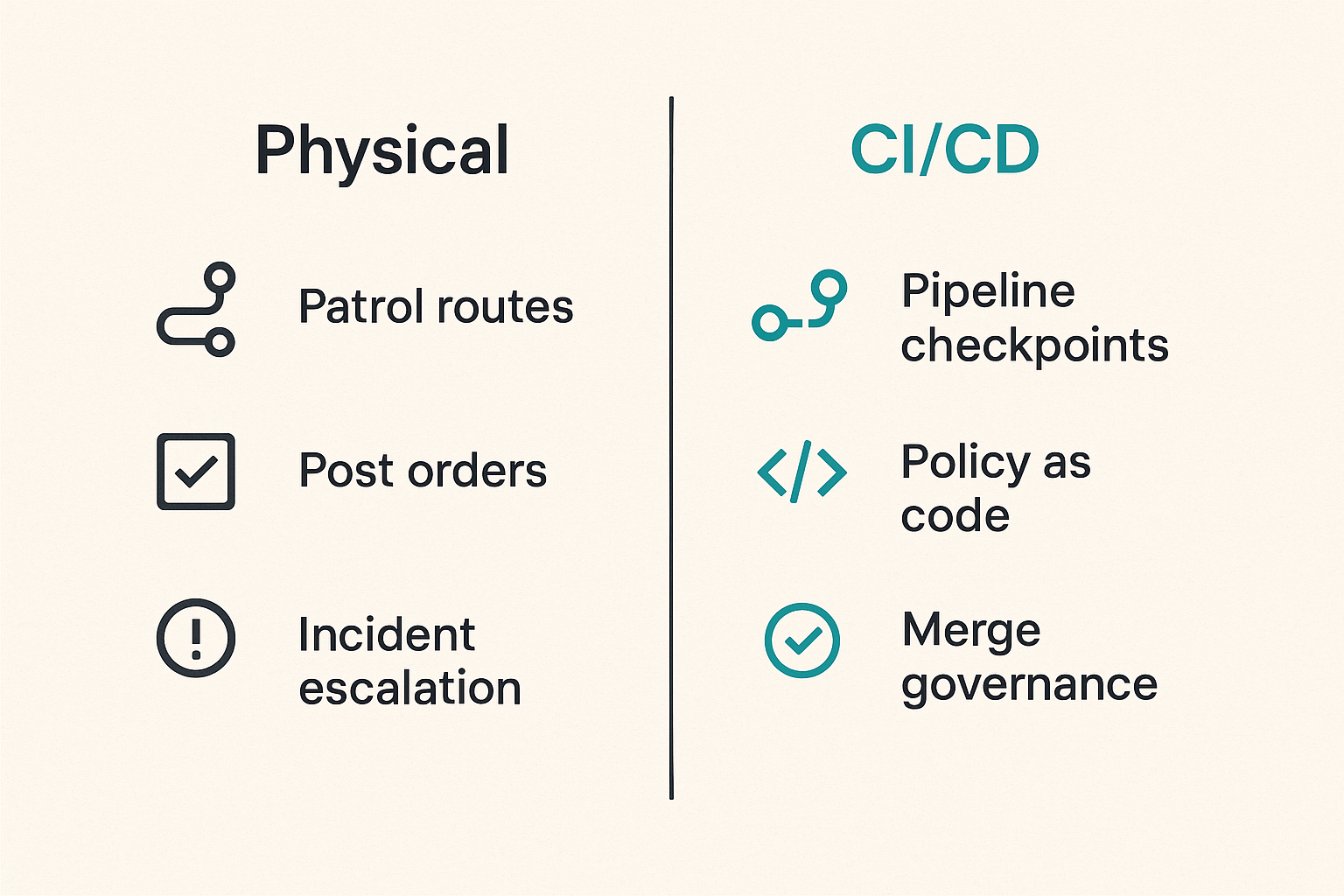
Patrol routes become pipeline checkpoints
The operating model behind securitas security services usa is not magic. It is repeatable coverage. Guards follow routes, check doors, document exceptions, and escalate incidents.
In CI/CD, the patrol route should follow the delivery path:
- Repository settings and branch protection
- Pull request source and actor trust
- Workflow trigger and permission model
- Dependency diff and package behavior
- Build runner trust boundary
- Artifact generation and provenance
- Deployment approval and environment secrets
- Release publishing and downstream consumption
This route should be automated wherever possible, but the important part is not automation alone. The important part is that the same route is applied consistently and produces evidence.
Incident escalation becomes merge governance
Physical security teams escalate based on severity, site rules, and business context. CI/CD security needs the same discipline.
Not every issue should block a merge. Not every issue should become a ticket. But some conditions should stop the line immediately:
- Workflow grants write tokens to pull request code
- Untrusted code can run on a privileged self-hosted runner
- A new dependency has suspicious install behavior
- A workflow downloads and executes remote scripts without pinning
- Branch protection can be bypassed by the same actor making the change
- Deployment credentials are exposed before review
The practical question is not “Can the scanner find it?” The practical question is “What decision should this finding force at merge time?”
Related reading from our network: SOC teams run into the same escalation design problem when adapting the Incident Command System as a SOC operating model, because unclear ownership breaks response faster than missing terminology.
Post orders become policy as code
A guard post has instructions: who can enter, when to call a supervisor, what to log, what exceptions are allowed. CI/CD needs the equivalent in policy as code.
Good policy is specific enough to enforce and readable enough for engineers to trust. Bad policy is a pile of vague rules nobody understands until it blocks a release.
Example policy intent:
ci_security_policy:
  pull_request:
    require_workflow_scan: true
    block_on:
      - untrusted_pr_write_token
      - self_hosted_runner_from_fork
      - unpinned_remote_script_execution
      - new_package_with_install_script_and_network_indicators
  exceptions:
    require_owner: security
    require_expiry_days: 14
    require_reason: true
This is not a universal policy. It is a model. The point is to encode the decision, not just detect the condition.
Where CI/CD security breaks in practice
Scanner sprawl creates blind spots
Scanner sprawl looks mature from a distance. There is a dashboard for dependencies, another for secrets, another for IaC, another for code scanning, another for containers, and maybe a SIEM ingestion pipeline for build logs.
The failure is that each tool sees a slice. The attacker uses the seams.
A malicious dependency is not just an SCA issue. It may be a CI execution issue if it has install scripts. It may be an identity issue if the build has cloud credentials. It may be an artifact issue if the package modifies release output. It may be a governance issue if the update was auto-merged.
When findings are disconnected from pull request state, teams lose the ability to answer the important question: “Should this change merge?”
Alerts without ownership decay fast
Security teams often underestimate alert decay. A finding with no owner becomes background noise. A finding assigned to “the platform team” becomes nobody’s problem. A finding that requires five clicks to reproduce becomes stale.
What works is direct ownership at the decision point:
- Repository owner handles code and dependency context
- Platform owner handles workflow and runner controls
- Security owner handles policy, exceptions, and abuse patterns
- Release owner handles deployment risk and rollback decisions
Practical rule: Every blocking control needs an owner, an exception path, and an expiry. Otherwise teams will route around it.
Pull request context is usually missing
Most supply chain attacks become easier to reason about when viewed as a diff. What changed? Who changed it? Which package is new? Which workflow permission changed? Which lockfile lines moved? Which scripts will execute? Which token exists at that point?
Post-merge scanning loses this context. It can still find issues, but investigation becomes slower because the reviewer must reconstruct the decision that should have happened earlier.
This is why pre-merge security is not just “shift left” branding. It is operationally cheaper because the evidence is still local: the diff, the actor, the workflow, the package, and the intended merge.
A practical CI/CD checkpoint architecture
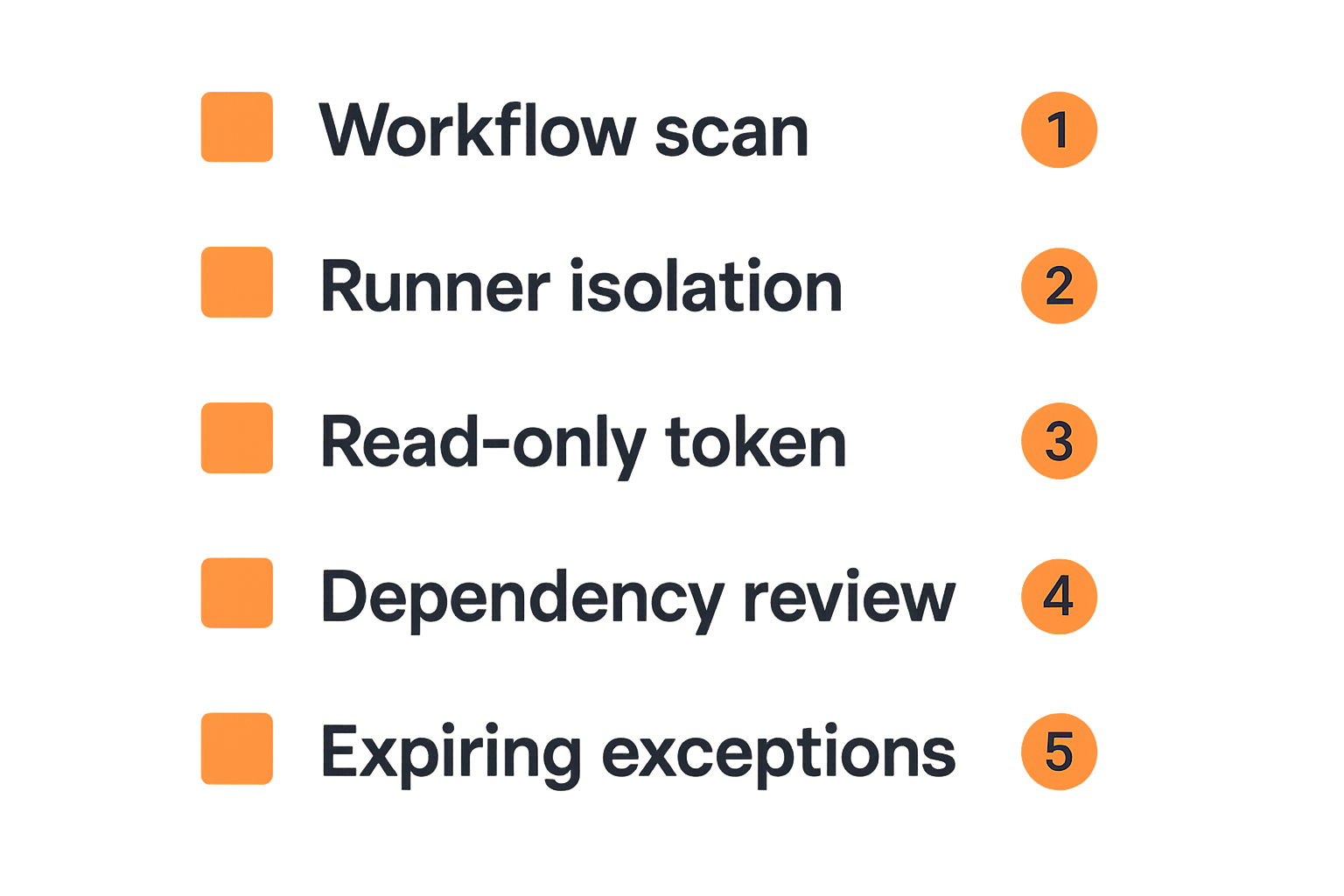
Pre-merge controls should be narrow and enforceable
Pre-merge controls should focus on high-signal decisions. If you block every medium-severity package advisory, engineers will learn to hate the system. If you only warn on exploitable pipeline misconfigurations, attackers will learn to love it.
Good pre-merge blockers include:
- Untrusted pull request code receiving write-scoped tokens
- Self-hosted runner exposure to forked or untrusted PRs
pull_request_targetmisuse with checkout of attacker-controlled code- Unpinned third-party GitHub Actions in sensitive workflows
- New dependency with suspicious install-time behavior
- Workflow changes that weaken required security jobs
- Deployment secrets available before human approval
The mistake teams make is trying to make pre-merge controls comprehensive. They should be selective. Save broad inventory and lower-confidence analysis for post-merge and scheduled jobs.
Post-merge controls should validate assumptions
Post-merge jobs should answer a different question: “Did our controls continue to hold after the change landed?”
This includes:
- Repository drift detection
- Branch protection validation
- Workflow permission inventory
- Runner label exposure review
- Dependency baseline comparison
- Artifact provenance checks
- Release signing verification
- Exception expiry enforcement
Post-merge security is where you catch drift, not where you first learn that an untrusted PR could have reached a deploy token.
Runtime feedback should tune pipeline policy
Runtime incidents should feed back into CI/CD policy. If production detection shows unusual package behavior, the pipeline should learn from it. If a compromised token is used in a suspicious way, the trust relationship that created it should be reviewed. If an incident involved artifact tampering, provenance checks should move earlier.
This is where proactive and reactive work connect. SOC alerts, cloud audit logs, package registry events, and repository audit logs should not live in separate universes.
Related reading from our network: teams evaluating remote access software architecture face a comparable control-plane problem: the UI is less important than trust boundaries, auditability, and operational ownership.
Package supply chain inspection is the loading dock problem
Known CVE checks are necessary but late
CVE-based scanning is useful. It catches known vulnerable versions and gives teams a common language for remediation. But modern package supply chain attacks often do not begin with a CVE. They begin with behavior: credential harvesting, install-script execution, environment probing, obfuscated payloads, unexpected network calls, or maintainer account compromise.
That means a pipeline that only asks “Is this version known vulnerable?” is late by design.
We wrote about this gap in what Dependabot misses, especially the difference between known vulnerable packages and malicious packages that are new, renamed, compromised, or not yet classified.
New dependency review needs behavioral signals
A useful package review workflow looks at what changed and what the package can do during build or install.
Signals worth inspecting include:
- New direct dependency added to manifest
- Lockfile introducing unexpected transitive dependencies
- Package with preinstall, install, or postinstall scripts
- Obfuscated JavaScript or generated-looking source
- Network calls during install or test phases
- Access to environment variables or home directory secrets
- Recently published package with low ecosystem history
- Maintainer or ownership changes
- Typosquatting patterns against popular packages
None of these signals alone proves malicious intent. That is why teams need scoring, context, and review paths. The goal is not to block all change. The goal is to force review when a package crosses a risk threshold at the point it enters the system.
Lockfiles are evidence, not paperwork
Lockfiles are often treated as noisy diffs. That is a mistake. Lockfiles are supply chain evidence. They show which exact package versions entered the build, which transitive dependencies moved, and sometimes which registries were involved.
A clean package review should preserve:
- Manifest diff
- Lockfile diff
- Package metadata at review time
- Install script presence
- Registry source
- Reviewer decision
- Exception reason, if any
This evidence matters during incident response. If a package is later found malicious, you need to know when it entered, which repositories accepted it, who approved it, and which artifacts were built from it.
What works and what fails
What works
What works is boring and operational:
- Put controls where merge decisions happen
- Scan workflow changes as aggressively as code changes
- Treat self-hosted runners as privileged assets
- Review new dependencies before merge
- Keep policy narrow enough to enforce
- Require expiring exceptions
- Preserve evidence for incident response
- Feed runtime lessons back into pipeline policy
This is not glamorous, but it is how teams reduce blast radius. The best CI/CD security programs feel less like a dashboard and more like a guarded delivery route.
What fails
What fails is also predictable:
- Buying tools without defining merge decisions
- Sending all findings to a central queue with no repository context
- Allowing untrusted code near trusted tokens
- Letting workflow files change without security review
- Treating package updates as low-risk automation
- Leaving exception approvals permanent
- Measuring only open vulnerability counts
- Assuming branch protection covers workflow abuse
The practical question is not whether a control exists somewhere. The practical question is whether it is active at the moment the attacker needs to pass.
A comparison teams can use in design reviews
| Design choice | What fails | What works |
|---|---|---|
| Dependency security | CVE-only checks after merge | Pre-merge review of new packages plus CVE baseline |
| Workflow security | Manual review when someone remembers | Automated checks on workflow diffs |
| Runner access | Broad labels and shared trust | Segmented runners by trust boundary |
| Token handling | Default permissions everywhere | Minimum permissions per job |
| Exceptions | Permanent bypass comments | Expiring exceptions with owner and reason |
| Metrics | Count all findings | Track decision time, bypasses, and repeat causes |
| Ownership | Central security queue | Repo, platform, and security owners with clear lanes |
Implementation sequence for security engineers
Step one map the delivery path
Start with one important repository. Not every repository. One that matters.
Document the path from pull request to production:
- Who can open a PR?
- Who can approve it?
- Which workflows run on PR events?
- Which workflows run on privileged events?
- Which jobs receive tokens or secrets?
- Which runners execute those jobs?
- Which dependencies install during build?
- Which artifacts are produced?
- Which deployment environments consume them?
- Which logs and audit events prove each step happened?
This map will expose uncomfortable gaps quickly. That is the point.
Step two place controls where decisions happen
Once the path is visible, place controls at decision points. Do not start with a giant policy document. Start with a small set of controls that prevent high-impact abuse.
A practical first pass:
- Require workflow security scanning on pull requests that modify
.github/workflows/**. - Block dangerous
pull_request_targetpatterns. - Restrict self-hosted runners from untrusted PR execution.
- Set default
GITHUB_TOKENpermissions to read-only. - Require explicit job permissions for write operations.
- Scan new dependencies and lockfile changes.
- Require review for install scripts and suspicious package behavior.
- Add expiring exceptions with security owner approval.
This is where a drop-in control helps. The vu1nz GitHub Action is designed for this pre-merge lane: workflow security checks plus package supply chain inspection on new dependencies before they become part of the trusted build.
Step three measure investigation friction
After controls are live, measure the friction that actually matters. Not just finding count. Investigation cost.
Ask:
- How many clicks does it take to understand a finding?
- Does the alert show the exact workflow line or dependency diff?
- Does it explain the trust boundary?
- Can the repository owner act without a security meeting?
- Are exceptions reviewed and expired?
- Are recurring findings converted into policy improvements?
If investigation takes too long, engineers will avoid the control. If the control blocks without context, they will bypass it. If the bypass process is easier than the fix, you have trained the organization badly.
Metrics that matter more than vulnerability counts
Time to understand beats time to alert
Fast alerts are useful only if they are understandable. In CI/CD security, the best metric is often time to understand: how long it takes an engineer to know what changed, why it matters, and what decision is required.
A finding that says “suspicious workflow pattern” is weak. A finding that says “this pull request uses pull_request_target, checks out attacker-controlled code, and runs with write token permissions” is actionable.
Shortening investigation time reduces both risk and resentment. Engineers are more likely to accept controls that explain themselves.
Policy bypass rate exposes real risk
Bypasses are not just exceptions. They are telemetry.
Track:
- Which teams request bypasses most often
- Which rules are bypassed repeatedly
- Which bypasses expire late
- Which bypasses become permanent in practice
- Which bypasses correlate with release pressure
- Which bypasses indicate a bad rule
A high bypass rate can mean the policy is too strict, the implementation is too noisy, or the organization is accepting more risk than leadership realizes. Any of those should trigger a design review.
Exception quality matters
A good exception includes owner, reason, scope, expiry, and compensating control. A bad exception says “needed for release” and lives forever.
Example exception record:
exception:
  rule: new-package-install-script
  repository: payments-api
  package: example-build-helper
  owner: platform-security
  reason: required by build migration; reviewed source and registry metadata
  compensating_control: run install in isolated runner without cloud credentials
  expires: 2026-08-15
This level of detail is not bureaucracy. It is future incident response data.
How vu1nz.com fits the CI/CD security service model
Use automation as the guardrail, not the whole guard force
The right lesson from securitas security services usa is not “hire guards for software.” It is that security becomes reliable when coverage, instructions, evidence, and escalation are designed together.
Automation should handle the repetitive patrol: workflow checks, dependency diffs, suspicious package signals, and obvious policy violations. Humans should handle the judgment calls: business context, exceptions, risk acceptance, and response.
The mistake teams make is expecting either side to replace the other. Pure manual review does not scale. Pure automation without ownership becomes noise.
Where vu1nz belongs in the workflow
vu1nz.com fits at the pre-merge checkpoint, where CI/CD and package supply chain decisions are still local to the pull request. It is built for security engineers and DevSecOps teams that care about workflow abuse, GitHub Actions misconfiguration, and malicious dependency entry points.
Architecturally, that means using vu1nz as one guardrail in the delivery route:
- Scan GitHub Actions workflow changes before merge
- Detect dangerous CI/CD patterns attackers use to cross trust boundaries
- Inspect newly added npm, pip, cargo, gem, Go, and Composer packages
- Surface findings where repository owners can act
- Keep the security decision attached to the pull request
For teams that want implementation detail and research context, the public vu1nz advisories show the kind of practical vulnerability work behind the product thinking.
The closing point is simple: securitas security services usa is a physical security search term, but the operating lesson applies directly to CI/CD. Do not secure the building by buying random flashlights. Define the route, guard the doors, record the evidence, and decide what happens when something fails.
Try vu1nz.com
vu1nz.com helps security engineers and DevSecOps teams defend CI/CD pipelines and software supply chains from modern attacks. Try vu1nz.com.
Catch the next supply-chain attack on the PR that adds it.
14-day free trial · no card required