Network security used to be easier to explain: draw a perimeter, put production behind it, monitor north-south traffic, and argue about firewall rules. That model was never perfect, but at least the diagram had edges.
In modern CI/CD, the edges are harder to find. A pull request can trigger a hosted runner, download packages from several registries, execute third-party actions, mint cloud credentials, publish artifacts, and deploy to production. Most of that happens before anyone thinks of it as “network security.”
Teams think the problem is blocking bad IPs. The real problem is controlling trust transitions across the software delivery system. That changes the conversation.
The practical question is not “Which network security tool should we buy?” It is “Where can code, dependencies, tokens, artifacts, and build systems communicate, and who owns the decision when that communication becomes suspicious?”
Table of contents
- Network security is now a pipeline control plane problem
- Map the real network graph before buying controls
- Segment CI/CD like production, not like a developer laptop
- Control egress because supply-chain attacks call home
- Secure ingress to the pipeline and its webhooks
- Use detection signals that understand build context
- Automate response without bricking delivery
- Validate the architecture with abuse cases
- Common failure modes in CI/CD network security
- Where vu1nz.com fits in the network security workflow
Network security is now a pipeline control plane problem

The old perimeter did not disappear, but it moved
The mistake teams make is treating CI/CD as an exception to the network model. Production gets VPC design, segmentation, private endpoints, egress policy, and detection engineering. The build system gets “whatever the hosted runner needs to work.”
That is backwards. Your pipeline is often the most privileged path into production. It builds deployable artifacts, signs releases, assumes cloud roles, writes containers, updates infrastructure, and touches secrets. If that path has unrestricted network access, your perimeter is not gone. It has moved into your workflow engine.
A useful way to think about it is this: CI/CD is a temporary production environment created many times per day. Each run has code execution, identity, network access, storage, and output artifacts. If you would not allow an unknown process in production to make arbitrary outbound connections, you should not allow an untrusted pull request to do it from a runner with release-adjacent context.
Practical rule: Treat every CI job as a short-lived workload with a network policy, identity boundary, and audit trail. “It only runs for three minutes” is not a control.
Why 2026 CI/CD changed the threat model
By 2026, CI/CD is not just compiling code. It is package resolution, AI-assisted review, ephemeral preview environments, infrastructure changes, deployment approvals, provenance generation, and release automation. Each step creates a network dependency.
A Node build may reach npm, GitHub, a private registry, a telemetry endpoint, a browser download mirror, and a container registry. A Python build may contact PyPI, a model registry, object storage, and a vulnerability database. A GitHub Actions workflow may pull third-party actions by tag, call cloud APIs, open a deployment ticket, and notify Slack.
What breaks in practice is that security teams monitor the cloud runtime while attackers target the delivery path. They do not need to exploit your production ingress if they can poison a dependency, steal a CI token, or modify a release artifact before it lands.
Related reading from our network: teams building compute-heavy delivery systems face similar workflow boundaries around retries, validation, and operator ownership in this Akash network alternative workflow guide.
Map the real network graph before buying controls
Inventory identities, egress, and implicit trust
Before adding more controls, draw the graph. Not the clean architecture diagram. The real graph.
You need to know:
- Which runners execute trusted branch code versus pull request code.
- Which jobs can access cloud credentials, package tokens, signing keys, or deployment secrets.
- Which registries are contacted during dependency resolution.
- Which third-party actions, scripts, installers, and curl pipes execute during builds.
- Which endpoints receive artifacts, logs, test output, coverage reports, and telemetry.
- Which webhooks can trigger workflow changes or deployment paths.
The network graph should include identity. A connection from a runner with no secrets to a public package registry is different from a connection from a release job with signing authority to an unknown host. The packet may look similar; the blast radius is not.
A minimal model looks like this:
| Asset | Network role | Security question | Typical owner |
|---|---|---|---|
| Hosted runner | Executes workflow code | What can it reach during untrusted events? | Platform / DevOps |
| Self-hosted runner | Bridges CI to internal systems | Can job code pivot laterally? | Infrastructure |
| Package registry | Supplies executable code | Are names, scopes, and sources pinned? | App team / security |
| Artifact store | Preserves build output | Can tainted jobs publish release material? | Release engineering |
| Webhook receiver | Triggers automation | Is the sender authenticated and replay-safe? | Platform |
| Cloud API | Changes production state | Which workflow identities can call it? | Cloud security |
Treat runners, registries, and webhooks as network assets
Runners are not “just compute.” Registries are not “just dependencies.” Webhooks are not “just integration glue.” They are network assets in the delivery system.
A self-hosted runner inside a corporate network is especially sensitive. If it can reach internal databases, metadata services, source mirrors, or deployment networks, then arbitrary workflow execution can become internal reconnaissance. That risk is not theoretical; it is the natural consequence of putting programmable automation near trusted systems.
The same applies to registries. A package registry is a remote code execution source with a nicer UI. Every install script, postinstall hook, native extension, and build plugin is code entering your pipeline over the network.
Practical rule: If a system can provide code to CI, trigger CI, receive artifacts from CI, or provide credentials to CI, put it on the network security map.
Segment CI/CD like production, not like a developer laptop
Separate build, test, release, and deploy paths
Most teams segment production by function. Web, app, data, admin, and observability do not all have the same paths. CI/CD should follow the same principle.
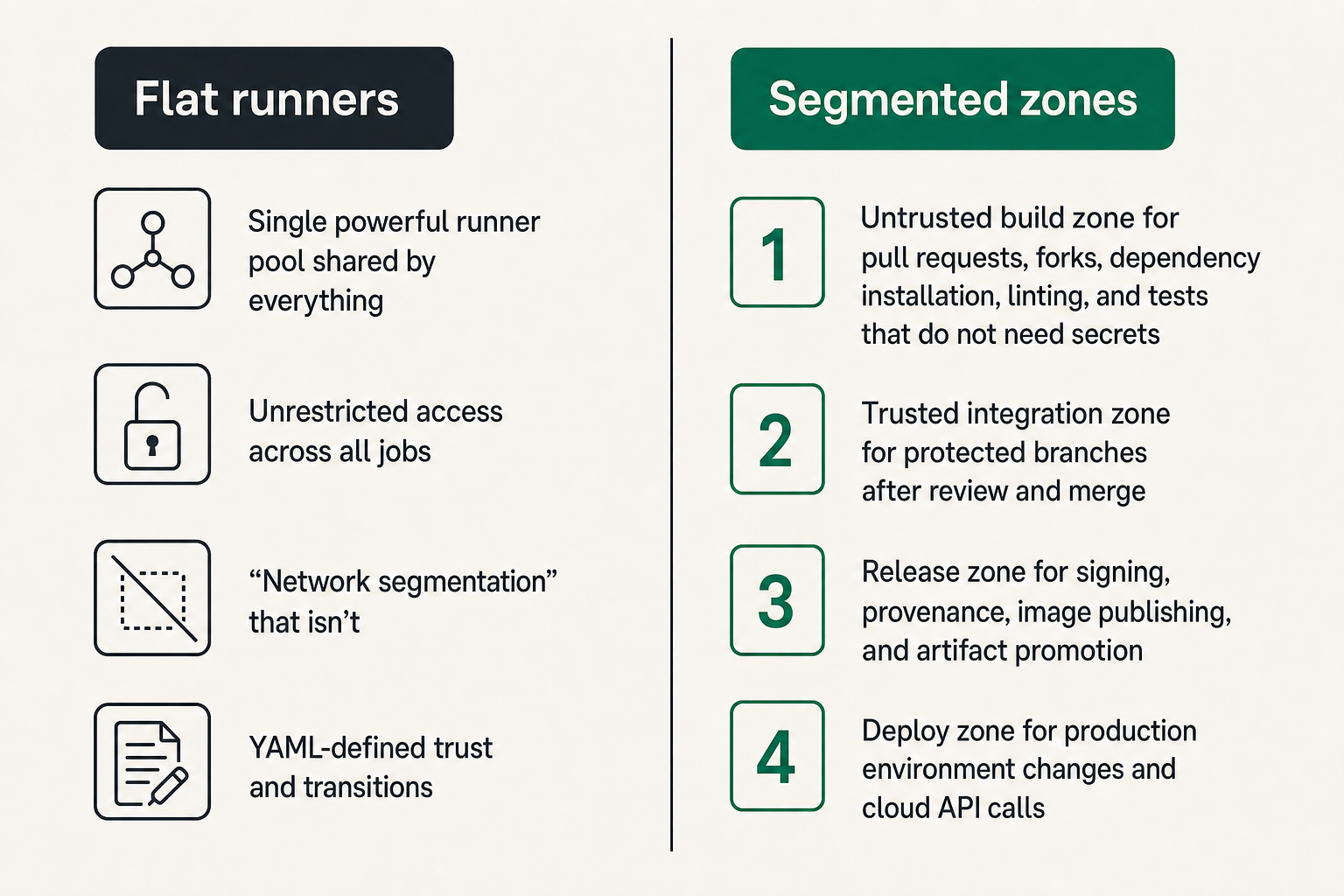
A practical segmentation model separates four zones:
- Untrusted build zone for pull requests, forks, dependency installation, linting, and tests that do not need secrets.
- Trusted integration zone for protected branches after review and merge.
- Release zone for signing, provenance, image publishing, and artifact promotion.
- Deploy zone for production environment changes and cloud API calls.
The key is not only network segmentation. It is transition control. A job should not move from “untrusted code execution” to “release authority” because a YAML file says so. The transition should require branch protection, workflow policy, environment approvals, scoped identity, and artifact validation.
What works and what fails in segmentation
What works is boring and explicit. Use separate runner groups. Use separate identities. Use environment protection. Use private networking only where required. Put release and deploy jobs behind protected branches and narrow egress.
What fails is a single powerful runner pool shared by everything because it is convenient. Another common failure is “network segmentation” that only exists on paper while runners keep broad outbound access and long-lived credentials.
| Approach | What works | What fails |
|---|---|---|
| One runner pool for all jobs | Simple scheduling | Pull request code can inherit too much reach |
| Separate runner groups | Clear blast-radius boundaries | Requires ownership and routing discipline |
| Broad outbound internet | Fewer build breaks | Malware and scripts can exfiltrate easily |
| Egress by job class | Better signal and containment | Needs package and endpoint inventory |
| Shared deploy token | Fast setup | Hard to revoke safely after suspicious runs |
| OIDC per workflow | Short-lived, auditable access | Misconfigured trust policies can overgrant |
A useful default is: untrusted jobs get internet access only to approved package sources and no secrets; release jobs get secrets but almost no arbitrary internet; deploy jobs get cloud access but only after artifact verification.
Control egress because supply-chain attacks call home
Default-deny for package install and build steps
Network security becomes concrete at egress. Malware in a package does not need inbound access. It needs to make an outbound request with a token, environment variable, SSH key, npm token, cloud credential, or repository secret.
That is why unrestricted outbound traffic from CI is dangerous. Package lifecycle scripts can run during install. Build tools can execute plugins. Test frameworks can load browser binaries. Native build steps can fetch additional payloads. The supply chain is full of legitimate reasons to talk to the network, which is exactly why attackers hide there.
The mistake teams make is assuming vulnerability management covers this. Known CVEs are only one slice. Many dependency attacks are malicious before they are known. We covered that gap in more detail in What Dependabot Misses, but the network lesson is simple: a clean CVE scan does not mean a safe install path.
Practical rule: For CI egress, “known good destination for this job class” is a stronger control than “not currently known bad.”
A workable default-deny model for builds usually allows:
- Your source host, such as GitHub.
- Approved package registries and mirrors.
- Internal artifact caches.
- Container registries required for the job.
- Security tooling endpoints that are part of the build.
It should block:
- Random paste sites and file-sharing hosts.
- New domains introduced by pull request code.
- Direct calls to cloud metadata endpoints from untrusted jobs.
- Outbound SSH from build jobs.
- Package install scripts reaching unexpected hosts.
Allowlist design without breaking developers
Bad allowlists fail because they are maintained as static firewall paperwork. Developers route around them, platform teams widen the rule, and security loses the signal.
Better allowlists are generated from workflow context and dependency sources. For example:
job_class: pull_request_test
allowed_egress:
  - github.com
  - api.github.com
  - registry.npmjs.org
  - pypi.org
  - files.pythonhosted.org
  - ghcr.io
blocked_patterns:
  - "*.ngrok-free.app"
  - "*.pastebin.com"
  - "169.254.169.254"
requires_review:
  - new_domain_from_pr
  - install_script_network_call
  - outbound_ssh
This is not perfect. Some ecosystems are messy. Mirrors, CDNs, binary downloads, and transitive tooling can be noisy. The practical question is where to enforce hard blocks and where to generate review signals.
For high-friction ecosystems, start with visibility mode. Record destination, process, package, job, repository, branch, and commit SHA. After two or three release cycles, promote stable destinations to allowlists and alert on drift.
Secure ingress to the pipeline and its webhooks
Webhook exposure is application attack surface
Ingress still matters. CI/CD systems receive webhooks from Git hosts, registries, ticketing systems, chat tools, scanners, deployment platforms, and internal services. Each webhook is an input to automation.
If an attacker can spoof a webhook, replay an old event, or trigger a privileged workflow with attacker-controlled parameters, they can influence the pipeline without touching production ingress. That is why webhook receivers should be treated like application endpoints, not integration conveniences.
At minimum, webhook ingress needs:
- Signature verification using the provider’s recommended scheme.
- Timestamp validation to reduce replay risk.
- Idempotency keys or event IDs to prevent duplicate execution.
- Strict parsing of event type and repository or organization scope.
- Isolation between notification-only events and privileged actions.
- Logs that preserve headers, signature status, source, and action taken.
Authentication, replay protection, and source validation
Webhook security fails when teams verify one thing and trust five others. A valid GitHub signature does not mean the event should deploy. It means the event came from GitHub and was signed with the configured secret. You still need to validate repository, branch, actor, event type, workflow, and environment.
A safer receiver pattern looks like this:
- Verify provider signature and timestamp.
- Parse event type using a strict schema.
- Confirm organization, repository, and installation ID.
- Check whether the event is allowed to trigger the requested action.
- Deduplicate using provider event ID.
- Enqueue a low-privilege internal event.
- Let a policy engine decide whether privileged automation can continue.
The important part is the privilege break. External webhooks should not directly call production deployment APIs. They should request state changes that internal policy can approve or deny.
Use detection signals that understand build context
Network logs need repo and job metadata
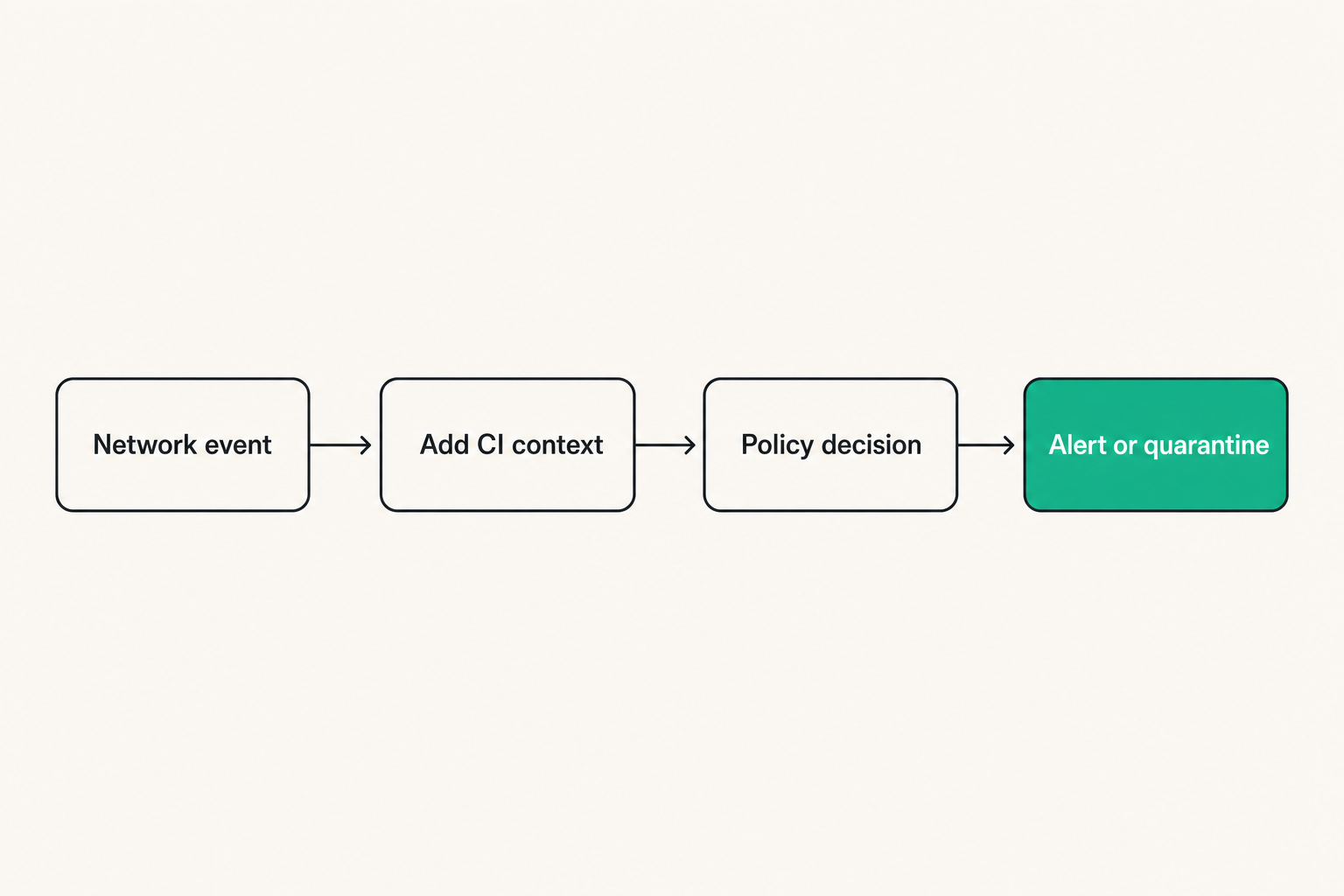
Generic network logs are not enough. “Runner 10.2.4.19 connected to example.net” is weak evidence if the runner is ephemeral and the job context is gone.
Detection needs build metadata attached to network events:
- Organization and repository.
- Workflow name and run ID.
- Job name and job class.
- Commit SHA and branch.
- Pull request number and fork status.
- Actor and triggering event.
- Runner group and image version.
- Process name and command line when available.
- Package being installed when the event occurred.
That changes the conversation from “Is this domain bad?” to “Why did an untrusted fork PR installing a new package call an unapproved domain while a secret-like environment variable existed in the job?”
Network security for CI/CD needs correlation. A DNS lookup is a weak signal. A DNS lookup during npm install for a newly added package with a postinstall script is a much stronger signal. A connection to an unknown endpoint from a release signing job is stronger still.
Alerts that should page versus alerts that should enrich
Not every network anomaly should page. If every new package CDN domain becomes a critical incident, the control will be disabled. The system needs tiers.
Page on events with immediate blast radius:
- Untrusted job reaches cloud metadata or internal address space.
- Release job contacts an unapproved external host.
- Build job sends data to a newly observed domain after secrets are loaded.
- Self-hosted runner attempts lateral movement.
- Workflow downloads executable code from a non-approved source.
Create investigation signals for lower-confidence events:
- New domain during dependency installation.
- Package lifecycle script making network calls.
- New registry source added in a pull request.
- Egress drift from a trusted branch.
- Repeated failed connections to blocked destinations.
Related reading from our network: if you are building escalation paths for security operations, this practical guide to incident command structure for SOC teams maps well to deciding who owns CI/CD containment, evidence, and recovery.
Automate response without bricking delivery
Quarantine jobs, tokens, and artifacts
Response automation in CI/CD has to be precise. If the only option is “turn off all builds,” nobody will use it until the incident is already painful. If the automation is too aggressive, it will block releases for benign package changes.
Useful response actions are scoped:
- Cancel the suspicious workflow run.
- Revoke short-lived credentials associated with the run.
- Mark produced artifacts as quarantined.
- Prevent artifact promotion from that run ID.
- Disable a runner until it is re-imaged.
- Open a security review on the pull request.
- Require maintainer approval for the next run.
- Snapshot logs, environment metadata, and network events.
The important detail is artifact handling. A suspicious job may already have built something. If your response cancels the job but allows the artifact to remain eligible for release, containment is incomplete.
A practical implementation sequence
The practical question is how to implement CI/CD network security without boiling the ocean. Start with the highest-risk paths and build from there.
- Classify workflows. Label jobs as untrusted PR, trusted branch, release, deploy, or administrative.
- Separate runner groups. Ensure untrusted and privileged jobs do not share the same runner pool or network reach.
- Remove secrets from untrusted jobs. Use environment protection and event rules to prevent accidental exposure.
- Collect egress telemetry. Attach repo, workflow, run ID, job, branch, commit, and actor to network events.
- Block obvious dangerous paths. Deny metadata services, internal networks, outbound SSH, and known exfiltration patterns from untrusted jobs.
- Build allowlists by job class. Start with registries, source control, artifact stores, and required security tools.
- Quarantine suspicious artifacts. Prevent promotion when network policy violations occur.
- Test abuse cases. Validate dependency confusion, token exfiltration, runner escape, and webhook replay scenarios.
- Document ownership. Decide who approves new egress, who handles incidents, and who restores delivery.
Practical rule: Response automation should stop promotion before it stops productivity. Blocking a bad artifact is usually safer than blocking every build.
Validate the architecture with abuse cases
Test dependency confusion, token exfiltration, and runner escape
A network security design that has not been abused is just a diagram. Validate it with scenarios that match real software supply-chain behavior.
Start with dependency confusion. Add a package name that should resolve only from an internal registry and verify the runner cannot fetch a public lookalike. Confirm the logs show package name, registry, workflow, and blocked destination.
Then test token exfiltration. In a controlled repository, simulate a malicious install script that attempts to send environment variables to an unapproved endpoint. The expected result depends on job class. In an untrusted PR job, secrets should not exist. In a trusted job, the egress should be blocked or alerted with high severity.
Runner escape is different. For self-hosted runners, test whether job code can reach internal services, metadata endpoints, Docker sockets, Kubernetes APIs, or neighboring workloads. If it can, decide whether that is intentional. Many teams discover that their “isolated” runner is effectively a jump box.
Evidence your controls should produce
Good controls produce evidence. Not just “blocked.” You need enough context for an engineer to reproduce and enough chain-of-custody for incident response.
For suspicious egress, capture:
- Destination domain, IP, port, and protocol.
- DNS response and timing.
- Process or command if available.
- Package manager phase, such as install, build, or test.
- Repository, workflow, job, run ID, and commit.
- Whether the run had secrets or cloud identity.
- Artifact IDs produced before the event.
- Policy decision and response action.
For webhook events, capture:
- Provider event ID.
- Signature verification result.
- Timestamp and replay decision.
- Repository, actor, event type, and branch.
- Internal action requested.
- Policy decision and downstream workflow triggered.
This evidence turns network security from a black box into an engineering workflow. Developers can see why something failed. Security can investigate without guessing. Platform teams can tune policy without weakening it globally.
Common failure modes in CI/CD network security
What breaks when teams implement it badly
CI/CD network security fails in predictable ways.
First, teams deploy controls without workflow context. The firewall sees traffic, but not whether it came from a fork PR, a protected branch, or a release job. That creates noisy alerts and weak decisions.
Second, they centralize approval without speed. Every new package domain needs a ticket. Developers wait. Platform teams get pressured. The policy becomes “allow all temporarily,” and temporary becomes permanent.
Third, they forget artifacts. A malicious run is blocked after the suspicious network call, but the artifact already exists in a bucket or registry. Later, another job promotes it because the release path checks build status, not network policy status.
Fourth, they overtrust hosted runners or under-isolate self-hosted runners. Hosted runners reduce persistence risk but still execute untrusted code with outbound internet unless controlled. Self-hosted runners give more network control but can expose internal systems if poorly isolated.
Fifth, they treat package security and network security as separate programs. They are not separate in the pipeline. A malicious package is code delivered over the network, executed by automation, often near credentials.
Ownership gaps between platform, security, and developers
The hardest part is ownership. Security may define policy, but platform teams operate runners. Developers own dependency changes. Release engineering owns artifact promotion. Cloud teams own identity. Nobody owns the whole path by default.
That is why the workflow needs explicit routing:
- Developers request new dependency sources in code review.
- Platform owns runner segmentation and egress enforcement.
- Security owns detection logic and incident criteria.
- Release engineering owns artifact trust and promotion gates.
- Cloud security owns OIDC trust and production role boundaries.
Related reading from our network: even though it is written for local network operators, this piece on community vocabulary as operating labels is a useful reminder that shared labels determine who owns routing, follow-up, and trust decisions.
A simple ownership matrix helps:
| Decision | Developer | Platform | Security | Release | Cloud |
|---|---|---|---|---|---|
| Add new package registry | Request | Implement route | Review risk | Validate artifact impact | Check identity exposure |
| Change runner group | Consult | Own | Review | Consult | Review network reach |
| Block suspicious egress | Informed | Enforce | Own detection | Quarantine artifacts | Revoke roles if needed |
| Promote release artifact | Informed | Support | Provide signal | Own | Confirm deploy role |
| Webhook trigger policy | Consult | Own receiver | Review abuse cases | Consult | Consult |
The mistake teams make is assuming this will emerge organically. It will not. During an incident, vague ownership becomes delay.
Where vu1nz.com fits in the network security workflow
Pre-merge scanning closes a timing gap
Network security controls are strongest when they see behavior at runtime, but some risks should be caught before a workflow runs with meaningful access. That is where pre-merge scanning matters.
If a pull request adds a new GitHub Actions workflow, changes permissions, introduces a risky third-party action, or adds a suspicious package, waiting for runtime detection is late. You want a review signal before the pipeline creates the risky execution path.
The vu1nz GitHub Action fits there: it scans CI/CD workflow changes and newly added packages in pull requests, giving DevSecOps teams a chance to stop dangerous delivery-path changes before they merge.
This does not replace egress policy, runner segmentation, webhook validation, or artifact quarantine. It makes those controls easier to operate because fewer bad changes reach the point where network enforcement has to save you.
Practical product fit, not another console
A useful way to think about vu1nz.com is as a pre-merge control for the software supply-chain side of network security. It sits close to the pull request, where developers already make decisions, and flags workflow and package changes that can alter network trust.
That matters because CI/CD risk often enters through normal engineering work:
- A new package with install-time behavior.
- A workflow permission change.
- A third-party action pinned poorly.
- A job that starts using secrets in the wrong event context.
- A dependency source that changes the build’s network path.
vu1nz.com is not trying to be your SIEM, firewall, or cloud network controller. The better fit is architectural: use it to reduce risky changes before they become runtime events, then let your network controls, logs, and response automation enforce policy during execution.
For security engineers and DevSecOps teams, that closes a practical loop: scan the proposed change, constrain the execution environment, observe network behavior, and quarantine outputs when trust is violated.
Network security in 2026 is not only about packets. In CI/CD, it is about controlling the path from proposed code to trusted artifact to production change.
Try vu1nz.com
vu1nz.com is for security engineers and DevSecOps teams who need to defend CI/CD pipelines and software supply chains from modern attacks. Try vu1nz.com.
Catch the next supply-chain attack on the PR that adds it.
14-day free trial · no card required