Your GitHub Actions workflow fails at 02:17. The build log includes a suspicious package resolution, a token rotation warning, and a maintainer mention. The alert lands in a shared channel with enough context for the team to move fast. It also lands in a place too many people can read.
That is where encrypted messaging github actions security becomes practical. Not as a privacy feature bolted onto chat, but as a control plane for how CI/CD systems communicate sensitive events.
Teams think the problem is sending fewer secrets to Slack or email. The real problem is that CI/CD pipelines generate operational intelligence: exploit paths, signing failures, dependency names, repository structure, incident timing, and response decisions. If that intelligence is broadcast through weak channels, your pipeline becomes a reconnaissance feed.
The practical question is not whether developers need alerts. They do. The question is how to design CI/CD messaging so the right humans and systems get enough information to act, without turning every failed job into a supply chain leak.
Table of contents
- Why encrypted messaging GitHub Actions security is an architecture problem
- Threat model the communication layer, not just the runner
- Where GitHub Actions leaks operational context
- Build a secure messaging lane for CI/CD
- Design encrypted messages for workflow events
- Implementation workflow for GitHub Actions
- What works in production
- What fails when teams bolt this on
- Validate the messaging path like a security control
- Measure response quality, not notification volume
- Making encrypted messaging GitHub Actions security operational
Why encrypted messaging GitHub Actions security is an architecture problem
Encrypted messaging GitHub Actions security sounds like a narrow implementation detail. In practice, it is a design choice about trust boundaries.
A GitHub Actions workflow is not just a build script. It is a programmable automation system with access to source code, package registries, cloud credentials, signing material, deployment targets, and security findings. When that system emits a message, the message often carries more than status. It carries a map of what happened, where it happened, and who is expected to respond.
The mistake teams make is treating messaging as the last mile of alerting. The workflow finishes, a notification fires, and everyone moves on. That works until the alert includes a failed secret scan, a dependency confusion signal, a private package name, or a signing key rotation failure.
The message is part of the attack surface
If a message can influence human response, it can be abused. If it contains sensitive pipeline context, it can be mined. If it links to privileged logs, it can become the easiest path to internal state.
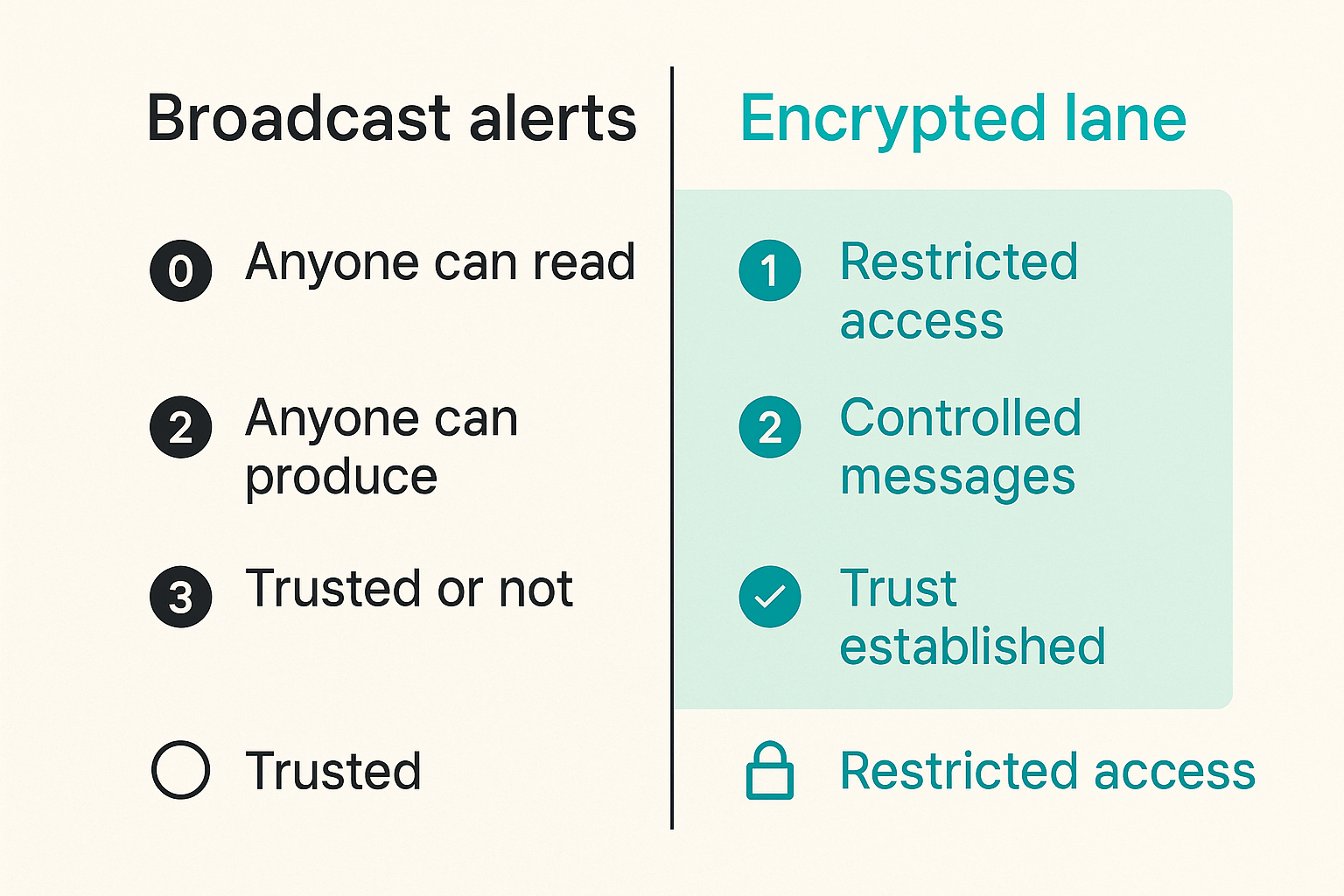
A useful way to think about it is this: every CI/CD message has three security properties.
- Who is allowed to read it.
- Who is allowed to produce it.
- Whether the recipient can trust it enough to act.
Encryption only solves one part of the first property. You still need event selection, payload minimization, recipient mapping, sender authentication, replay handling, audit trails, and operational ownership.
Practical rule: if a CI/CD message would help an attacker prioritize their next move, treat it as sensitive even when it contains no literal secret.
Why this matters more in 2026
Modern supply chain attacks are not limited to stealing a token and pushing code. Attackers look for maintainer behavior, package release timing, failed security controls, noisy automation, and human escalation paths. GitHub Actions often sits in the middle of all of it.
At the same time, DevSecOps teams have pushed more detection into CI: dependency review, provenance checks, SAST, secret scanning, container scanning, OIDC policy checks, SBOM generation, and release signing. That changes the conversation. Your pipeline now produces high-value security telemetry, and telemetry needs a secure path to responders.
Encrypted messaging is not a replacement for GitHub permissions, runner isolation, or secret management. It is the communication layer that prevents security workflows from leaking their own findings.
Threat model the communication layer, not just the runner
Most CI/CD threat models focus on untrusted pull requests, compromised actions, dependency poisoning, credential exposure, and runner persistence. Those are necessary. They are not sufficient.
The communication layer has its own failure modes. A malicious workflow can send fake approvals. A compromised integration can read alerts. A broad chat channel can expose incident detail to contractors or dormant accounts. A noisy notification rule can train people to ignore the only message that mattered.
Attackers want context before credentials
Credentials are useful, but context makes them powerful. A leaked deployment token is more useful if the attacker knows which repository deploys production, when release windows happen, which checks are flaky, and which team owns the service.
CI/CD messages often reveal exactly that. Consider these examples:
- A dependency scan alert names an internal package and vulnerable version.
- A failed deploy notification includes the production environment name.
- A provenance check failure identifies the signing workflow.
- A secret rotation job says which credential was rotated.
- A manual approval message exposes who can approve emergency releases.
None of those are passwords. All of them are operational intelligence.
Define what a CI/CD message can reveal
Before adding encrypted delivery, classify the message types your workflows produce. Do this at the event level, not the tool level.
| Message type | Typical content | Risk if exposed | Recommended handling |
|---|---|---|---|
| Build status | Job name, branch, commit | Low to medium | Public or team channel if repository visibility allows |
| Security finding | Package, file path, rule, severity | Medium to high | Encrypted to owning team and security triage |
| Secret scan hit | Location, token type, actor | High | Encrypted to incident responders only |
| Release approval | Environment, approvers, artifact hash | High | Encrypted plus signed provenance reference |
| Deployment failure | Target, rollback state, error class | Medium to high | Encrypted for production systems |
| Incident coordination | Actions taken, hypotheses, owners | High | Encrypted with tight membership and audit metadata |
The table is intentionally simple. The goal is to force an architectural decision: some messages can be broad, some must be private, and some should not be sent at all.
Practical rule: classify CI/CD messages by the value of the context they reveal, not by whether they contain a credential string.
Where GitHub Actions leaks operational context
GitHub Actions gives teams many surfaces for feedback. That is useful for developer velocity. It also creates inconsistent security boundaries.
What breaks in practice is not one obvious leak. It is the combination: a job summary here, an artifact there, a pull request comment, a chat alert, and an email forwarded to a shared mailbox. Each piece looks harmless. Together they describe the pipeline.
Logs, artifacts, annotations, and comments
The first surface is inside GitHub itself. Workflows produce logs. Actions can upload artifacts. Checks can annotate files. Bots can comment on pull requests. Job summaries can render markdown. These are all messaging systems, even if teams do not call them that.
Common problems include:
- Security scanners printing too much evidence into logs.
- Uploading raw reports as artifacts with broad repository access.
- Bot comments exposing private package names on pull requests.
- Job summaries containing remediation instructions meant for security teams.
- Debug flags enabled during incident response and forgotten afterward.
GitHub permissions matter here, but visibility is not binary. A private repository may still have many readers. A public repository may run workflows on untrusted contributions. An enterprise may have outside collaborators with legitimate code access but no need to see incident detail.
ChatOps, email, issue trackers, and paging tools
The second surface is outside GitHub. Many teams send workflow alerts to chat, incident tools, ticketing systems, or email. The risk shifts from repository access control to integration access control.
The mistake teams make is assuming that because a chat platform supports private channels, the workflow message is secure. Usually the problem is more complicated:
- Webhook URLs become long-lived secrets.
- Channel membership drifts over time.
- Bot tokens have broad workspace access.
- Incident tickets inherit default project permissions.
- Email distribution lists include former responders.
- Message exports or backups have different access rules.
Encrypted messaging narrows the readable audience, but only if it is designed as a lane with explicit producers, recipients, and metadata. If you simply encrypt the same oversized alert and drop it into the same unowned channel, you have reduced one risk while preserving several others.
Build a secure messaging lane for CI/CD
The secure messaging lane is a pattern, not a product category. It is the path a sensitive workflow event takes from GitHub Actions to the humans or systems allowed to act on it.
Think of it as a small pipeline next to your main pipeline. It has inputs, transformations, policies, delivery, acknowledgements, and logs. That sounds heavier than a webhook. It is. Sensitive CI/CD communication deserves more than a webhook.
Separate producers, brokers, and recipients
A clean design separates three roles.
- Producers create events. In this case, GitHub Actions workflows, security scanners, release jobs, and policy checks.
- Brokers classify and route events. This can be a small service, a serverless function, or an internal automation platform.
- Recipients decrypt and act. These are team inboxes, secure messaging clients, incident responders, or downstream systems.
This separation gives you control points. Producers should not decide every recipient directly. Recipients should not need access to raw workflow secrets. Brokers should not be able to silently alter message meaning without traceability.
A minimal architecture looks like this:
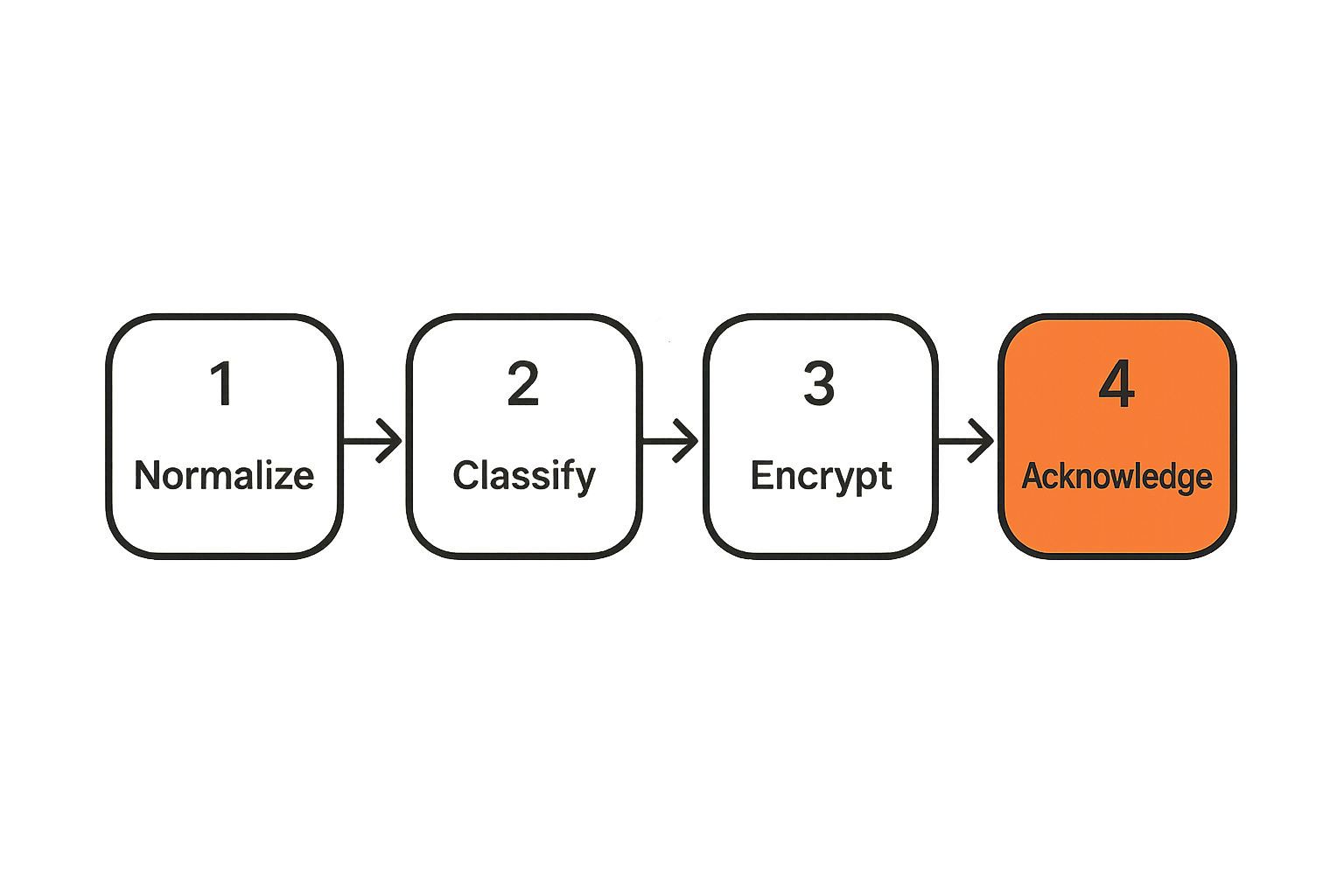
GitHub Actions event
  -> normalize event
  -> classify sensitivity
  -> encrypt payload for recipient group
  -> deliver message
  -> record delivery metadata
  -> require acknowledgement for high severity
Treat policy as a routing decision
Policy should answer practical questions:
- Is this event safe for a normal repository channel?
- Does it include security evidence?
- Is it tied to production or release infrastructure?
- Does it involve a secret, token, certificate, or signing key?
- Which team owns the repository, package, or environment?
- Should the message require acknowledgement?
This is where encrypted messaging becomes more than privacy. It becomes a way to enforce least privilege for operational context.
Practical rule: the workflow should produce a normalized event; policy should decide who can read it.
Design encrypted messages for workflow events
Encryption is not a license to send everything. It is a protection mechanism for content you have already decided is necessary.
The best encrypted CI/CD messages are usually small. They tell the recipient what happened, why it matters, what to verify, and where to retrieve more detail through an authenticated path. They do not replicate entire logs.
Minimize payloads before encrypting them
Payload minimization is the cheapest control you can apply. A good message should include:
- Event type.
- Repository or service identifier.
- Workflow run identifier.
- Severity or policy decision.
- Short human-readable summary.
- Pointer to the authoritative record.
- Required action and owner.
- Expiration or review deadline when relevant.
Avoid including:
- Raw tokens or masked token fragments.
- Full scanner reports.
- Environment variable dumps.
- Complete stack traces from production systems.
- Internal package registry URLs when a stable identifier is enough.
- Names of unrelated services discovered during a broad scan.
The practical question is whether the recipient can start the right workflow from the message. If they need deeper evidence, send them to a controlled system with proper authorization.
Bind messages to identity and provenance
Recipients need to know that a message came from the workflow it claims to represent. This matters because CI/CD messaging can trigger human action: rotate a secret, approve a release, block a deployment, or investigate a package.
At minimum, bind the message to:
- Repository.
- Workflow name.
- Run ID.
- Commit SHA.
- Actor or triggering event.
- Environment when relevant.
- Timestamp.
- Broker policy version.
If your organization uses OIDC federation, signed artifacts, or provenance attestations, reference those records rather than copying them. The message should carry enough provenance to verify the event, not enough sensitive data to become the source of truth.
As the team at qrypt.chat, we see the same pattern in secure communication work generally: confidentiality helps, but trust comes from the combination of encryption, identity, metadata discipline, and operational rules.
Implementation workflow for GitHub Actions
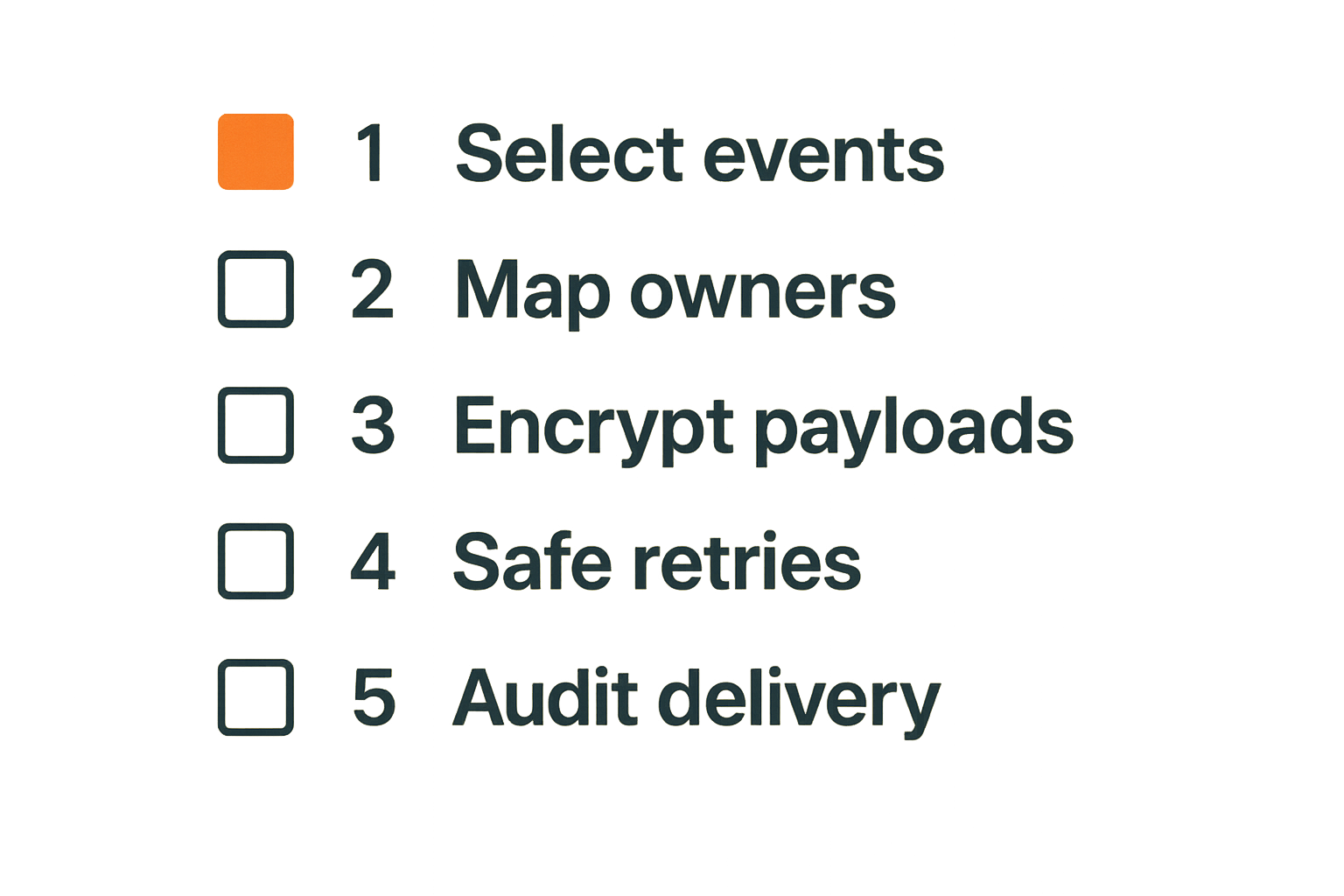
Implementation should start with a narrow event set. Do not begin by replacing every CI notification. Begin with the events where exposure creates real risk and where responders are clearly defined.
The mistake teams make is trying to secure all messages at once. That produces a slow migration, confused ownership, and a half-secure system. Start with the highest sensitivity events, prove the lane, then expand.
Select the events that deserve encrypted routing
A practical first pass usually includes:
- Secret scanning detections in private repositories.
- Release signing failures.
- Failed production deployment approvals.
- Dependency confusion or unexpected registry resolution.
- Security scanner findings above a defined severity.
- Changes to workflow files in protected repositories.
- OIDC trust policy failures.
- Package publication anomalies.
For each event, document the owner, recipient group, expected response, and maximum acceptable delay. If you cannot name the owner, do not automate the message yet. Fix ownership first.
Use envelope encryption and delivery receipts
A common pattern is envelope encryption. The workflow or broker generates a content key for the message, encrypts the payload, then encrypts the content key for the recipient group or key management system. The broker stores only metadata needed for routing and audit.
A simplified sequence:
- GitHub Actions emits a normalized event with minimal fields.
- The broker validates repository, workflow, and trigger context.
- The broker classifies the event sensitivity.
- The broker encrypts the payload for the approved recipient group.
- The delivery service sends the encrypted message.
- Recipients acknowledge receipt or create an incident record.
- The broker records metadata: event ID, policy version, delivery time, acknowledgement state.
This design keeps sensitive content away from broad infrastructure while preserving enough auditability to operate the system.
Make retries safe with idempotency
CI/CD systems retry. Networks fail. Webhooks duplicate. Runners get cancelled. If your secure messaging lane cannot handle duplicates, responders will either miss messages or receive conflicting alerts.
Give each message a stable idempotency key derived from non-secret context:
repository + workflow_run_id + job_id + event_type + policy_version
Then define retry behavior:
- Duplicate delivery with the same idempotency key updates status, not content.
- Expired events are not resent without a new policy decision.
- Acknowledgement state survives retries.
- Failed encryption blocks delivery and raises a separate operational alert.
- Failed delivery does not print the sensitive payload into Actions logs.
What works is boring reliability. What fails is clever alerting that cannot explain whether a message was sent, received, decrypted, and acknowledged.
What works in production
Teams that make this work usually do less than expected. They do not encrypt every developer notification. They identify the sensitive paths where CI/CD communication overlaps with incident response, release integrity, or privileged operations.
They also keep the user experience direct. A responder receives a concise message, verifies provenance, follows a controlled link or run reference, and takes an action that is tracked somewhere durable.
Route by sensitivity, not by repository popularity
Repository importance matters, but sensitivity is more precise. A small internal package can be more sensitive than a large web repository if it sits in the build path for many services. A low-traffic infrastructure repo can be critical if it controls OIDC trust policies.
Good routing uses multiple signals:
- Repository classification.
- Environment target.
- Package ownership.
- Workflow file path.
- Branch protection level.
- Scanner severity.
- Whether the event is on a release path.
- Whether the event changes trust material.
This keeps encrypted messaging focused. Developers still get normal build feedback. Security and platform teams get private, actionable messages when pipeline context becomes sensitive.
Keep break-glass workflows boring
Break-glass is where many secure messaging designs become fragile. A production deploy is blocked, the normal recipient is unavailable, and someone needs to act. If the secure lane becomes an obstacle, people route around it.
A usable break-glass design should define:
- Who can request emergency access.
- Who can approve access.
- How long access lasts.
- What message history becomes visible.
- How the action is reviewed afterward.
- Which systems must record the exception.
Do not make responders negotiate cryptographic ceremony during an outage. Predefine groups, backup owners, and escalation rules. Security controls that only work during calm business hours are not production controls.
What fails when teams bolt this on
Encrypted messaging fails when it is treated as a wrapper around existing habits. The same oversized messages, weak ownership, and broad routing remain. Only now everyone feels safer because the word encrypted appears in the architecture diagram.
That is worse than doing nothing, because it creates false confidence.
Dumping logs into an encrypted wrapper
Full logs are rarely the right payload. They are noisy, hard to classify, and likely to include sensitive material from unrelated steps. Encrypting them does not solve data minimization. It only changes who can read the mess.
Better pattern:
- Store logs in the system of record with existing access control.
- Extract the specific finding or policy result.
- Send a short encrypted summary.
- Include a run reference and evidence pointer.
- Require authentication before deeper evidence is viewed.
The message is a trigger for workflow, not a replacement for evidence management.
Static recipients and forgotten ownership
Static recipient lists drift. Teams reorganize, services move, contractors leave, and incident rotations change. If your secure lane depends on a manually maintained list from last quarter, it will fail quietly.
Tie recipients to authoritative ownership data where possible:
- CODEOWNERS for repository-level signals.
- Service catalog for production systems.
- Package metadata for publishing events.
- On-call schedules for urgent incidents.
- Security team queues for cross-cutting findings.
When ownership is ambiguous, route to a triage function and create a task to fix metadata. Do not silently broadcast to everyone.
Secrets that move sideways into notifications
Secrets rarely leak only from obvious variables. They appear in command output, tool debug logs, stack traces, generated configuration, and copied remediation snippets.
Common sideways leaks include:
- A scanner prints the matched secret context.
- A deployment script echoes cloud account identifiers and role names.
- A package manager prints private registry paths.
- A failed curl command includes authorization headers.
- A bot comment copies the exact failing command.
The fix is layered: prevent secret printing, mask known patterns, avoid debug output by default, minimize encrypted payloads, and review message templates like code.
Validate the messaging path like a security control
A secure messaging lane is not done when the first encrypted message arrives. It needs tests, failure drills, and review. Treat it like any other control in your CI/CD security program.
The validation goal is simple: prove that sensitive pipeline events are delivered only to the right recipients, with enough integrity to support action, and with enough audit data to investigate failures.
Test confidentiality, integrity, and delivery
Build tests around realistic failure modes:
- A low-privilege repository event should not reach production responders.
- A forged event should fail validation.
- A revoked recipient should not decrypt new messages.
- A workflow rerun should not create duplicate incident records.
- A broker outage should not dump payloads into logs.
- A missing owner should route to triage, not to a public channel.
These can be implemented as scheduled test workflows or as part of a platform security test suite. The important part is that they run repeatedly. One clean manual test during rollout is not assurance.
Audit without rebuilding the sensitive payload
Audit trails should not require storing plaintext copies of every sensitive message. You usually need metadata, not content.
Useful audit fields include:
- Event ID.
- Repository and workflow run reference.
- Classification decision.
- Policy version.
- Recipient group identifier.
- Delivery status.
- Acknowledgement timestamp.
- Break-glass flag if used.
- Error class for failed delivery.
Avoid storing decrypted payloads in the broker unless you have a clear retention and access model. A messaging security system should not become a shadow data lake of incident evidence.
Measure response quality, not notification volume
Teams often measure alerting by volume: messages sent, channels configured, repositories onboarded. Those numbers are easy. They are also weak indicators of security value.
Encrypted messaging GitHub Actions security should improve response quality. That means faster triage for sensitive events, fewer unnecessary readers, fewer duplicate alerts, and less context leakage.
Metrics that expose real workflow health
Useful metrics include:
| Metric | Why it matters | Bad smell |
|---|---|---|
| Sensitive events routed privately | Shows coverage of high-risk cases | Everything is public by default |
| Median acknowledgement time | Shows whether recipients act | Messages are delivered but ignored |
| Duplicate message rate | Shows retry quality | Responders see repeated alerts |
| Unknown owner rate | Shows metadata quality | Security becomes default owner for everything |
| Failed encryption rate | Shows key and recipient health | Delivery silently falls back to plaintext |
| Payload size trend | Shows minimization discipline | Messages grow into log bundles |
The point is not to create another dashboard nobody reads. The point is to notice when the secure lane stops matching reality.
Ownership model for secure CI/CD messaging
Ownership should be explicit:
- Platform engineering owns the GitHub Actions integration pattern.
- Security engineering owns classification rules for sensitive events.
- Service teams own response to their repositories and packages.
- Incident response owns escalation and break-glass behavior.
- Compliance or governance may own retention requirements.
If every encrypted message goes to security by default, the system will become a bottleneck. If every message goes to service teams without security context, high-risk events will be mishandled. Split ownership by decision type.
Practical rule: encrypted CI/CD messaging is a shared control; platform owns the path, security owns sensitivity rules, and service teams own the fix.
Making encrypted messaging GitHub Actions security operational
Encrypted messaging GitHub Actions security becomes useful when it is connected to the rest of your pipeline defense work. It should not be a sidecar project owned by one enthusiastic engineer. It should be part of how your organization handles sensitive CI/CD events.
The operating model is straightforward:
- Identify sensitive workflow events.
- Normalize the event payload.
- Classify sensitivity with policy.
- Encrypt only the required message content.
- Route to the smallest useful recipient group.
- Preserve provenance and delivery metadata.
- Test the path continuously.
- Review ownership drift.
Where vu1nz.com fits the workflow
vu1nz.com focuses on CI/CD and software supply chain security for teams that need more than generic best practices. That matters here because encrypted messaging is only valuable if the events are worth routing in the first place.
You still need to understand how workflows are abused, how package ecosystems fail, how GitHub Actions permissions interact with pull requests, and where automation creates new trust boundaries. The secure message lane is the response path for that work. It connects detection to the people who can verify and act without leaking the finding to everyone else.
For DevSecOps teams, the product fit is architectural: use rigorous pipeline testing and supply chain research to decide what deserves private routing, then make encrypted communication part of the workflow rather than an afterthought.
Decision checklist
Use this checklist before shipping encrypted CI/CD messaging:
- Have you classified message types by context sensitivity?
- Do workflows emit minimal normalized events instead of raw logs?
- Is recipient selection based on ownership data?
- Can recipients verify repository, run, commit, and policy version?
- Are retries idempotent?
- Does failed delivery avoid plaintext fallback?
- Can you audit delivery without storing decrypted payloads?
- Is break-glass behavior defined and reviewed?
- Are message templates reviewed like code?
- Does someone own the system after rollout?
If the answer to several of these is no, pause the rollout. The control is not mature enough yet.
Encrypted messaging will not fix a weak pipeline. It will not save a compromised runner, replace least-privilege tokens, or make unreviewed third-party actions safe. But it does close a gap many teams leave open: the sensitive communication generated by their own security automation.
That is the real value of encrypted messaging github actions security. It keeps CI/CD findings, response decisions, and release-sensitive context on a controlled path from detection to action.
Try vu1nz.com
vu1nz.com publishes practical CI/CD and supply chain security research for engineers defending real pipelines. Try vu1nz.com.
Catch the next supply-chain attack on the PR that adds it.
14-day free trial · no card required