Cyber security software used to be evaluated like a procurement checkbox: vulnerability scanner, SAST, dependency scanner, dashboard, ticket export. That model breaks when the thing you are defending is not a static application but a constantly changing CI/CD system.
A pull request can add a GitHub Actions workflow, introduce a new npm package, change a build script, request broader token permissions, and ship within an hour. By the time a weekly report says something looks suspicious, the artifact may already be in production.
Teams think the problem is buying more cyber security software. The real problem is deciding where security control belongs in the software delivery workflow.
That changes the conversation. The practical question is not “which tool has the longest feature list?” It is “which controls can observe the right change, at the right moment, with enough context to block or route risk before it becomes an incident?”
Table of contents
- Cyber security software is now a pipeline architecture decision
- Start with the workflow, not the vendor category
- The CI/CD attack surface your tools must understand
- Dependency scanning is necessary but incomplete
- What good cyber security software does in a pull request
- Signal quality beats scanner count
- Implementation workflow for CI/CD security controls
- Common failure modes when teams implement cyber security software badly
- How to evaluate vendors and open-source tools
- Where vu1nz.com fits
- Closing the loop on cyber security software
Cyber security software is now a pipeline architecture decision
Why traditional tooling misses delivery-layer risk
Most security programs still have tools organized around old boundaries: application code, infrastructure, endpoints, cloud accounts, identities, and tickets. Those categories still matter, but modern software delivery cuts across all of them.
A GitHub Actions workflow can request an OIDC token, run third-party code, download packages, build an artifact, publish a container, and deploy to cloud infrastructure. That single YAML file may affect identity, secrets, build integrity, artifact provenance, and production release paths.
The mistake teams make is treating CI/CD as plumbing. In practice, the pipeline is privileged production infrastructure with a developer-friendly interface.
If your cyber security software only sees source code after merge, dependencies after release, or cloud drift after deployment, it is looking at the system too late. You may still catch known vulnerabilities. You will miss risky workflow changes, package introduction patterns, suspicious install scripts, permission expansion, and unreviewed automation paths.
Where control needs to sit
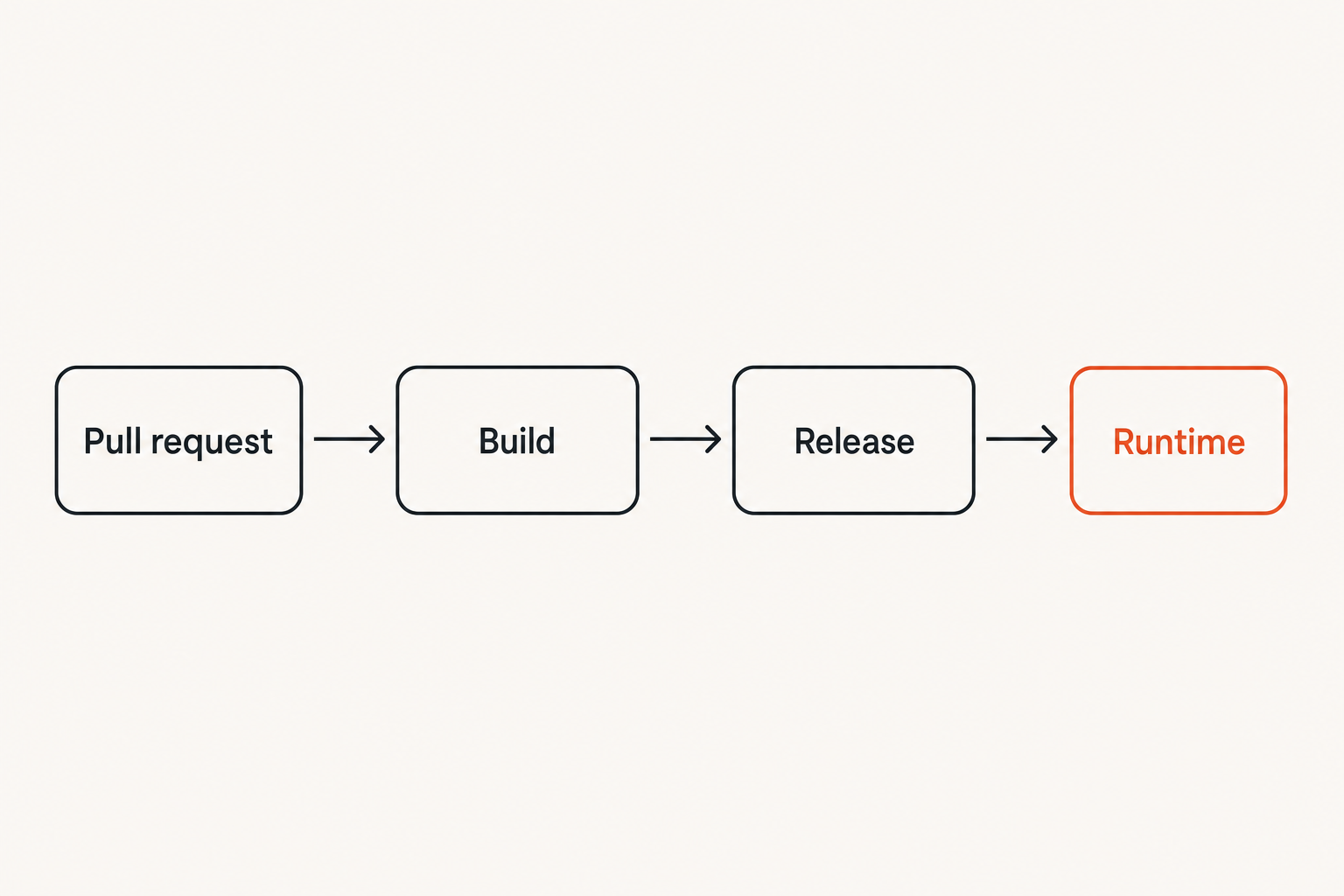
A useful way to think about it is control proximity. The closer a control is to the change that creates risk, the cheaper and more accurate the response can be.
- A PR check can block a dangerous workflow permission before merge.
- A package scanner can flag a suspicious dependency before it lands in the lockfile.
- A release policy can stop unsigned artifacts before deployment.
- A runtime detector can catch exploitation after impact has started.
You need all layers, but they are not equivalent. Runtime detection is necessary, not a substitute for pre-merge control.
Practical rule: If a security issue is introduced by a pull request, first ask whether it can be detected and handled inside the pull request.
Related reading from our network: SOC teams face a similar control-placement problem when endpoint action is disconnected from detection, and this breakdown of fleet response architecture is useful if you think in terms of triggers, ownership, and response loops.
Start with the workflow, not the vendor category
Map the path from pull request to production
Before evaluating cyber security software, map the delivery path. Not the idealized architecture diagram. The actual path.
For each repository or service tier, document:
- who can open and approve pull requests;
- which branches trigger privileged workflows;
- which workflows can access secrets;
- which package ecosystems are used;
- where artifacts are built and stored;
- how deployments are triggered;
- which steps require human approval;
- where logs and decisions are retained.
This map usually reveals why scanner-only programs feel noisy. The scanner is reporting technical facts without knowing whether the affected path can publish an artifact, access secrets, or deploy to production.
What breaks in practice is not only detection. It is prioritization. A vulnerable dev dependency in a sandbox package and a newly added install-time script in a production build path should not land in the same queue with the same urgency.
Separate advisory tools from enforcement tools
Not every tool should block builds. Some tools are useful because they inform engineers, enrich tickets, or support research. Others must produce a pass/fail decision.
The important part is being explicit.
| Tool behavior | Good use | Bad use |
|---|---|---|
| Advisory | Research, backlog grooming, trend analysis | Pretending unread dashboards reduce risk |
| Soft gate | Warn on medium risk, require owner acknowledgement | Letting every warning become normalized noise |
| Hard gate | Stop credential exposure, dangerous workflow permissions, known exploited issues | Blocking ambiguous findings with no override path |
| Evidence store | Audit, incident review, policy validation | Collecting logs nobody can query during an incident |
A tool can play more than one role, but each role needs a workflow. If the tool creates findings, who triages them? If it blocks, who can override? If it warns, what turns a warning into policy?
Practical rule: A security tool without a routing model is not a control. It is a source of work.
The CI/CD attack surface your tools must understand
Workflow files are executable infrastructure
CI/CD security is not just about whether a repository contains vulnerable code. It is about whether the automation around that code can be abused.
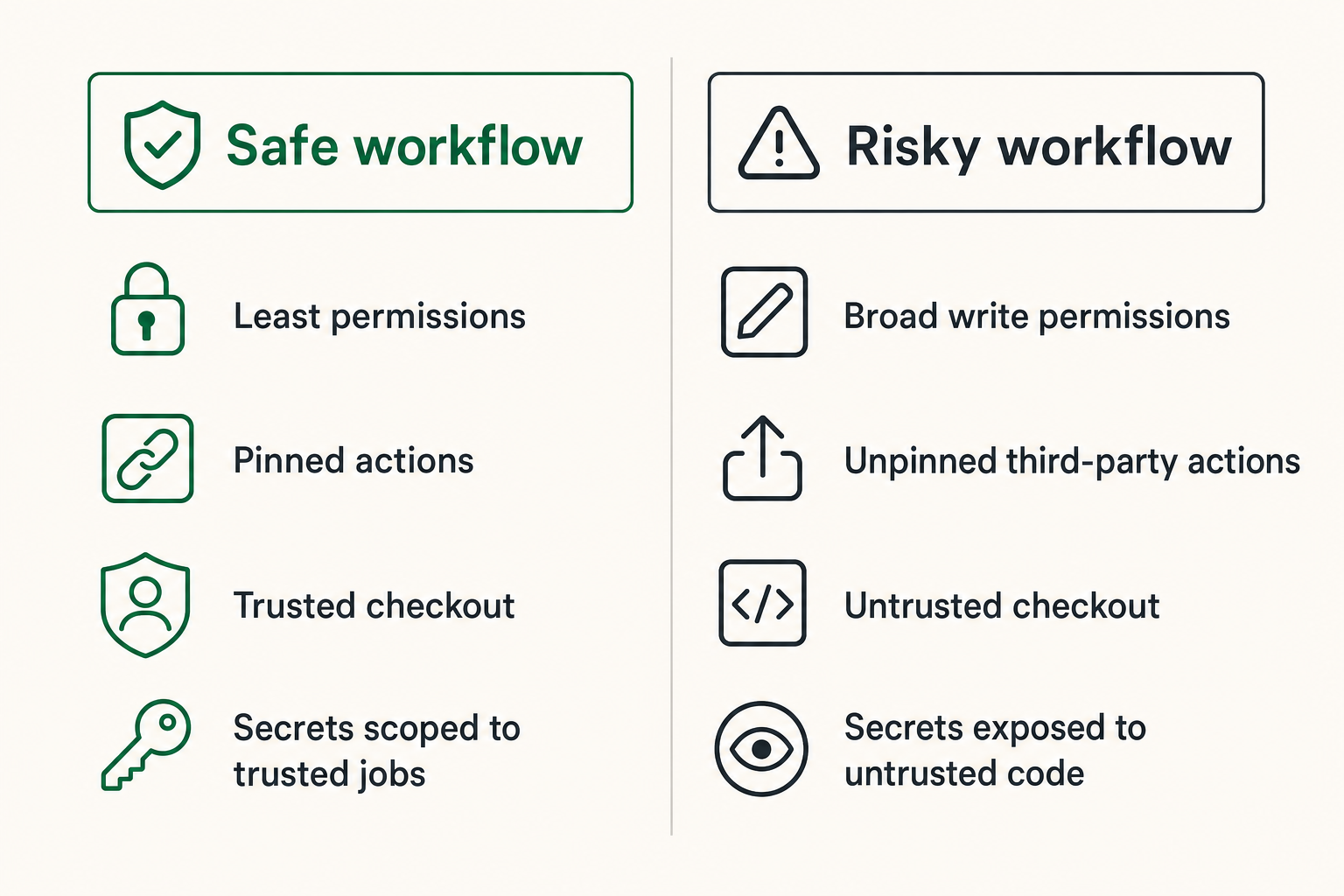
In GitHub Actions, the risky details often live in small changes:
pull_request_targetused with untrusted checkout behavior;- broad
contents: writeorid-token: writepermissions; - unpinned third-party actions;
- shell injection through PR-controlled variables;
- secrets exposed to jobs that run untrusted code;
- artifact upload/download paths that cross trust boundaries;
- release workflows triggered from mutable branches.
A generic code scanner may not understand the execution semantics. A cloud scanner may only see the downstream damage. CI/CD-aware cyber security software needs to parse workflow context and understand how permissions, triggers, and checkout patterns interact.
Example of a risky pattern:
on: pull_request_target

permissions:
  contents: write
  id-token: write

jobs:
  build:
    runs-on: ubuntu-latest
    steps:
      - uses: actions/checkout@v4
        with:
          ref: ${{ github.event.pull_request.head.sha }}
      - run: npm install && npm test
The issue is not one line. It is the combination: privileged event, write permissions, untrusted code checkout, and package execution.
Secrets, tokens, and runner context matter
Security tools that ignore runner context are half blind. A job running on a locked-down ephemeral runner with no secrets is different from a job running on a self-hosted runner with internal network reachability.
The practical question is: what can this job touch if compromised?
At minimum, evaluate:
- repository token permissions;
- cloud federation permissions;
- organization and environment secrets;
- self-hosted runner labels and network access;
- artifact write permissions;
- package registry publish rights;
- deployment credentials.
This is where many teams underestimate CI/CD risk. They look at YAML as configuration. Attackers look at it as an execution plan.
Related reading from our network: software launch teams have an adjacent problem with system-of-record drift, and the discussion of product catalog architecture maps well to security teams trying to define ownership and source-of-truth boundaries.
Dependency scanning is necessary but incomplete
Known CVEs are only one risk class
Dependency scanners are useful. You should run them. Known CVEs, vulnerable transitive dependencies, abandoned packages, and license issues all matter.
But supply-chain attacks often do not start as CVEs. They start as behavioral anomalies: a new maintainer, a typosquat, an install script, credential harvesting, obfuscated code, dependency confusion, or a package that is too new to have reputation.
That is why a dependency program based only on advisory databases will always lag some classes of attack. The scanner can be accurate and still late.
We have written about this exact gap in what Dependabot misses: advisory-driven tools are valuable, but they are not designed to catch every malicious package before the ecosystem has named the issue.
New package behavior needs review at merge time
The highest-leverage dependency event is not “a vulnerability exists somewhere in the tree.” It is “this pull request adds a new package or changes how package code executes.”
That changes the workflow. Instead of scanning the entire dependency graph with the same priority every night, focus on deltas:
- new direct dependencies;
- new lockfile entries;
- install scripts added to the build path;
- packages from unfamiliar namespaces;
- packages with suspicious names or low ecosystem reputation;
- dependency source changes from registry to Git URL;
- postinstall behavior that touches network, filesystem, or credentials.
Practical rule: Treat newly introduced package execution as a code review event, not just a vulnerability management event.
A practical PR comment should not say “package risk detected” and stop there. It should explain which package changed, why the behavior is suspicious, whether the package runs during install/build/test, and what the reviewer should do next.
What good cyber security software does in a pull request
It produces a decision, not just a finding
A pull request is a decision point. Merge or do not merge. Request changes or accept risk. Route to an owner or auto-approve.
Good cyber security software respects that. It should translate technical findings into review actions:
- block because the workflow exposes secrets to untrusted code;
- warn because a new package has install scripts and low reputation;
- require security review because token permissions expanded;
- pass because the dependency is already approved in this organization;
- suppress because the finding is accepted for this repository and expires in 30 days.
The output should be concise enough for a reviewer under time pressure. If the tool needs a separate portal, five filters, and a PDF export before a developer understands the risk, it will not survive production usage.
It explains ownership clearly
Ownership is where many programs fail. A finding is not resolved because it exists. It is resolved because the right person takes the right action.
For CI/CD and supply-chain risk, ownership may be split:
- repository maintainers own workflow changes;
- platform engineering owns reusable workflows and runners;
- security owns policy and exception criteria;
- release engineering owns artifact promotion;
- service teams own dependency acceptance;
- incident response owns confirmed compromise.
Your tooling should preserve that boundary. Do not route every package warning to the central security team. Do not ask application developers to evaluate organization-wide runner isolation. Do not make platform engineers approve every low-risk library update.
A useful routing model looks like this:
| Finding type | Primary owner | Escalation path |
|---|---|---|
| Unpinned action in app repo | Repo maintainer | Platform security if privileged |
pull_request_target misuse | Security/platform | Repo owner for code change |
| New suspicious package | Service team | Security research if behavior is unclear |
| Self-hosted runner exposure | Platform engineering | Infrastructure/security leadership |
| Release token permission expansion | Release engineering | Security approval required |
That changes the conversation from “security found another thing” to “the workflow assigned the right decision to the right owner.”
Signal quality beats scanner count
Normalize findings into engineering language
Adding five scanners does not give you five times the security. It often gives you five incompatible severity models, five duplicate issue formats, and five ways for developers to ignore the same problem.
Cyber security software for engineering teams needs normalization. Not vague “AI risk summaries,” but clear mapping from signal to action.
Useful normalized fields include:
- affected repository and branch;
- change source: PR, schedule, manual trigger, dependency update;
- execution path: test, build, release, deploy;
- trust boundary crossed;
- credential or token exposure potential;
- package ecosystem and dependency depth;
- recommended reviewer;
- blocking status and exception expiry.
This makes findings composable. A package with a moderate risk score may become high priority if it is introduced in a release workflow with registry publish credentials. A dangerous workflow trigger may be lower urgency if it runs only in a sandbox repository with no secrets.
Track what actually reduces risk
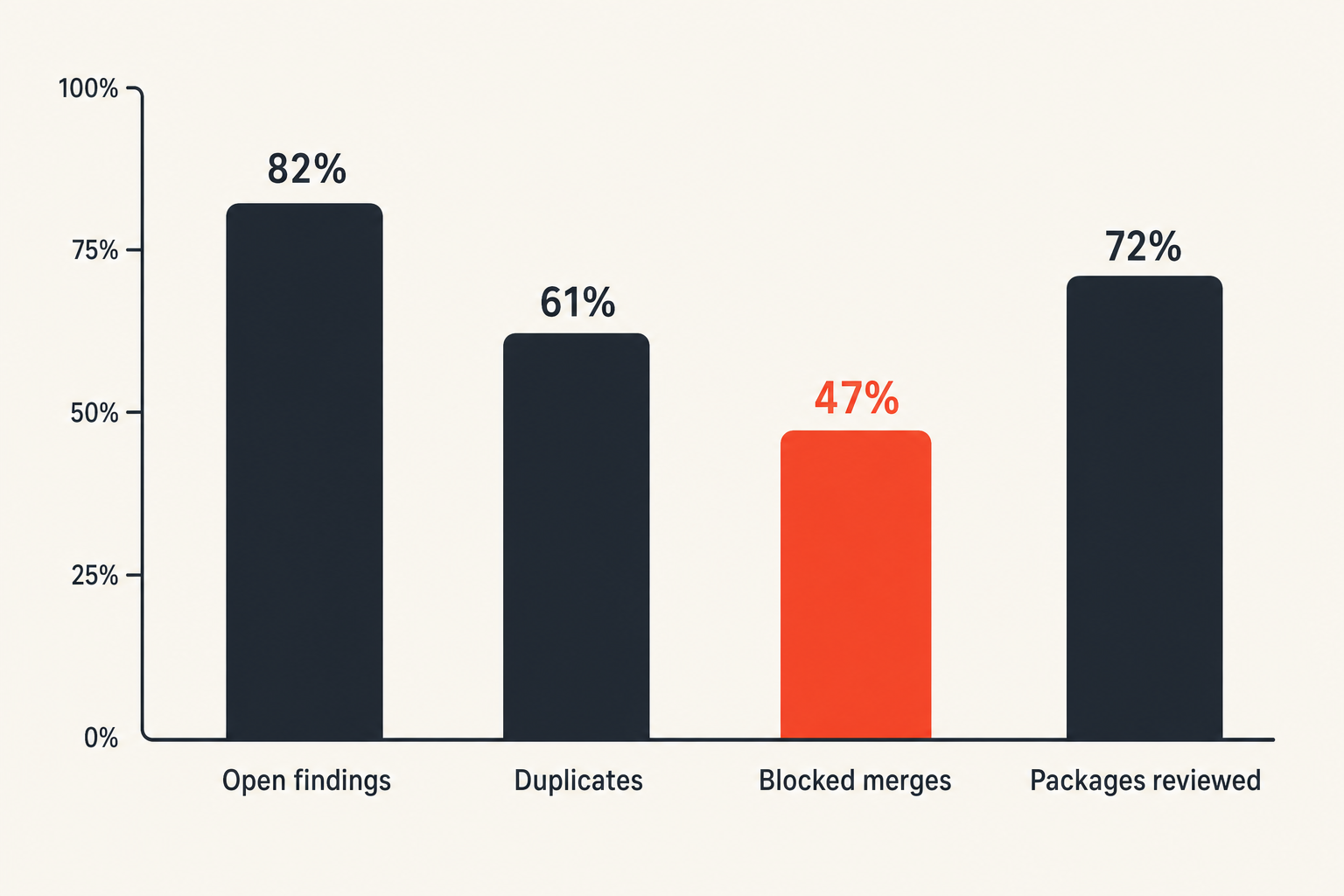
Dashboards tend to optimize for what is easy to count: open findings, severity counts, mean time to remediate. Those are not useless, but they are incomplete.
For CI/CD and supply-chain security, track operational metrics that show whether controls work at the delivery layer:
- risky workflow changes blocked before merge;
- new packages reviewed before entering lockfiles;
- privileged workflows using pinned actions;
- repositories with explicit token permissions;
- exceptions with owners and expiry dates;
- time from risky PR opened to decision;
- recurring findings by team or template;
- reduction in manual security review for low-risk changes.
The mistake teams make is measuring scanner activity instead of control effectiveness.
A scanner that produces 2,000 findings and changes no merge decisions is less useful than a PR-native control that blocks 12 genuinely dangerous changes and quietly passes everything else.
Implementation workflow for CI/CD security controls
A practical rollout sequence
Do not start by turning on hard blocking across every repository. That creates political pain, false positives, and emergency bypasses. Start with visibility, then narrow enforcement.
A practical sequence:
- Inventory repositories and workflows. Identify release paths, privileged workflows, self-hosted runners, and package ecosystems.
- Classify repositories by blast radius. Production deployers and package publishers get stricter policy before docs sites and sandboxes.
- Run scanners in report-only mode. Capture findings without blocking. Measure false positives and ownership gaps.
- Define policy tiers. Decide which issues block, warn, or route for review.
- Add PR comments with clear remediation. Make the tool useful to developers before it becomes mandatory.
- Enforce high-confidence controls first. Block secret exposure, dangerous trigger patterns, broad token expansion, and suspicious new package execution in sensitive repos.
- Create exception workflow. Require owner, reason, expiry, and audit trail.
- Review metrics monthly. Tune rules based on merge friction, bypasses, and incident learnings.
Practical rule: Roll out enforcement where confidence and blast radius are both high. Expand after the workflow proves it can handle exceptions.
Policy examples that work in production
Good policies are specific enough to automate and explainable enough for engineers to accept.
Examples:
policy:
  workflow_permissions:
    block_if:
      - event: pull_request_target
        permissions_contains:
          - contents: write
          - id-token: write
        checkout_untrusted_head: true

  third_party_actions:
    warn_if:
      - action_ref_not_pinned_to_sha: true
    block_if:
      - action_ref_not_pinned_to_sha: true
        workflow_has_secrets: true

  packages:
    require_review_if:
      - new_direct_dependency: true
      - install_script_present: true
    block_if:
      - new_package: true
      - suspicious_obfuscation: true
      - production_release_path: true
The exact syntax depends on your toolchain. The principle matters more: policies should combine context. A single weak signal may warn. Multiple signals crossing a trust boundary should block.
Related reading from our network: rollout friction is not unique to security; this workflow-oriented guide to time tracking software is a useful reminder that tools fail when approvals, integrations, privacy, and reporting are not designed into adoption.
Common failure modes when teams implement cyber security software badly
Alert piles without routing
The most common failure mode is the alert pile. A tool finds real issues, sends them to a dashboard, maybe opens tickets, and nobody owns the queue.
This creates three bad outcomes:
- security thinks engineering is ignoring risk;
- engineering thinks security is dumping vague work;
- leadership sees metrics but no risk reduction.
What breaks in practice is accountability. Alerts need routing, severity needs context, and policies need a decision path.
If a workflow change introduces id-token: write, the system should know whether that repository can assume cloud roles. If it can, route to the platform or cloud security owner. If it cannot, warn or record the change without waking people up.
Blocking without context
The second failure mode is premature blocking. A tool flags everything, builds fail, engineers learn the bypass path, and security loses credibility.
Hard gates are powerful only when they are predictable. A developer should be able to answer:
- What rule failed?
- What changed in this PR?
- Why is this risky in this repository?
- How do I fix it?
- Who can approve an exception?
- When does the exception expire?
If the answer is “ask security in Slack,” the policy is not mature enough.
Bad blocking also creates shadow behavior. Teams move logic into scripts the scanner does not parse. They reuse old dependencies to avoid review. They disable checks on “temporary” branches. Tooling should reduce risky behavior, not push it into darker corners.
How to evaluate vendors and open-source tools
Questions that reveal architecture fit
When evaluating cyber security software, skip the first ten slides. Ask operational questions.
Good questions:
- Does the tool analyze CI/CD workflow semantics or only scan files as text?
- Can it distinguish
pull_requestfrompull_request_targetrisk? - Does it understand token permissions and secret exposure paths?
- Can it scan dependency deltas in a pull request?
- Does it inspect package behavior beyond known CVEs?
- Can policies combine signals, such as new package plus install script plus release path?
- Can it run as a required PR check?
- Does it support exceptions with owners and expiry?
- Are results available in the PR without forcing a dashboard context switch?
- Can findings be exported to the systems your teams already use?
- Does it fail open or fail closed, and can that vary by repository tier?
The answer does not always need to be “yes.” But the vendor should understand the question. If they only talk about coverage percentages and dashboard screenshots, they may not be solving your workflow problem.
Comparison table for CI/CD security tools
Use this comparison as a starting point, not a universal ranking.
| Capability | Generic dependency scanner | SAST-only tool | CI/CD-aware security software | Manual review only |
|---|---|---|---|---|
| Known CVE detection | Strong | Weak | Strong if integrated | Inconsistent |
| Malicious package behavior | Limited | Weak | Stronger if package-aware | Depends on reviewer |
| Workflow trigger analysis | Weak | Limited | Strong | Inconsistent |
| Token and secret context | Weak | Weak | Strong if platform-aware | Often missed |
| PR-native decisioning | Sometimes | Sometimes | Core capability | Slow |
| Exception workflow | Varies | Varies | Should be built in | Informal |
| Developer usability | Good when focused | Mixed | Good if concise | Depends on culture |
| Best role | Baseline hygiene | Code bug discovery | Delivery-layer control | High-risk edge cases |
The right architecture usually combines categories. You still want SAST. You still want dependency CVE coverage. You still want runtime detection. But for CI/CD and supply-chain defense, you need a layer that understands the merge path.
Where vu1nz.com fits
PR-native CI/CD and package scanning
vu1nz.com is built around the idea that the pull request is the right control point for many CI/CD and package supply-chain risks.
The vu1nz GitHub Action is designed to run directly in GitHub workflows, scan CI/CD configuration for common workflow vulnerabilities, and inspect newly added packages across ecosystems such as npm, pip, cargo, gem, Go modules, and Composer.
That matters because it keeps the decision close to the change. A risky workflow edit should be visible in the PR where it was introduced. A suspicious package should be reviewed before it becomes part of the repository’s normal dependency graph.
This is not a replacement for every security control. It is a focused layer for a specific failure mode: delivery systems accepting dangerous automation and package changes before anyone with security context sees them.
When vu1nz is the right layer
vu1nz is a fit when:
- your organization relies on GitHub Actions;
- repositories accept frequent dependency changes;
- package supply-chain risk is a real concern;
- security review is too manual or too late;
- you want PR-native feedback instead of another detached dashboard;
- you need controls that developers can understand during code review.
It is less useful if your main problem is endpoint detection, cloud posture inventory, or runtime exploit telemetry. Those are different layers. The point is not to collapse security into one tool. The point is to put the right tool at the right control point.
Closing the loop on cyber security software
What works
Cyber security software works when it is treated as delivery architecture, not shelfware.
What works in 2026:
- controls placed at pull request, build, release, and runtime boundaries;
- CI/CD-aware analysis of workflow triggers, permissions, secrets, and runners;
- dependency scanning that includes both known CVEs and suspicious new package behavior;
- policies that combine signals instead of treating every finding equally;
- routing that maps findings to real owners;
- exception workflows with expiry;
- metrics based on risk decisions, not just scanner output.
The practical question is always: did this control change a risky decision before damage occurred?
What fails
What fails is buying cyber security software as a generic category and hoping coverage turns into security.
Tools fail when they are too late, too noisy, too detached from engineering, or too vague to enforce. They fail when they generate alerts without owners. They fail when they block merges without explaining the trust boundary. They fail when package risk, CI/CD permissions, and release context live in separate systems that never talk to each other.
The mistake teams make is looking for one platform to solve the entire problem. A better approach is to build a control architecture: advisory where you need research, enforcement where confidence is high, and PR-native decisioning where risky changes enter the system.
That is the standard cyber security software should meet now: not more findings, but better control over how software gets built, packaged, and shipped.
Try vu1nz.com
vu1nz.com is for security engineers and DevSecOps teams who need to defend CI/CD pipelines and software supply chains from modern attacks. Try vu1nz.com.
Catch the next supply-chain attack on the PR that adds it.
14-day free trial · no card required