Cyber security analyst jobs used to be described as alert triage, ticket routing, and dashboards. That model breaks down fast when the incident starts in a pull request, a poisoned package, a leaked GitHub token, or a self-hosted runner that nobody owns.
Teams think the problem is hiring more analysts. The real problem is that the analyst workflow was designed around perimeter alerts, while modern software risk moves through CI/CD pipelines and package ecosystems.
That changes the conversation. A good analyst in 2026 is not just someone who watches a SIEM. They connect signals from source control, build systems, dependency changes, cloud identities, artifact registries, deployment gates, and incident response. They know when to block a release and when to let engineering keep moving.
The practical question is not what a cyber security analyst is. The practical question is how cyber security analyst jobs should be designed when software delivery is the attack surface.
Table of contents
- Why cyber security analyst jobs changed in 2026
- The job is not a title it is a control loop
- Where analysts plug into CI/CD and supply chain security
- What breaks when analyst work stays disconnected
- The skills matrix for modern cyber security analyst jobs
- A practical analyst workflow for pipeline incidents
- Hiring and interviewing for this role
- What works and what fails in production
- Career path for DevSecOps minded analysts
- Where vu1nz fits in the workflow
Why cyber security analyst jobs changed in 2026
From alert queues to delivery risk
The older analyst model assumed that bad activity showed up after something was deployed. A host beaconed. A firewall logged a connection. An EDR agent raised an alert. The analyst investigated after the blast radius already existed.
Software supply chain attacks invert that timing. The malicious change may be in a package update, workflow permission, release script, build artifact, or credential path. If the analyst only sees runtime alerts, the organization has already missed the cheapest intervention point.
A useful way to think about it is this: modern analyst work begins before production. It starts at change review.
Common examples:
- A new npm package appears in a pull request with no maintainer history.
- A GitHub Actions workflow changes from read-only permissions to broad write permissions.
- A release job starts executing unpinned third-party actions.
- A build script curls a remote shell script during install.
- A contributor modifies a lockfile in a way reviewers do not inspect.
Those are not just developer hygiene issues. They are analyst signals.
Why CI/CD context matters
The same alert means different things depending on delivery context. A secret detected in a stale branch is not the same as a secret added to the default branch and consumed by a privileged deployment job. A new package in a documentation toolchain is not the same as a new package in a signing pipeline.
Analysts who understand CI/CD can ask better questions:
- Can this code path run in a trusted workflow?
- Does this job receive cloud credentials or package publishing tokens?
- Is the runner ephemeral or long-lived?
- Can a forked pull request influence this execution path?
- Is the artifact deployed, published, or only tested?
That context shortens investigation time because the analyst can separate suspicious from dangerous.
Practical rule: Treat pipeline context as part of severity. A medium-looking finding in a release workflow can be more urgent than a high-looking finding in dead code.
The analyst as workflow owner
The mistake teams make is writing cyber security analyst jobs as generic monitoring roles, then expecting those analysts to handle supply chain incidents. The work requires ownership of a loop: collect signals, interpret risk, route action, validate remediation, and improve detection.
That does not mean every analyst must be a senior security engineer. It means the job design must give analysts access to the systems that explain the alert. Read-only GitHub access, workflow logs, package diffs, deployment metadata, and ownership maps are not luxuries. They are operating requirements.
| Old analyst model | Modern CI/CD analyst model |
|---|---|
| Triage SIEM alerts after deployment | Triage change risk before merge and after deploy |
| Focus on hosts and network events | Include repositories, workflows, packages, runners, artifacts |
| Escalate to whoever is available | Route to service owner with evidence and recommended action |
| Measure ticket volume | Measure time to decision and release-risk reduction |
| Learn tools in isolation | Understand how tools connect across delivery workflow |
The job is not a title it is a control loop
Inputs
A cyber security analyst job is only as useful as the signals feeding it. In CI/CD security, inputs should include more than vulnerability scanner output.
Useful inputs include:
- Pull request metadata: author, reviewer, changed files, branch source, review history.
- Workflow metadata: permissions, triggers, action versions, secrets exposure, runner type.
- Dependency metadata: newly added packages, lockfile changes, install scripts, maintainer patterns.
- Build metadata: artifact hashes, build provenance, environment variables, publishing targets.
- Runtime metadata: deployment time, service ownership, cloud identity used, exposed endpoints.
- Historical context: previous incidents, recurring noisy rules, known risky repos.
Analysts do not need every raw event. They need correlated signals that answer what changed, who can act, and what the change can reach.
Related reading from our network: Sunstates Security and SOC architecture is about cyber-physical response, but the operating lesson is the same: signals only matter when they connect to escalation and ownership.
Decisions
The analyst decision layer is where many programs become vague. A finding appears, but nobody knows whether the analyst can block a release, request changes, open an incident, or only comment on a ticket.
Define decision rights explicitly:
- Informational: document the risk, no action required.
- Needs owner review: route to the owning team before merge.
- Must fix before merge: block the pull request or require approval.
- Must rotate credentials: trigger secret response workflow.
- Incident: preserve evidence and start response.
The decision must be tied to an action. Otherwise analysts become narrators of risk rather than operators of control.
Outputs
Good analyst output is not a wall of scanner text. It is a decision package.
A useful analyst note includes:
- What changed.
- Why it matters.
- What system or secret could be reached.
- Whether exploitation is plausible.
- The recommended owner action.
- The validation step after remediation.
Example:
Finding: workflow release.yml changed permissions from contents: read to contents: write and added pull_request_target.
Risk: forked PR code may influence a privileged context if checkout uses attacker-controlled ref.
Owner: platform-engineering.
Action: require explicit checkout of base ref or remove pull_request_target.
Validation: rerun workflow scan and confirm token scope is reduced.
This is the difference between alert forwarding and security analysis.
Where analysts plug into CI/CD and supply chain security
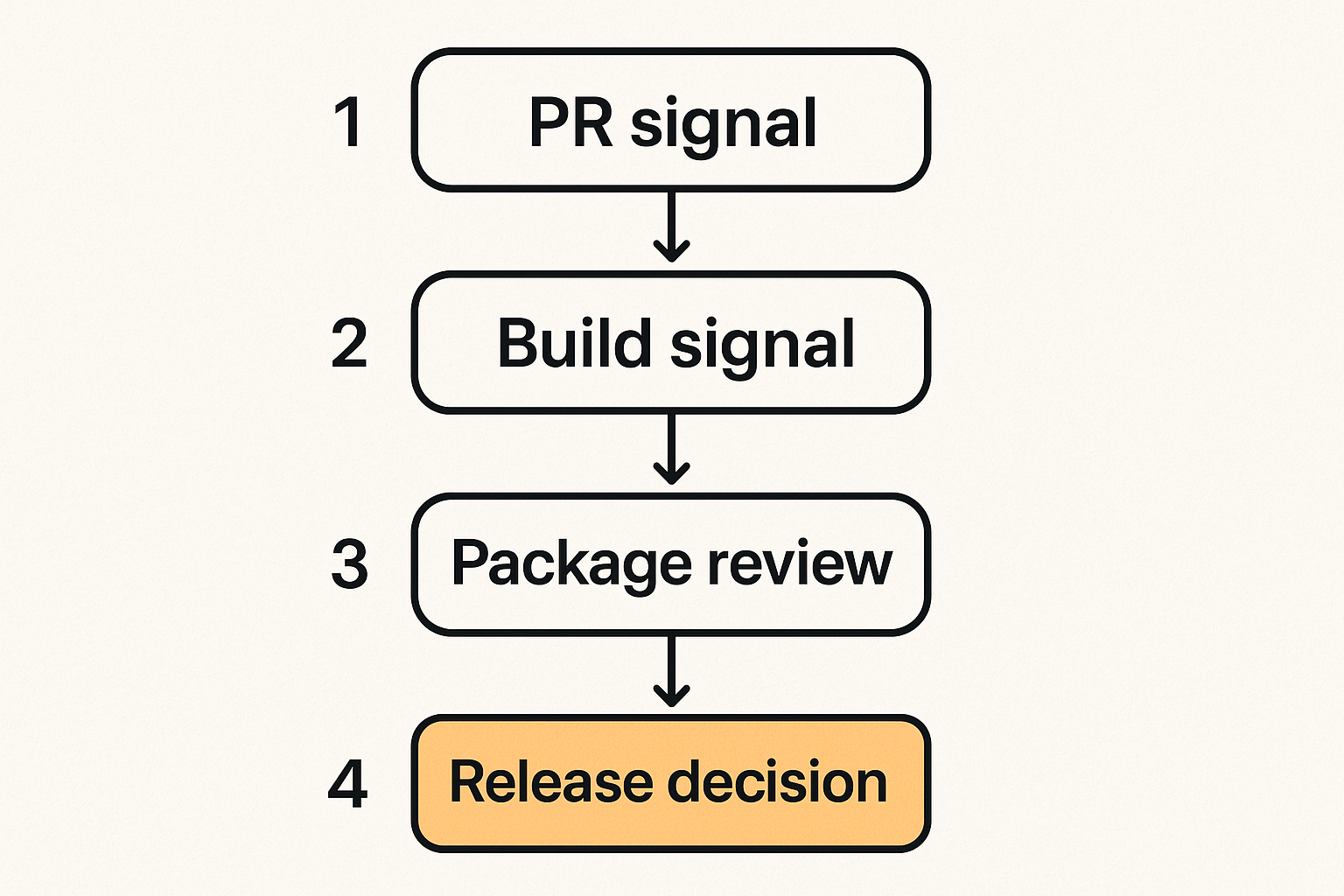
Pull request signals
Pull requests are where modern analyst work becomes practical. A PR contains intent, diff, ownership, test results, and reviewer behavior in one place. The analyst can inspect risk before it becomes production state.
High-value PR signals include:
- New workflow files or modified workflow triggers.
- Changes to
permissions,secrets,env, and deployment jobs. - Added install scripts, postinstall hooks, or generated code.
- Lockfile churn that does not match manifest changes.
- New maintainers or external contributors touching release paths.
- Review bypasses, force pushes, or unusual approval patterns.
The point is not to make analysts review every PR manually. The point is to make automated findings land where analysts and engineers can make a release decision.
Build and runner signals
What breaks in practice is that build infrastructure is treated as plumbing. In many environments, CI runners have more practical access than production users: source code, signing keys, deployment credentials, package registry tokens, cloud roles, and artifact stores.
Analysts should understand runner trust boundaries:
- Hosted runner versus self-hosted runner.
- Ephemeral versus persistent runner.
- Forked PR restrictions.
- Cache poisoning paths.
- Artifact upload and download permissions.
- Secrets available by trigger type.
A suspicious command in a low-privilege test job is one thing. The same command in a release job with package publish rights is another.
Practical rule: If a workflow can publish, deploy, sign, or assume cloud identity, treat changes to that workflow as security-sensitive by default.
Package ecosystem signals
Known CVEs are only one slice of dependency risk. Many supply chain attacks are malicious from the start, compromised before disclosure, or abused through install-time behavior. That is why analysts need to inspect newly added packages, maintainer changes, scripts, typosquatting patterns, and unexpected transitive changes.
For a concrete example of why CVE-only dependency monitoring leaves gaps, see our writeup on what Dependabot misses in npm supply-chain attacks. The lesson for analyst roles is direct: if the queue only contains known vulnerabilities, the queue is incomplete.
A practical package review asks:
- Is this package new to the organization?
- Is it newly published or recently transferred?
- Does it execute code during install?
- Does it request network access during build?
- Does it resemble a popular package name?
- Is the lockfile change explainable?
Analysts do not need to reverse every dependency. They need a repeatable way to flag the few changes that deserve human review.
What breaks when analyst work stays disconnected
Alert triage without ownership
Disconnected analyst teams produce technically correct findings that do not change outcomes. The analyst sees the alert, opens a ticket, and waits. Engineering does not know if the ticket is blocking, advisory, or noise. The release continues.
The failure is not laziness. It is missing ownership architecture.
Every actionable finding needs:
- A service owner.
- A repository owner.
- A severity rule.
- A response expectation.
- A validation method.
Without those, analysts become ticket routers. With them, analysts become part of the delivery control plane.
Vulnerability queues without exploit context
Many teams drown analysts in vulnerability backlogs. The scanner finds thousands of issues. The analyst sorts by CVSS. Engineering ignores the queue because most items do not map to reachable code, exposed services, privileged workflows, or active exploit paths.
For supply chain and CI/CD work, prioritization needs context:
| Finding type | Low-context response | Context-aware response |
|---|---|---|
| CVE in dependency | Patch by score | Check reachability, deployment path, exploitability |
| New package | Allow if scanner is clean | Review maintainer, install scripts, age, name similarity |
| Workflow permission change | Treat as config diff | Evaluate token scope and trigger risk |
| Secret detected | Open ticket | Rotate, audit usage, invalidate build artifacts |
| Runner anomaly | Rebuild runner | Preserve logs, check cache, inspect credentials |
The analyst adds value by turning raw findings into operational priority.
Tool sprawl and duplicate truth
A common failure mode is buying another tool for every signal. One for secrets. One for dependencies. One for CI misconfigurations. One for SAST. One for cloud posture. Each has its own severity model and ticket format.
The mistake teams make is assuming more tools mean more coverage. More often, they mean more duplicate truth.
Related reading from our network: remote access software architecture covers a different buyer category, but the same rule applies here: workflow, ownership, and support operations matter more than adding another disconnected console.
The analyst workflow should normalize tool output into one question: does this change create unacceptable delivery risk?
The skills matrix for modern cyber security analyst jobs
Core technical skills
Cyber security analyst jobs still require fundamentals. Analysts need to read logs, understand authentication, reason about networks, recognize malware behavior, and write clear incident notes.
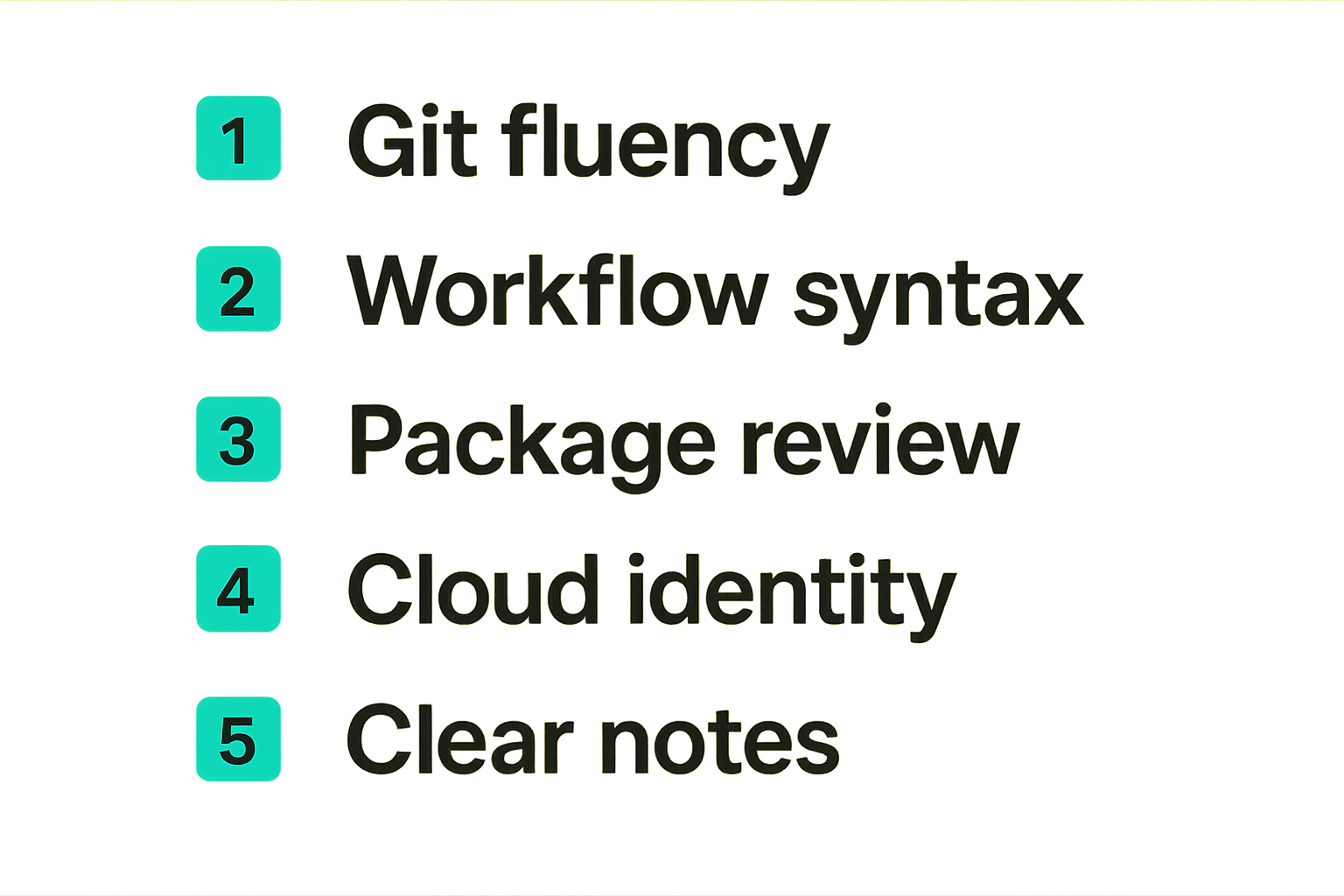
For CI/CD and software supply chain work, the baseline expands:
- Git fundamentals: branches, tags, commits, signed commits, force pushes.
- GitHub permissions: repository roles, branch protection, environments, CODEOWNERS.
- Workflow syntax: triggers, jobs, steps, permissions, secrets, reusable workflows.
- Package managers: npm, pip, cargo, gem, Go modules, Composer.
- Basic scripting: Bash, Python, jq, regex, API calls.
- Cloud identity basics: assumed roles, service accounts, OIDC, short-lived tokens.
- Artifact concepts: build outputs, checksums, provenance, registries.
This is not about turning every analyst into a platform engineer. It is about giving them enough mechanical sympathy to avoid bad escalations.
DevSecOps literacy
DevSecOps literacy means understanding how security controls interact with engineering speed. Analysts who only say no will be bypassed. Analysts who never block anything become decorative.
The practical balance is to classify controls by friction:
- Silent detection: log and enrich signals without blocking.
- Soft gate: comment on PR, request owner review.
- Hard gate: block merge or release.
- Incident gate: freeze deployment, preserve evidence, rotate credentials.
Practical rule: Use hard gates for high-confidence, high-impact findings. Use soft gates when the signal needs owner context. Do not block releases on vague scanner output.
A useful analyst can explain why a control belongs in one category and how to tune it over time.
Research and communication
Security research matters because attackers do not wait for clean vulnerability records. Analysts need to inspect weird behavior, read package metadata, search commit history, compare names, and test hypotheses.
Communication matters because the final output is usually read by an engineer under delivery pressure. The analyst note should be short, specific, and reproducible.
Bad note:
Critical dependency risk detected. Please remediate ASAP.
Good note:
PR adds package colors-utils-js, published 2 days ago, with postinstall network call to unknown domain. Package is used in build step before artifact publishing. Recommend remove or replace before merge.
One creates noise. The other creates action.
A practical analyst workflow for pipeline incidents
The five step incident path
Pipeline incidents need a workflow that is faster than a committee meeting and more rigorous than a Slack thread.
A practical sequence:
- Detect the change. Identify the PR, commit, workflow run, dependency change, or runner event that triggered the signal.
- Classify the execution path. Determine whether the change can run in test, release, deploy, signing, or publishing context.
- Map reachable trust. Identify secrets, tokens, cloud roles, artifact permissions, and package registry access available to the path.
- Decide the gate. Allow, request review, block merge, block release, rotate credentials, or open an incident.
- Validate and tune. Confirm remediation, preserve evidence if needed, and adjust rules to reduce repeat noise.
This sequence keeps analysts from jumping directly from alert to panic. It also keeps teams from treating every pipeline issue as a theoretical concern.
Evidence to collect
Evidence collection is where CI/CD incidents differ from classic endpoint alerts. The relevant evidence may expire quickly, especially with ephemeral runners and short log retention.
Collect:
- PR number, commit SHA, branch, author, reviewers.
- Workflow file before and after the change.
- Workflow run ID and logs.
- Runner identity and environment.
- Token permissions and secret exposure.
- Package manifest and lockfile diff.
- Artifact hashes and publication status.
- Deployment target and time.
- Any external network calls made during install or build.
Related reading from our network: end-to-end encrypted messaging architecture is in a different domain, but it reinforces a useful point for incident evidence: trust boundaries and key material must be explicit, not assumed.
When to block a release
Blocking a release is expensive, so the rule must be clear. Analysts should block when the combination of confidence and impact justifies it.
Block when:
- A workflow change expands token permissions in a release or deploy path without review.
- Untrusted code can execute in a privileged trigger such as
pull_request_target. - A new package runs install-time code before artifact publishing.
- A secret is exposed in logs, committed code, or build output.
- A runner compromise is plausible and artifacts were produced.
- The same change touches code and the control that validates that code.
Do not block when the signal is weak, isolated, and not in a trusted path. Instead, route for owner review and collect more context.
Hiring and interviewing for this role
Write the job around outcomes
If you are hiring, do not start with a generic list of tools. Start with the control loop the analyst will operate.
Better job outcome language:
- Triage CI/CD and dependency findings in pull requests.
- Investigate suspicious workflow, runner, package, and artifact behavior.
- Work with engineering owners to decide merge and release gates.
- Maintain detection logic for GitHub Actions and package ecosystem risks.
- Produce concise incident notes with evidence and remediation guidance.
- Validate fixes and reduce recurring false positives.
This attracts candidates who understand operational security, not only dashboard monitoring.
Interview with realistic artifacts
A good interview should use artifacts the analyst will actually see. Give the candidate a PR diff, workflow file, package manifest, lockfile excerpt, and abbreviated run log. Ask them to walk through risk.
Example interview prompt:
name: release
on:
  pull_request_target:
    branches: [main]
permissions:
  contents: write
  packages: write
jobs:
  publish:
    runs-on: ubuntu-latest
    steps:
      - uses: actions/checkout@v4
      - run: npm install
      - run: npm publish
Ask:
- What concerns you?
- What evidence do you need?
- Would you block the release?
- What change would make this safer?
- How would you explain it to the repo owner?
You are testing reasoning, not trivia.
Red flags in candidates and teams
Candidate red flags:
- They cannot explain what a CI workflow does at a basic level.
- They treat all scanner output as equal.
- They escalate without recommended action.
- They cannot distinguish suspicious from exploitable.
- They write incident notes that engineers cannot reproduce.
Team red flags:
- Analysts lack repository visibility.
- Findings have no owner map.
- Security cannot define blocking criteria.
- Engineering can bypass gates without review.
- Metrics reward ticket volume instead of risk decisions.
The team side matters. A strong analyst in a broken workflow will still produce weak outcomes.
What works and what fails in production
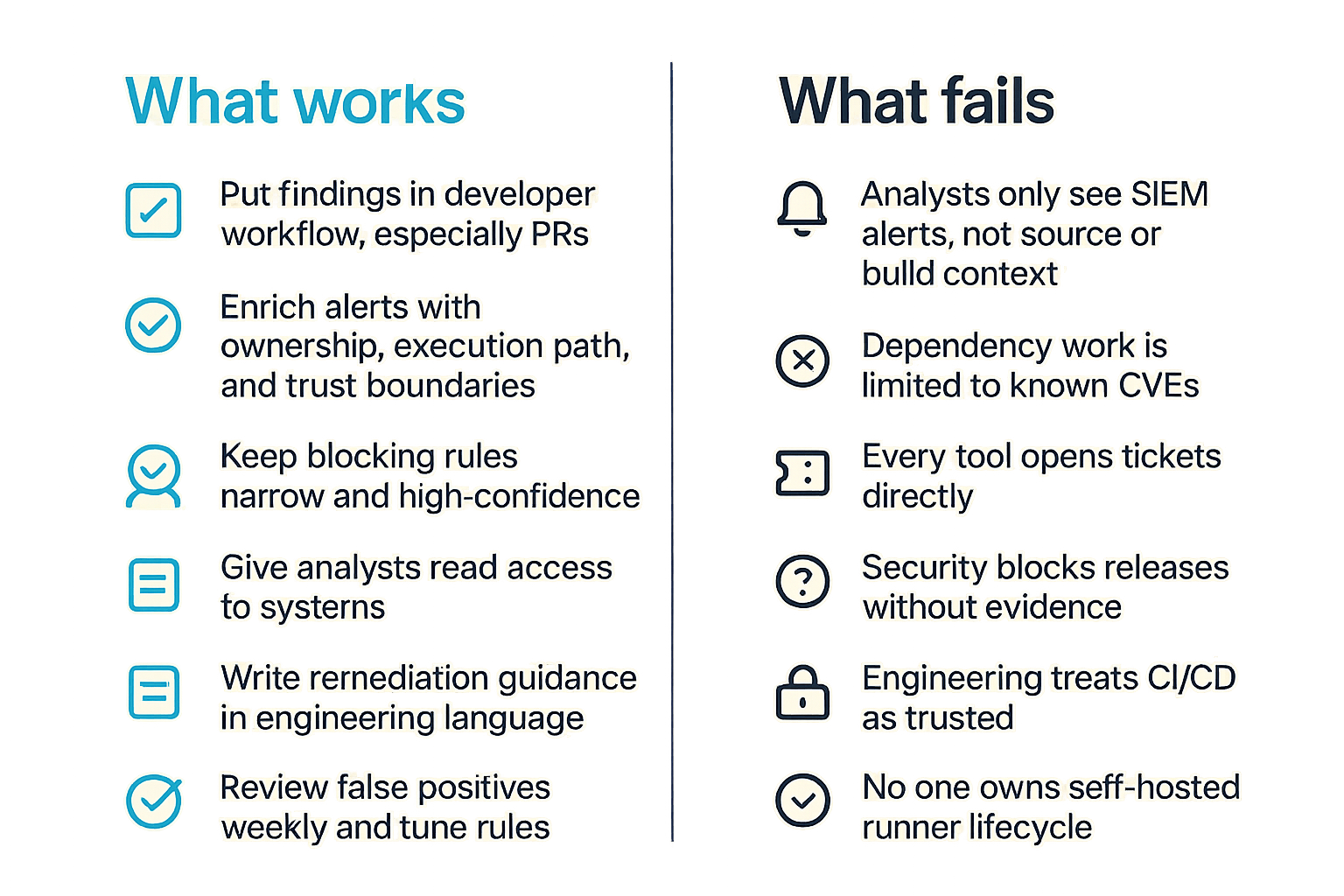
What works
What works is boring and repeatable.
- Put findings in the developer workflow, especially PRs.
- Enrich alerts with ownership, execution path, and trust boundaries.
- Keep blocking rules narrow and high-confidence.
- Give analysts read access to the systems they investigate.
- Write remediation guidance in engineering language.
- Review false positives weekly and tune rules.
- Preserve incident evidence before rerunning jobs or deleting runners.
The best analyst programs reduce ambiguity. Engineers know why something was flagged, who owns it, and what action closes it.
What fails
What fails is also predictable.
- Analysts only see SIEM alerts, not source or build context.
- Dependency work is limited to known CVEs.
- Every tool opens tickets directly with different severity labels.
- Security blocks releases without reproducible evidence.
- Engineering treats CI/CD as internal and therefore trusted.
- No one owns self-hosted runner lifecycle.
- Secret rotation is manual, slow, and unverified.
The root failure is usually not a missing dashboard. It is a missing operating model.
Metrics that do not lie
Avoid vanity metrics like total alerts reviewed unless they connect to outcomes. Better metrics include:
- Time from risky PR signal to analyst decision.
- Percentage of high-confidence findings with owner response.
- Number of blocked releases later confirmed as real risk.
- False positive rate by rule.
- Time to rotate exposed credentials.
- Percentage of release workflows with least-privilege tokens.
- New package review coverage for critical repos.
Metrics should tell you whether analysts are shortening investigation time and reducing delivery risk. If the metric only proves that people are busy, it is not useful.
Career path for DevSecOps minded analysts
Build a portfolio from real workflows
For candidates, the fastest way to stand out is to show work. Not certificates alone. Work.
Build a small portfolio:
- Analyze vulnerable GitHub Actions patterns.
- Write detections for risky workflow triggers.
- Review malicious package case studies.
- Create a dependency review checklist.
- Publish incident-style writeups with evidence and remediation.
- Build scripts that inspect workflow permissions across repositories.
A portfolio should show how you think. Hiring teams want to see whether you can move from artifact to decision.
Move from analyst to security engineer
The path from analyst to security engineer usually runs through automation. Once you have investigated the same pattern five times, write a rule, script, query, or workflow gate.
Examples:
- Convert manual package review checks into a PR scanner.
- Turn runner investigation steps into a collection script.
- Build a dashboard of privileged workflow changes.
- Add CODEOWNERS rules for release workflow files.
- Create playbooks for secret exposure in CI logs.
This is how analysts become force multipliers. They stop being only responders and start shaping the control system.
Specialize without becoming narrow
Supply chain security is a strong specialization, but do not become tool-bound. The durable skill is reasoning about trust across software delivery.
Understand:
- Who can change code.
- Who can approve code.
- What automation runs after change.
- What credentials automation receives.
- What artifacts are produced.
- Where those artifacts are deployed or published.
If you can map that chain, you can work across GitHub Actions, GitLab CI, Jenkins, Buildkite, npm, PyPI, Cargo, container registries, and cloud deployment systems.
Where vu1nz fits in the workflow
Product fit for CI/CD security teams
vu1nz is built around the part of analyst work that often arrives too late: risky CI/CD and package changes before they merge. The goal is not to replace analysts. The goal is to give analysts and DevSecOps engineers better signals at the point where a decision still matters.
The vu1nz GitHub Action scans workflow security issues and newly added packages in pull requests, which makes it a practical input for the analyst control loop described above. It fits best when teams already use GitHub PRs as the place where engineering decisions happen.
That matters because analysts should not have to hunt across five consoles to answer whether a workflow permission change or new dependency is risky. The signal should appear next to the change, with enough context to act.
Start small then automate
A practical rollout looks like this:
- Start with critical repositories that publish packages, deploy infrastructure, or handle sensitive build artifacts.
- Run scans in PR context without blocking to measure noise.
- Review findings with repo owners and classify which rules deserve hard gates.
- Add blocking only for high-confidence cases such as dangerous workflow triggers or suspicious new packages in release paths.
- Feed confirmed incidents and false positives back into analyst playbooks.
This gives teams a path from visibility to control without turning security into a random release tax.
Cyber security analyst jobs will keep changing, but the direction is clear: closer to code, closer to pipelines, and closer to the decisions that determine whether risky software ships.
Try vu1nz.com
vu1nz.com is for security engineers and DevSecOps teams who need to defend CI/CD pipelines and software supply chains from modern attacks. Try vu1nz.com.
Catch the next supply-chain attack on the PR that adds it.
14-day free trial · no card required